National Association for the Education of Young Children | NAEYC
  • Home
  • About NAEYC
  • Affiliates
  • Newsroom
  • Advertise
  • For Families
  • Contact Us
  • Membership
    • Overview
    • Benefits and Options
    • Member FAQ
    • Comprehensive Membership
    • Interest Forums
    • Join or Renew
    • Login
  • Publications
    • Overview
    • Books
      • Overview
      • NAEYC Online Store
      • Bestsellers
      • New Books
      • Author Q&As
      • Supplements
      • Writing a Book
        • Submitting a Proposal
        • Style Guide
        • Being Accepted
        • Sending the Manuscript
        • Editing/Proofing
        • Obtaining Permissions
    • Young Children
    • Teaching Young Children
    • Early Childhood Research Quarterly
    • Voices of Practitioners
      • About Voices
      • What Is Teacher Research?
      • Teacher Research Articles
      • Teacher Research Initiatives
      • Teacher Research Resources
      • Supporting Teacher Researchers
      • Manuscript Guidelines
    • For Authors and Photographers
      • Writing for Young Children
      • Writing for Teaching Young Children
      • Writing a Book
      • Writing for ECRQ
      • Writing for Voices of Practitioners
      • Writing for families.naeyc.org
      • Frequently Asked Questions
      • Photograph Submission Guidelines
    • Permissions/Reprints
  • Accreditation
    • Overview
    • Accredited Program Search
    • Programs for Young Children (Academy)
    • Associate Degree Program (ECADA)
    • Bacc./Grad. Degree Program (NCATE)
  • Conferences
    • Overview
    • Annual Conference & Expo
    • National Institute for Early Childhood Professional Development
  • Resources
    • Position Statements
      • Statements
    • Week of the Young Child
      • Overview
      • Frequently Asked Questions
      • WOYC Themes
      • Suggested Activities
      • Event Planning Handbook
      • Community Outreach
      • Graphics
      • In the News
      • Social Media Guide
      • Resources
      • Featured Products
      • Event Map
    • Affiliates
      • Overview
      • Membership Options
      • Offices
      • Conferences
      • Login
    • Center for Applied Research
  • Professional Development
    • About Professional Development
      • CEUs
    • Online Learning
      • Creating Classroom Portfolios
      • eLearn: TYC
    • Face-to-Face Training
      • Developmentally Appropriate Practice
      • Communications Skills
      • Assessment
    • Training DVDs
    • Accreditation Training
    • Conference
    • Institute
    • Training Resources
  • Public Policy
    • Overview
    • Take Action Now
      • Strong Start for Children Coalition
    • Federal Developments
      • Updates and Alerts
      • Federal Recommendations
      • Federal Programs
      • American Recovery & Reinvestment Act
    • State Trends
    • Early Childhood Workforce Systems Initiative
      • Overview
      • ECE Workforce Data Systems Meeting
      • Technical Assistance Professionals
      • State Policy Blueprint
      • Database of State Policies
      • Professional Development Definitions
      • ECWSI Peer-to-Peer Exchange
    • Effective Advocacy Resources
    • Government Links
  • Topics
    • Anti-Bias Education: Holidays
    • Back to School
      • Great Books for Teachers
      • NAEYC Online Q&A Schedule
      • Welcoming Children and Families
      • Resources for Administrators, Faculty, and Trainers
    • Common Core
    • Coping with Disasters and Tragedies
    • DAP
      • Overview
      • DAP Position Statement
      • Essential Resources
      • FAQ
    • Ethics
    • Family Engagement
    • Guidance
    • Music
    • Nature
    • Obesity Prevention
    • Play
    • Summer Learning
      • For Teachers
      • With Children
    • Technology and Young Children
      • With Infants & Toddlers
      • With Preschoolers & Kindergarteners
      • With School-Age Children
    • Response to Intervention
  • Member Login
  • NAEYC Online Store
  • Position Statements
  • Get Involved
Home > 10 Effective DAP Teaching Strategies

10 Effective DAP Teaching Strategies


10 Effective DAP Teaching Strategies  


An effective teacher or family child care provider chooses a strategy to fit a particular situation. It’s important to consider what the children already know and can do and the learning goals for the specific situation. By remaining flexible and observant, we can determine which strategy may be most effective. Often, if one strategy doesn’t work, another will.

  1. Acknowledge what children do or say. Let children know that we have noticed by giving positive attention, sometimes through comments, sometimes through just sitting nearby and observing. (“Thanks for your help, Kavi.” “You found another way to show 5.”)
  2. Encourage persistence and effort rather than just praising and evaluating what the child has done. (“You’re thinking of lots of words to describe the dog in the story. Let’s keep going!”)
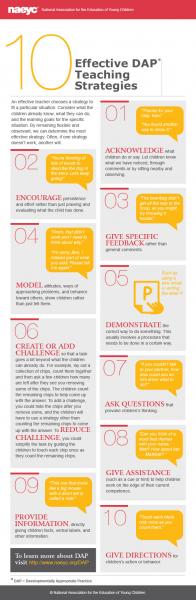
  3. Give specific feedback rather than general comments. (“The beanbag didn’t get all the way to the hoop, James, so you might try throwing it harder.”)
  4. Model attitudes, ways of approaching problems, and behavior toward others, showing children rather than just telling them (“Hmm, that didn’t work and I need to think about why.” “I’m sorry, Ben, I missed part of what you said. Please tell me again.”)
  5. Demonstrate the correct way to do something. This usually involves a procedure that needs to be done in a certain way (such as using a wire whisk or writing the letter P).
  6. Create or add challenge so that a task goes a bit beyond what the children can already do. For example, you lay out a collection of chips, count them together and then  ask a small group of children to tell you how many are left after they see you removing some of the chips. The children count the remaining chips to help come up with  the answer. To add a challenge, you could hide the chips after you remove some, and the children will have to use a strategy other than counting the remaining chips to come up with the answer. To reduce challenge, you could simplify the task by guiding the children to touch each chip once as they count the remaining chips.
  7. Ask questions that provoke children’s thinking. (“If you couldn’t talk to your partner, how else could you let him know what to do?”)
  8. Give assistance (such as a cue or hint) to help children work on the edge of their current competence (“Can you think of a word that rhymes with your name, Matt? How about bat . . . Matt/bat? What else rhymes with Matt and bat?”)
  9. Provide information, directly giving children facts, verbal labels, and other information. (“This one that looks like a big mouse with a short tail is called a vole.”)
  10. Give directions for children’s action or behavior. (“Touch each block only once as you count them.” “You want to move that icon over here? Okay, click on it and hold down, then drag it to wherever you want.”)
 
For more information about DAP, the 3 Core Considerations, the 12 Principles of Child Development and Learning, and the 5 Guidelines for Effective Teaching, read the NAEYC position statement "Developmentally Appropriate Practice in Early Childhood Programs Serving Children from Birth through Age 8" (PDF), adopted in 2009.  
DAP Resources

DAP Overview
DAP Position Statement

DAP Essential Resources

FAQ

DAP with Infants and Toddlers
DAP with Preschoolers
DAP with Kindergarteners
DAP in the Early Primary Grades

 
What is DAP?

3 Core Considerations
12 Principles of Child Development
5 Guidelines for Effective Teaching
10 Suggested Teaching Strategies

 
DAP Books
Developmentally Appropriate Practice in Early Childhood Programs Serving Children from Birth through Age 8 (3d ed.)

Developmentally Appropriate Practice in Early Childhood Programs Serving Children from Birth through Age 8 (3rd ed.)

DAP Basics Kit for Preschool Educators DAP Basics Kit for Preschool Educators
Basics of Developmentally Appropriate Practice: An Introduction for Teachers of Children 3 to 6 Basics of Developmentally Appropriate Practice: An Introduction for Teachers of Infants & Toddlers
See more »


  • Join NAEYC
  • Contact Us
  • Sitemap
  • Terms of Use
  • Privacy and Security Policy

naeyc_logo

© National Association for the Education of Young Children - Promoting excellence in early childhood education 1313 L St. NW, Suite 500, Washington, D.C. 20005 | (202)232-8777 | (800)424-2460 | webmaster@naeyc.org