Building Connections with Others: Developing Relationships in Infants and Toddlers
You are here
Eleven-month-old Zach stands beside a sofa, firmly holding onto the arm to support his balance. On the other end of the sofa, 15-month-old Noah stands in a similar position. They watch each other intently. Suddenly, Noah ducks down out of view, then pops up, his eyes fixed on Zach, a smile forming on his face. Zach returns the smile as Noah ducks back down and pops up again. Both boys begin giggling. As Noah pops up again, Zach mimics him, ducking down and then popping up.
Michelle, one of the teachers nearby, notices Zach pop up. She frowns and says, “Zach, you’re going to get hurt. Be careful.” Noah looks between Michelle and Zach, wide-eyed, and toddles away. Zach’s gaze then turns to Michelle as he ducks down behind the sofa and quickly pops up. Michelle turns away. Zach waits until she looks back, squats down again behind the sofa, and pops up smiling. Michelle looks back with a neutral face before turning away again. Zach’s smile fades.
Another teacher, Elise, enters the room and with a smile calls out, “What are you doing over there, Zach?” Zach immediately looks her way, ducks down behind the sofa, and pops up again. With a smile, Elise calls out, “Peekaboo, Zach!” Zach ducks down and pops up again with a big grin. Again, Elise says, “Peekaboo, Zach!” The game continues for about two minutes until Zach, giggling, collapses exhausted onto a floor cushion.
Young children process and respond to the social world beginning at birth. Even before uttering their first words, they actively perceive and respond to subtle differences in social cues while journeying into relationships, including friendships. Indeed, the earliest years are a critical time for social development, including developing relationships with adults and other children (Yrttiaho et al. 2014; Grossman 2015). Studies have traditionally focused on the growth of adult-child relationships in infants and toddlers (Shohet et al. 2019), but there is emerging evidence about peer relationships in the earliest years too (Davis & Degotardi 2015).
As an early childhood teacher and teacher educator for close to four decades, I have observed that, too often, infants’ and toddlers’ attempts to interact with adults and peers may be missed or misunderstood in early childhood settings. I have also witnessed how close friendships can form and be nurtured during the earliest years. Therefore, I identified the need to call attention to and more fully understand early relationships in infant and toddler settings.
When early childhood educators understand how infants and toddlers establish social connections with others, they can more effectively support these growing relationships. In this article, I present some key findings about how infants build the foundations of social connection through eye gaze and facial emotion processing. I discuss the ways infants and toddlers follow adults’ cues in new situations, and I explore how very young children initiate social interactions and friendships. Throughout, I offer practical strategies for how early childhood educators can respond to infant and toddler social cues and behaviors.
Eye gaze and facial emotion processing can help initiate and maintain one-on-one exchanges. Both have been researched with infants, and studies provide important insights about their roles in developing social competence.
Foundations of Relationship Building
Early childhood educators may be familiar with the concept of serve and return; that is, the back-and-forth conversation-like interactions that can occur between an infant and an adult (Center on the Developing Child 2017). In an infant setting, an educator “returns the child’s serves with relevant information by responding to the child’s interest and actions, following the child’s gaze or gesture, or responding to the child’s vocalizations and babble” (Laurin & Goble 2018, 21). This strategy helps adults to effectively respond in the moment, facilitating neural connections in the infant’s brain. In this way, it contributes to cognitive, language, and social development over time (Center on the Developing Child 2017), including greater social competence and emotional regulation and fewer experiences of anxiety and behavioral issues (Deans 2020).
There are many elements that go into an effective serve-and-return interaction. Two are eye gaze (looking directly at someone) and facial emotion processing (showing and understanding emotions through facial expressions). Eye gaze and facial emotion processing can help initiate and maintain one-on-one exchanges. Both have been researched with infants, and studies provide important insights about their roles in developing social competence (Grossmann 2013). Infants actively seek out and enjoy engagement with others, and through eye gaze and facial emotion processing, they gather a variety of information about social interactions and relationships.
For example, studies demonstrate that newborns show a preference for faces over other objects. At 2 months, infants prefer to engage with faces that offer direct eye contact (Lloyd-Fox et al. 2009; Meltzoff & Kuhl 2016). By 3 months, infants prefer smiling faces over neutral expressions, and between 5 and 7 months, they begin to distinguish between smiling and fearful facial expressions (Yrttiaho et al. 2014; Di Lorenzo et al. 2019). In addition, around this age, infants can understand and follow the direction of where someone is looking (an averted gaze) (Grossmann 2013).
By recognizing what infants notice and attend to, early childhood educators can support early social development and the foundations of relationships. Their work can begin by being aware of infants’ and toddlers’ cues to initiate an interaction, such as through eye gaze, smiling, cooing, babbling, excitedly waving their arms and legs, and/or pointing. The educator can return these cues (or serves) by making eye contact, smiling, talking, or even mimicking the child’s facial expressions or vocalizations. Then, they can wait, giving the child an opportunity to respond, and be ready to repeat the process. For example, if an infant babbles “mom-mom-mom” (serve), an educator can respond with “mom-mom-mom” (return). The infant will likely repeat this (serve), and the adult can repeat it again (return), continuing for as long as the infant is interested in this exchange.
Educators can use these strategies during different times of the day, including during routines like diaper changes and mealtimes (Laurin & Goble 2018). In addition to strengthening emotional connections, these exchanges introduce infants and toddlers to the turn-taking conversational style and cues that develop and sustain relationships. It is also important for educators to get to know each child so they can balance when stimulation is appropriate and when rest may be needed (Berger 1999).
Teachers can also use an averted gaze to point an infant’s or toddler’s attention to something that is new, different, or of interest. It is important to consider where an adult’s gaze goes—in a moment and over time—and whether it leads to shared attention and interest. For example, what might be conveyed to a child if an educator consistently, over time, gazes away to a screen to engage with a device or to another adult to engage in adult-focused conversations? Studies have shown, for example, that parent engagement with mobile devices decreases interactions with their children (e.g., Radesky et al. 2015). This can apply to teachers who may become distracted by devices, even if these devices are being used to carry out day-to-day tasks, such as writing observations.
Educators responsively interact—and offer important social information—when they give infants and toddlers their full attention as much as possible and are aware of the signals being sent through eye gaze and facial expression. For example, in the opening vignette, Zach used eye gaze to try to attract Michelle’s attention to involve her in his peekaboo game, but she did not return his serve. In contrast, Elise quickly picked up on Zach’s cues and began responding to create an extended, playful interaction. Elise continued the game until Zach signaled the end (dropping onto a cushion). Elise skillfully engaged in serve and return, tapping into the power of eye gaze and facial expressions.
Following Adults’ Cues
Looking behavior has another important function. Starting in infancy, young children look to the adults in their lives to help them learn about the social world around them. They examine, for example, how family members and educators react—socially and emotionally—to unfamiliar situations (like encountering a stranger). They use this information to figure out how they themselves should respond, spurring them to either engage or not engage with the unfamiliar person, items, or event (Repacholi et al. 2016; Walle, Reschke, & Knothe 2017). This is referred to as social referencing.
Researchers continue to investigate how different factors influence social referencing and how it develops over time (Ehli et al. 2020). However, several decades of work highlight that even in infancy, children engage in social referencing (Sorce et al. 1985; Meltzoff 2007), and social referencing plays an important role in social and emotional development (Walle, Reschke, & Knothe 2017). Knowing that very young children gauge others’ social and emotional responses to help them make sense of their world, early childhood educators can consider the messages they send to infants and toddlers about specific contexts. It is with that information that infants and toddlers will build their social and emotional connections (or disconnections).
An example of how social referencing can affect children is shown in the following vignette.
Educator Charlotte is with a small group of toddlers engaged in a learning experience when Maggie, a new staff member in charge of food preparation—who is unfamiliar to the children—enters the room. She wants to speak with Charlotte about the week’s menu and any food allergies the children have. Charlotte is annoyed at the interruption: her irritation can be heard in her voice as she bluntly informs Maggie that she was scheduled to come earlier and now is not a convenient time. Nonetheless, Charlotte pauses her interaction with the children to confer with Maggie. Some of the children watch cautiously. When Maggie walks toward the children with Charlotte as they finish their conversation, these children clamber toward Charlotte for a protective hug.
Because Charlotte was unaware of her response’s effect on the children, she may have spurred concern or fear in these toddlers. Particularly if this happens time and again, social referencing can negatively impact children’s growing understanding of the world. Charlotte could have used Maggie's visit as an engaging learning experience like her colleague Elise did. When Maggie entered Elise's toddler classroom, Elise paused, introduced Maggie to the children, and explained why Maggie was there. Later, she followed up with Maggie one-on-one to discuss her concern about the timing of the visit.
The vignette and example above illustrate how social referencing can be used either to thwart or support children’s ventures into unknown territory and in fact, how effective Elise’s strategy was: she used role modeling and her knowledge of social referencing to introduce the children to an unfamiliar person and support their social development.
A similar concept to social referencing, emotional eavesdropping is when young children watch and listen to adult conversations and adapt their behavior to suit the perceived emotion (Repacholi & Meltzoff 2007). Watching and interpreting an adult’s emotional reaction to someone else’s behavior help shape infants’ social development. For example, even very young children may avoid performing certain actions if they see others experiencing negative consequences as a result of those actions. This was demonstrated in a detailed study by Repacholi et al. (2016), who found that “eavesdropping” children were hesitant to touch an object when an adult had appeared angry at someone else for touching it. Emotional eavesdropping is also illustrated in the opening vignette with Zach and Noah. When Noah perceived Zach was “getting into trouble,” he withdrew from the game.
Therefore, it is important for educators to be aware of their reactions to different people and situations and ensure that they respond in a way that supports, rather than negatively impacts, children’s social development. Even at nap time, children may be watching, listening, and looking to the educator for social and emotional signs of how to react to situations. To facilitate children’s relationship building, educators can be aware of their tone of voice and facial expressions and model appropriate social behaviors and emotional responses in all interactions, with all children, other educators, families, and visitors to the program.
How Young Children Engage with Their Peers to Initiate Friendships
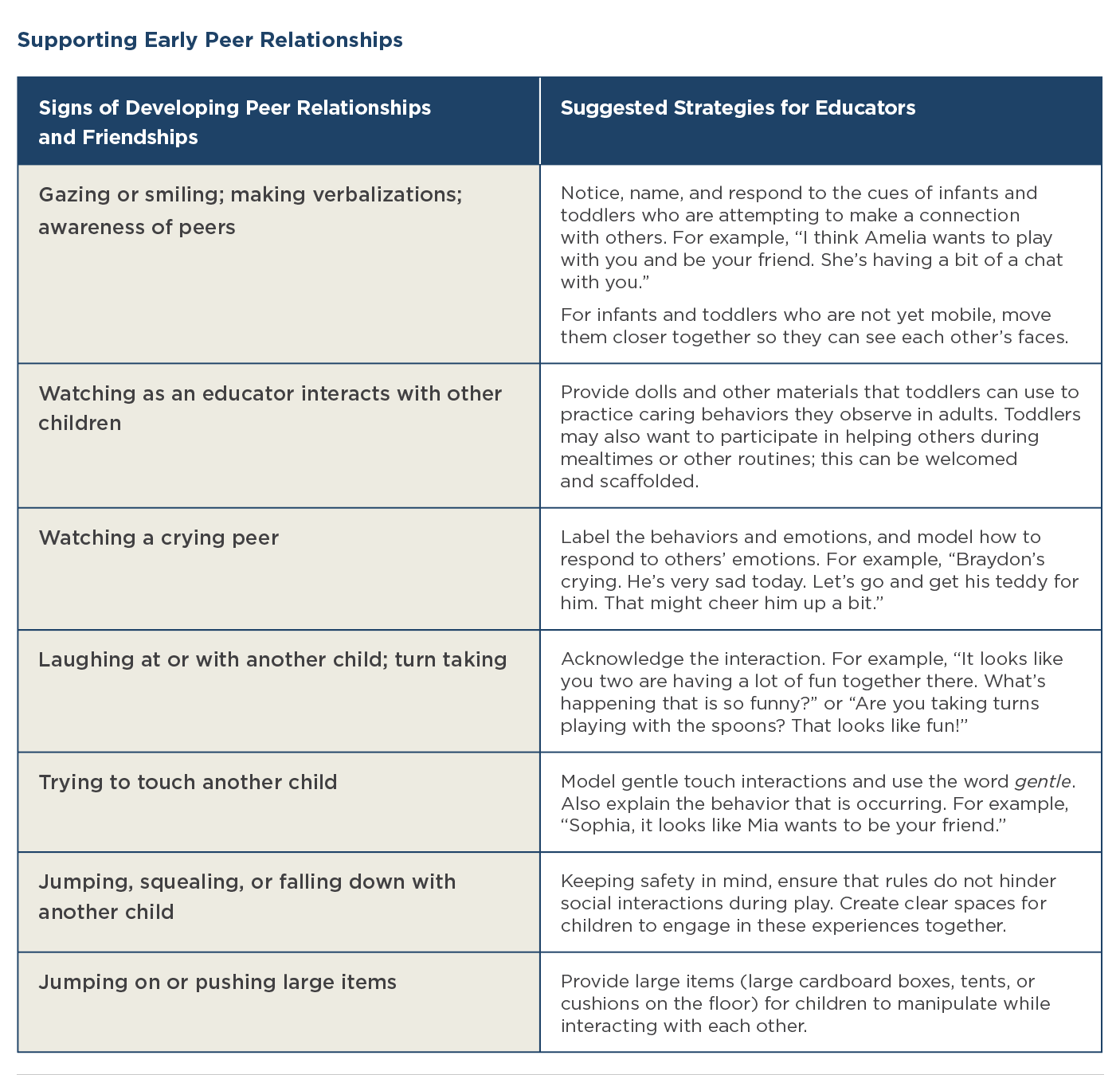
Traditionally, early childhood educators have been taught that infants and young toddlers are not yet capable of forming friendships and prefer to play alone or in parallel play (e.g., Parten 1933). However, a small body of research has highlighted key components of emerging friendships in infants and toddlers. This includes one young child having a preference for another child in a group setting, which is often demonstrated by signs of affection and engagement in social play (Howes 1988; Shin 2010). Children attempt to initiate interactions with peers in a variety of ways (Løkken 2000; Engdahl 2011; Warsha & Mayuri 2015). Some of these are
- gazing or smiling at another child or making verbalizations
- demonstrating an awareness of peer presence by, for example, watching another child
- watching closely as an educator interacts with other children during activities and routines
- closely watching a peer who is crying or expressing other strong emotions
- laughing at or with another child
- turn taking of repetitive actions such as banging on something
- trying to hug, kiss, or touch another child
- jumping, squealing, or falling down with another child or while gazing at another child
- jumping on or pushing large items around the room
In addition to nurturing social connections with adults, eye gaze plays an important role in emerging peer relationships, including friendships. Eye gaze can be one of the first signals infants and toddlers use to express their desire to initiate or join the play or interaction. In the opening vignette, Noah and Zach used eye gaze to initiate and maintain a playful interaction. Through these interactions, infants and toddlers can develop knowledge and skills related to social competence, such as verbal or nonverbal back-and-forth interactions and using eye contact to indicate and share points of interest.
For example, during an ethnographic study of toddlers in a Swedish early learning program, Engdahl (2021) observed turn taking, perspective taking, and the emergence of friendship during play. The following scenario exemplifies these observations: A 17-month-old child climbed onto a bench and smiled at another child (30 months) who had approached. The second child then climbed up onto the bench, which was met by laughter from the first child. The turn-taking interaction continued when the second boy climbed down and laughingly mimicked the other—who was now stomping his feet on the bench—by stomping his feet on the ground. He then climbed back onto the bench smiling. Throughout, each child carefully watched and mimicked the behavior of the other.
While peer relationships and early friendships can develop in infant and toddler settings, early childhood educators may miss opportunities to foster these connections—even if they create and maintain positive teacher-child relationships (Howes, Hamilton, & Matheson 1994). They may not recognize the attempts of one child to involve another in their play, or they may inadvertently hinder relationship building by placing more emphasis on following rules (Shin 2010). For example, in the scenario from Engdahl’s study, it would be easy to miss the social cues and focus more on the potential danger of climbing onto the bench.
To nurture emerging relationships and friendships, educators can look out for and recognize the signs of an infant or toddler trying to establish connections with others. By providing space, resources, and guidance, adults can scaffold young children’s efforts to develop relationships with each other (Shin 2010; Engdahl 2011; McGaha et al. 2011). For example, educators can
- acknowledge a child’s attempt to interact with a peer, verbalizing the child’s intentions
- provide dolls and accessories to give toddlers an opportunity to engage in caring behaviors, imitating an educator’s interactions with them and their peers
- accounting for safety, ensure that class or group rules do not hinder social interactions and cues during play
- create clear spaces to help maintain safety while facilitating social interactions
- provide large items, such as large cardboard boxes, tents, or cushions on the floor, for children to play with; this will help children recognize these as items that belong to everyone (smaller objects and toys may be perceived as belonging to a specific child)
See “Supporting Early Peer Relationships” below for signs of developing peer relationships and suggested strategies for educators to support them.
Infants and toddlers enter the social world ready to engage, and they do so through behaviors that demonstrate their emerging abilities and eagerness to develop relationships with others, including their teachers and peers.
As shown by Elise in the opening vignette, early childhood educators can recognize and foster children’s early social development and relationship formation. They can identify and respond to children’s attempts to forge relationships, situated within a context of guidance and safe play spaces, and they can recognize that very young children notice and are influenced by adults’ reactions and cues.
Conclusion
Infants and toddlers enter the social world ready to engage, and they do so through behaviors that demonstrate their emerging abilities and eagerness to develop relationships with others, including their teachers and peers. Early childhood educators play an important role in supporting infants’ and toddlers’ social development, beginning with recognizing cues and nurturing these attempts. This article offers foundational findings and strategies that can be incorporated into everyday practice with infants and toddlers.
Research will undoubtedly continue to offer new insights and considerations and can further guide early childhood educators’ knowledge and practices related to infants’ and toddlers’ social development.
Photograph: © Getty Images
Copyright © 2023 by the National Association for the Education of Young Children. See Permissions and Reprints at NAEYC.org/resources/permissions.
References
Berger, E.H. 1999. “Supporting Parents with Two Essential Understandings: Attachment and Brain Development.” Early Childhood Education Journal 26 (4): 267–70.
Center on the Developing Child at Harvard University. 2017. “Serve and Return.” http://developingchild.harvard.edu/science/key-concepts/serve-and-return.
Davis, B., & S. Degotardi. 2015. “Educators’ Understandings of, and Support for, Infant Peer Relationships in Early Childhood Settings.” Journal of Early Childhood Research 13 (1): 64–78.
Deans, C.L. 2020. “Maternal Sensitivity, Its Relationship with Child Outcomes, and Interventions that Address It: A Systematic Literature Review.” Early Child Development and Care 190 (2): 252–75.
Di Lorenzo, R., A. Blasi, C. Junge, C. van den Boomen, R. van Rooijen, et al. 2019. “Brain Responses to Faces and Facial Expression in 5-Month-Olds: An fNIRS Study.” Frontiers in Psychology 10:1240. https://www.frontiersin.org/articles/10.3389/fpsyg.2019.01240/full.
Ehli, S., J. Wolf, A. Newen, S. Schneider, & B. Voigt. 2020. “Determining the Function of Social Referencing: The Role of Familiarity and Situational Threat.” Frontiers in Psychology 11: 1-7. https://www.frontiersin.org/articles/10.3389/fpsyg.2020.538228/full.
Engdahl, I.M. 2011. “Toddlers as Social Actors in the Swedish Preschool.” PhD diss., Stockholm University. https://www.diva-portal.org/smash/get/diva2:391762/fulltext01.pdf.
Engdahl, I.M. 2021. “Toddlers as Social Actors in Early Education.” Psicología, Conocimiento y Sociedad 11 (1): 68–84.
Grossmann, T. 2013. “Mapping Prefrontal Cortex Functions in Human Infancy.” Infancy 18 (3): 303–24.
Grossmann, T. 2015. “The Development of Social Brain Functions in Infancy.” Psychological Bulletin 141 (6): 1266–87.
Howes, C. 1988. “Peer Interaction of Young Children.” Monographs of the Society for Research in Child Development 48 (217): 1–88.
Howes C., C. Hamilton, & C. Matheson. 1994. “Children’s Relationships with Peers: Differential Associations with Aspects of the Teacher-Child Relationship. Child Development 65: 253–63.
Laurin, D.E., & C.B. Goble. 2018. “Enhancing the Diapering Routine: Caring, Communication, and Development.” Young Children 73 (3): 18–25.
Lloyd-Fox, S., A. Blasi, A. Volein, N. Everdell, C.E. Elwell, et al. 2009. “Social Perception in Infancy: A Near Infrared Spectroscopy Study.” Child Development 80 (4): 986–99.
Løkken, G. 2000. “Tracing the Social Style of Toddler Peers.” Scandinavian Journal of Educational Research 44 (2): 163–76.
McGaha, C.G., R. Cummings, B. Lippard, & K. Dallas. 2011. “Relationship Building: Infants, Toddlers, and 2-Year-Olds.” Early Childhood Research and Practice 13 (1): 15.
Meltzoff, A.N. 2007. “Like Me: A Foundation for Social Cognition.” Developmental Science 10 (1): 126–34.
Meltzoff, A.N., & P.K. Kuhl. 2016. “Exploring the Infant Social Brain: What’s Going on in There?” Zero To Three 36 (3): 2–9.
Parten, M.B. 1933. “Social Play Among Preschool Children.” Journal of Abnormal and Social Psychology 28: 136–47.
Radesky, J., A.L. Miller, K.L. Rosenblum, D. Appugliese, N. Kaciroti, et al. 2015. “Maternal Mobile Device Use During a Structured Parent-Child Interaction Task.” Academic Pediatrics 15 (2): 238–44.
Repacholi, B.M., & A.N. Meltzoff. 2007. “Emotional Eavesdropping: Infants Selectively Respond to Indirect Emotional Signals. Child Development 78: 503–21.
Repacholi, B.M., A.N. Meltzoff, T.S. Toub, & A.L. Ruba. 2016. “Infants’ Generalizations About Other People’s Emotions: Foundations for Trait-Like Attributions.” Developmental Psychology 52 (3): 364–78.
Shin, M. 2010. “Peeking at the Relationship World of Infant Friends and Caregivers.” Journal of Early Childhood Research 8 (3): 294–302.
Shohet, C., M. Shay, C. Almog-Greenberg, & E. Adi-Japha. 2019. “Early Friendships: Does a Friend’s Presence in Daycare Promote Toddlers’ Prosocial Behavior Toward Peers?” The Journal of Experimental Education 87 (3): 517–29.
Sorce, J.F., R.N. Emde, J.J. Campos, & M.D. Klinnert. 1985. “Maternal Signaling: Its Effect on the Visual Cliff Behavior of 1-Year-Olds.” Developmental Psychology 21: 195–200.
Walle, E.A., P.J. Reschke, & J.M. Knothe. 2017. “Social Referencing: Defining and Delineating a Basic Process of Emotion.” Emotion Review 9 (3): 245–52.
Warsha, N., & K. Mayuri. 2015. “Child to Child Interaction: An Observational Study.” International Journal of Science and Research 4 (2): 1056–61.
Yrttiaho, S., L. Forssman, J. Kaatiala, & J.M. Leppanen. 2014. “Developmental Precursors of Social Brain Networks: The Emergence of Attentional and Cortical Sensitivity to Facial Expressions in 5 to 7 Months Old Infants.” PLoS ONE 9 (6). https://journals.plos.org/plosone/article?id=10.1371/journal.pone.0100811.