Creating Dramatic Play Areas That Support Literacy Development

You are here
Play is an essential part of childhood. It allows children to explore, experiment, and learn about the world around them. It can also be a powerful tool for promoting foundational early literacy and language skills. Children develop these skills through engagement in a variety of learning areas and experiences. Intentionally blending literacy with dramatic play is one such avenue for meaningful and enjoyable engagement. In this article, I describe the ways dramatic play fosters literacy skills and offer strategies for creating literacy-enriched dramatic play environments.
How Dramatic Play Promotes Literacy
Dramatic play serves as a context for early literacy and language learning. It offers children opportunities to
- engage in language-rich interactions. Children expand their vocabulary, enhance communication skills, and develop an understanding of narrative structure.
- encounter print materials. Books, signs, and labels foster print awareness (understanding how print works), letter recognition, links between letters and sounds, and more.
- explore different genres and storylines. Children can act out familiar stories or experiences, invent narratives, create literacy-related artifacts and props (grocery lists, field notes during an expedition, or recipes), or retell information they’ve learned. These kinds of activities enhance their understanding of the different types and features of texts and their real-life purposes.
Dramatic play also supports other skills that are intertwined with literacy and language development—such as critical thinking, problem solving, and social and emotional skills. Children participate in decision making, negotiation, and cooperation as they interact with peers during dramatic play. This helps to develop their comprehension skills, perspective taking, and their ability to analyze and make connections within and across narratives. As they navigate play scenarios, children practice empathy and cooperation. These skills lay a foundation for effective communication and understanding diverse perspectives, which are also useful as they learn to read and write.
Planning for Literacy in the Dramatic Play Area
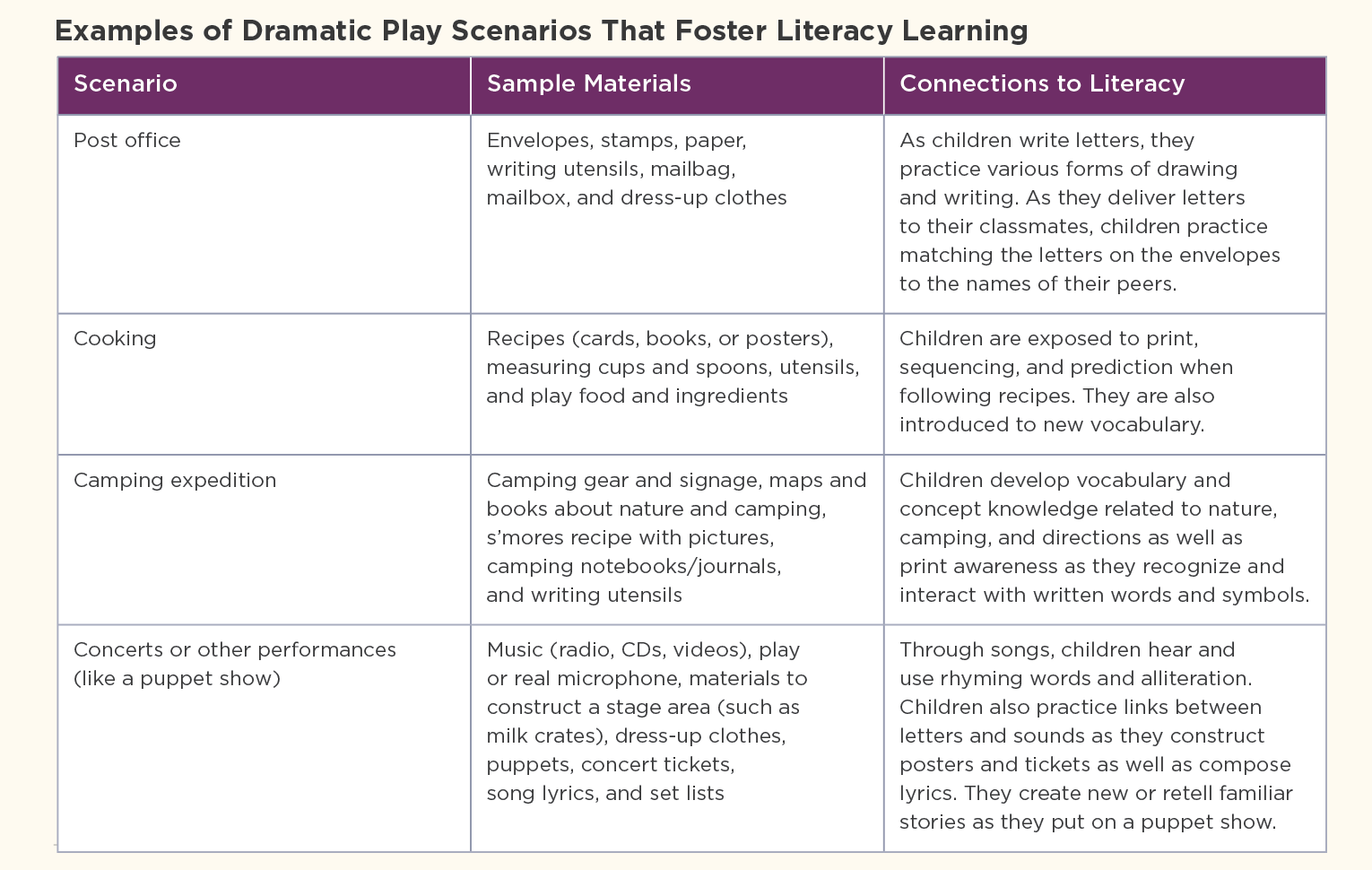
Dramatic play areas are often equipped with props, costumes, and other materials that support a particular theme or play event. By incorporating literacy materials (books, writing tools, and technology), teachers create spaces and scenarios that foster children’s literacy learning. (See “Examples of Dramatic Play Scenarios That Foster Literacy Learning” below for some suggested play scenarios.)
To scaffold children’s understanding, educators can first model working with a new literacy-related material, then provide guidance, and finally invite children to engage with the material independently. For example, after multiple readings and discussions of The Very Hungry Caterpillar, by Eric Carle, educators can introduce felt pieces that correlate to the story (caterpillar, butterfly, fruits). Placing each piece on the felt board, the educator retells the story, then encourages the children to choose felt pieces and tell the story together. Then the pieces can be placed in the dramatic play area, so children can retell the story independently.
As children play, teachers can introduce and reinforce new vocabulary, incorporate authentic opportunities for writing, and scaffold their storytelling. A discussion of each follows.
Introduce New Vocabulary
Incorporating new words and concepts during pretend play supports children’s literacy learning. Children can use and practice the words they’ve learned as they engage in role playing. Along with bolstering their listening and speaking skills, this expands their world (or background) knowledge and the words they’ll encounter in print. For example, in my preschool classroom, children learned the names of vegetables along with words to describe their taste (scrumptious) during daily routines; these new words and ideas then filtered into their play.
New vocabulary can also be introduced during instructional times, like morning meetings, and can be incorporated by children during their play. For instance, during our morning circle, I read a book about construction and introduced the words build, construction, sturdy, stable, wobbly, and brick. My coteacher and I placed materials that were highlighted in the text, along with labels showing the words and corresponding images for them, in the dramatic play area to expose children to print and the new ideas. While children interacted with the materials, they practiced the words learned from the book, such as “It’s wobbly and looks like it’s going to fall down.” I also used these vocabulary words while facilitating children’s play. For instance, when Steve built his brick house, I said, “Your brick house is sturdy.” I also commented on Celia’s house that was falling by saying, “Oh no! The bricks are wobbly. How can we make the house stable?”
Incorporate Writing
When early childhood educators encourage children to write (by providing writing materials, props, and labels), children gain valuable experience with written language. Writing in dramatic play can help children practice the physical aspects of writing, including the fine motor skills involved in holding writing tools and making marks on a page. In addition, writing goes beyond the physical to meaning and purpose: whether writing a letter, creating a menu, or making signs for a pretend store, teachers can help children learn that writing is a way to express their thoughts and that writing serves important purposes for real-life activities. Writing also allows children to engage in meaningful interactions: they can write notes to their peers, leave messages for others, or record their pretend play experiences.
Encourage Storytelling
When children engage in storytelling, they actively construct narratives to express their ideas. Through storytelling, children learn to organize their thoughts, articulate ideas, and develop a sense of narrative structure. They begin to understand character development, plot progression, and story elements—essential components of reading and writing stories. (For more on this topic, see “6X. Developing a Storytelling Culture in Early Childhood”.)
So much of children’s dramatic play involves storytelling, with imaginative scenarios, characters, and settings. For example, during a discussion about tigers, children in my class learned that the Sumatran tiger is an endangered species. My coteacher and I explained that not many of them are left, so we (as humans) need to take care of the ones that remain. Later, I observed children creating and acting out their own story. They created a plot and assigned roles to each other. Charles said, “Put them [the tigers] inside the house; the hurricane is coming.” They also had a veterinarian, or “animal doctor,” as Jane said, to care for the tigers who got hurt from the hurricane and someone to fix the houses damaged by the storm. This kind of back-and-forth interaction nurtures young learners’ literacy development as well as development in other domains.
Conclusion
By intentionally weaving literacy with dramatic play, early childhood educators create a dynamic and enriching environment that supports early literacy development and prepares children for a lifelong love of reading and writing. I invite you to get creative and design literacy-rich dramatic play areas that will inspire and engage children in the joy of learning in your setting!
Photograph: © Getty Images
Copyright © 2024 by the National Association for the Education of Young Children. See permissions and reprints online at NAEYC.org/resources/permissions.

 This article supports the following NAEYC Early Learning Programs standards and topics
Standard 2: Curriculum
2D: Language Development
2E: Early Literacy
2J: Creative Expression and Appreciation for the Arts
Standard 3: Teaching
3F: Making Learning Meaningful