Intentionally Building Self-Regulation and Literacy Skills: The Power of Dramatization in Kindergarten

You are here
With a hum of deep engagement all around, Darah, Sofia, and Jada are standing at the table in the dramatization center in Ms. Skylar’s kindergarten classroom. Inspired by a recent read aloud, they are dramatizing events related to an ocean exploration.
“We’ll all need to do the octopus and the shark,” Sofia says.
“Right, they are gigantic,” Jada agrees.
Darah turns and calls out to two other children nearby: “Mateo and Kayla, we’re ready; get started!”
“Okay, so we get into the minisub,” Mateo says as he opens a door cut into the top of a large painted box.
“Wait, you forgot!” Darah reminds him about what the characters did: “Jack doesn’t open the hatch door on the sub; Annie does!”
“I’m Annie,” Kayla says as she and Mateo climb into the box and act out a scene involving the hatch, control buttons, and observing sea creatures around them.
Jada, Sofia, and Darah hold a large octopus and wrap it around the minisub.
“It’s attacking us!” Kayla says.
“No, my book says octopuses are just curious,” Mateo tells her. “They like to eat c-r-a-b-s; crabs! Not minisubs.”
There is a pause, and Mateo pokes his head out of the hatch door. “Hey, octopus, you are supposed to squirt black ink!” he says, closing the door quickly behind him.
Jada, Sofia, and Darah laugh. They grab a black cloth and drape it over the sub windows.
“I can’t see anything!” Mateo and Kayla both say, pretending to be afraid.
“This is not good.” Mateo says. “Octopuses squirt black ink to get away from a predator. That means . . .”
Darah slides the black cloth off the box with one hand while she holds part of a large shark in the other.
“It’s a hammerhead shark!” shouts Mateo. “Now we pretend the sub is starting to leak. Oh no, we forgot to make the crack sound. Crack! We’re leaking! Push the up arrow!”
Many early childhood educators feel increased pressure to spend time teaching academic skills in lieu of social and emotional competencies. This challenge has only grown over the past several decades as teachers allocate time to helping children meet state learning goals and benchmarks. Research comparing kindergarten in 1998 versus 2010 found that kindergarten teachers in 2010 devoted more time to advanced literacy and math content, teacher-directed instruction, and assessment (Bassok, Latham, & Rorem 2016), with a decrease in time for other activities, many of which are associated with the development of self-regulation. How can early childhood educators effectively help children both develop self-regulation and master content area knowledge in developmentally appropriate ways?
In the opening vignette, children in Ms. Skylar’s kindergarten class worked in the dramatization center to act out a scene from a Magic Treehouse book that Ms. Skylar had recently read aloud. Dramatization is literature-based make-believe play, in which children act out stories from fiction as well as nonfiction texts. As they worked together, Darah, Sofia, Jada, Mateo, and Kayla built a range of literacy skills. At the same time, they were developing self-regulation skills—the ability to manage their bodies, emotions, and attention. When teachers plan for and organize dramatization in a specific way, it scaffolds children’s self-regulation.
For the last 30 years, we have worked in early childhood classrooms, translating the theory of Lev Vygotsky (who studied the links between social interactions and cognition) into actionable teaching practices. Our aim has been to help teachers build regulated, inclusive classrooms full of engaged learners. Through our work, we have found that teachers can use dramatization to effectively support both crucial literacy skills (including oral language, text comprehension, vocabulary, and story structure) and children’s self-regulation development. In this article, we share how teachers can pair read alouds with dramatization to strengthen literacy and self-regulation. Doing this in kindergarten can have lasting impact: when teachers embed self-regulation development into literacy through dramatization, it can influence children’s literacy trajectory beyond the end of kindergarten and into first grade, including for children who struggle in or face challenges to their literacy learning (Blair & Raver 2014).
Why Is Self-Regulation Important?
In the late 1990s, kindergarten teachers began to rank self-regulation as one of the most important skills for development and learning (Rimm-Kaufman, Pianta, & Cox 2000). Almost two decades later, kindergarten teachers continued to identify self-regulation as an area needing attention (Curby et al. 2018). Self-regulation consists of an array of skills, which develop over time and depend not only on child characteristics and individual development (McClelland et al. 2015; Montroy et al. 2016) but also on the experiences children have and the scaffolding they receive (Wesarg-Menzel et al. 2023). Self-regulation is often defined in different ways or referred to using other terms, like self-control or goal-directed behavior. This creates a lack of clarity in the literature, and it makes it difficult for educators, policymakers, and others to know how to think about, assess, and make decisions related to self-regulation (Cole et al. 2019; Rademacher & Koglin 2019; Robson et al. 2020).
Self-regulation is directly connected to executive function—the underlying set of mental processes that enable self-regulation. Executive function is composed of three core processes—working memory, inhibitory control, and cognitive flexibility—which rely on a network of brain structures, primarily in the prefrontal cortex (Diamond 2002, 2014). There is a strong, and still growing, research base on the development of executive function. Early childhood educators can observe children’s executive function skills as they engage in everyday learning activities; for example, when children
- remember prior events in a story to make sense of the rest of the story (working memory)
- stop themselves from automatically applying a rule to words that are exceptions to that rule when reading or writing (inhibitory control)
- switch attention back and forth between working on an assignment and self-monitoring (“Did I follow the directions?”) (cognitive flexibility)
Research has shown a strong relationship between self-regulation and academic skills, social and emotional development, and children’s general mental health, with self-regulation having a significant effect on success and happiness in the short term as well as in years to come (Moffitt et al. 2011). Research has also shown that the components of executive function predict academic performance better than IQ, child readiness scores, social class, and parent education level (Blair & Razza 2007; Nesbitt, Baker-Ward, & Willoughby 2013; Spiegel et al. 2021; Waters et al. 2021). In addition, early childhood (ages 3 to 7) has been identified as a key period for the development of executive function skills, and research has shown that self-regulation can be developed with scaffolding and support in the classroom (Cantor et al. 2021).
The learning demands we make of children in today’s kindergarten settings often require levels of cognitive and social and emotional self-regulation that many children have not yet developed (Flanne 2018; Harmon & Viruru 2018; Costantino-Lane 2019; Brown & Barry 2020). For example, behaviors that sometimes look like social or learning difficulties can have their roots in a lack of self-regulation: children may know the right thing to do but act inappropriately because they are still developing the skills that enable them to inhibit immediate desires or ignore distractions. In order to integrate and apply new skills and strategies they have learned, children need to exercise cognitive self-regulation. If self-regulation is still emerging, they may revert to previous ways of doing things, including making errors. For example, a child who has learned and practiced how to write lowercase letters may continue to write their name in all capital letters.
It is tempting to think of self-regulation as something that can be developed using a few exercises and activities in the classroom. Yet research has shown that isolated exercises, such as computer-based cognitive training, are not that effective (Diamond & Ling 2016). In addition, these exercises add another set of activities to fit into a busy kindergarten day, resulting in even more demands for self-regulation. Instead, playful learning activities that offer children opportunities to simultaneously practice self-regulation and academic skills meet both needs. One such activity is dramatization, or literature-based make-believe play, which promotes both self-regulation and literacy development.
Supporting Self-Regulation Through Dramatization
Among the contributions Vygotsky and his colleagues made to education is the insight that self-regulation in the early childhood years is best developed through make-believe play. Vygotsky called play “the school for self-regulation” (quoted in El’konin 1978, 290). While other kinds of play, such as assembling alphabet puzzles, building with blocks, or playing hopscotch, are beneficial for development, they do not provide the same support for self-regulation that make-believe play does (Vygotsky 1967; El’konin 1999). Ongoing research has reiterated and expanded on our understanding of the role of play in promoting self-regulation and executive function (Colliver et al. 2022; Miller et al. 2022; Bredikyte & Brandisauskiene 2023) and effective ways to plan for and support this powerful connection (Diamond et al. 2019; Pyle et al. 2022).
To promote self-regulation, make-believe play must reach a mature stage, which has the following characteristics (Leong & Bodrova 2024):
- Children plan the make-believe scenario in advance and negotiate changes in the scenario as their play unfolds.
- Play has roles with rules that define them (for example, if a child is pretending to be a patient, they cannot use the doctor’s stethoscope or give the doctor a shot).
- Children practice role speech during play, using the vocabulary, phrasing, and vocal prosody of the character(s) they are playing.
- Children use symbolic props to enact the role and scenarios.
This kind of make-believe play creates the conditions in which children practice self-regulatory skills. They intentionally inhibit what they do and say to act in character, and they monitor the actions of others, reminding children who have stepped out of their role how they should act so the scenario advances according to their plan (Bredikyte & Brandisauskiene 2023). Because teacher involvement in make-believe play varies, children have repeated opportunities to voluntarily regulate themselves and accept regulation from peers (Zachariou & Whitebread 2022).
In kindergarten, mature make-believe play involves dramatization, or acting out stories from fiction as well as nonfiction texts (Baldwin & Fleming 2003; Brown 2017). Routinely used to promote vocabulary and text comprehension, dramatization can be a powerful vehicle for developing self-regulation because it has the same essential characteristics as mature make-believe play. There is a planned scenario to act out—only this scenario is literature-based instead of child-generated. Children talk together to plan the roles and props they will need, regulate one another by reminding each other what happens next and how different characters sound or feel, and develop self-regulation in the process (Bestwick 2021). In the opening vignette, children monitored one another’s actions, reminding each other of steps in the dramatization that had been forgotten (the octopus squirting ink) and which roles should engage in which actions (Annie is the one who opens the hatch door). In kindergarten-age children, higher levels of executive function skills have been associated with higher levels of play, as defined by the complexity of the play scenario and play-related peer interactions as well as the use of props in a symbolic way (Veraksa, Bukhalenkova, & Smirnova 2020). Children in classrooms where dramatization was actively supported by teachers had higher levels of self-regulation compared to control groups (Diamond et al. 2019).
Supporting Literacy Skills Through Dramatization
Research demonstrates the benefits play has for children’s mastery of reading and writing. Indeed, when engaged in pretend play and games, children demonstrate higher rates of emergent reading and writing behaviors (Rand & Morrow 2021). The areas most affected by play experiences include skills necessary for text comprehension (Westby & Wilson 2017), such as vocabulary, decontextualized language, and oral narrative competence, or understanding what makes a story a story. Decontextualized language refers to language children use to describe something that is not present at the moment but happened in the past or will happen in the future (Dickinson & Tabors 2001). It is also used to describe things that are imaginary and may never happen in real life—something that children do when they pretend. The children in the opening vignette used decontextualized language as they prompted one another about what should happen next, and they used lots of high-level vocabulary (hatch, curious, squirt ink, and hammerhead shark). In dramatization, children may be intrinsically motivated to decode and read as part of their play.
Children engaging in dramatization of fiction and nonfiction texts are building multiple literacy skills at the same time they are developing self-regulation (Blair & Raver 2014; Cavanaugh et al. 2017; Diamond et al. 2019). For examples of these literacy skills, see “Text Comprehension Skills Developed Through Dramatization” below.
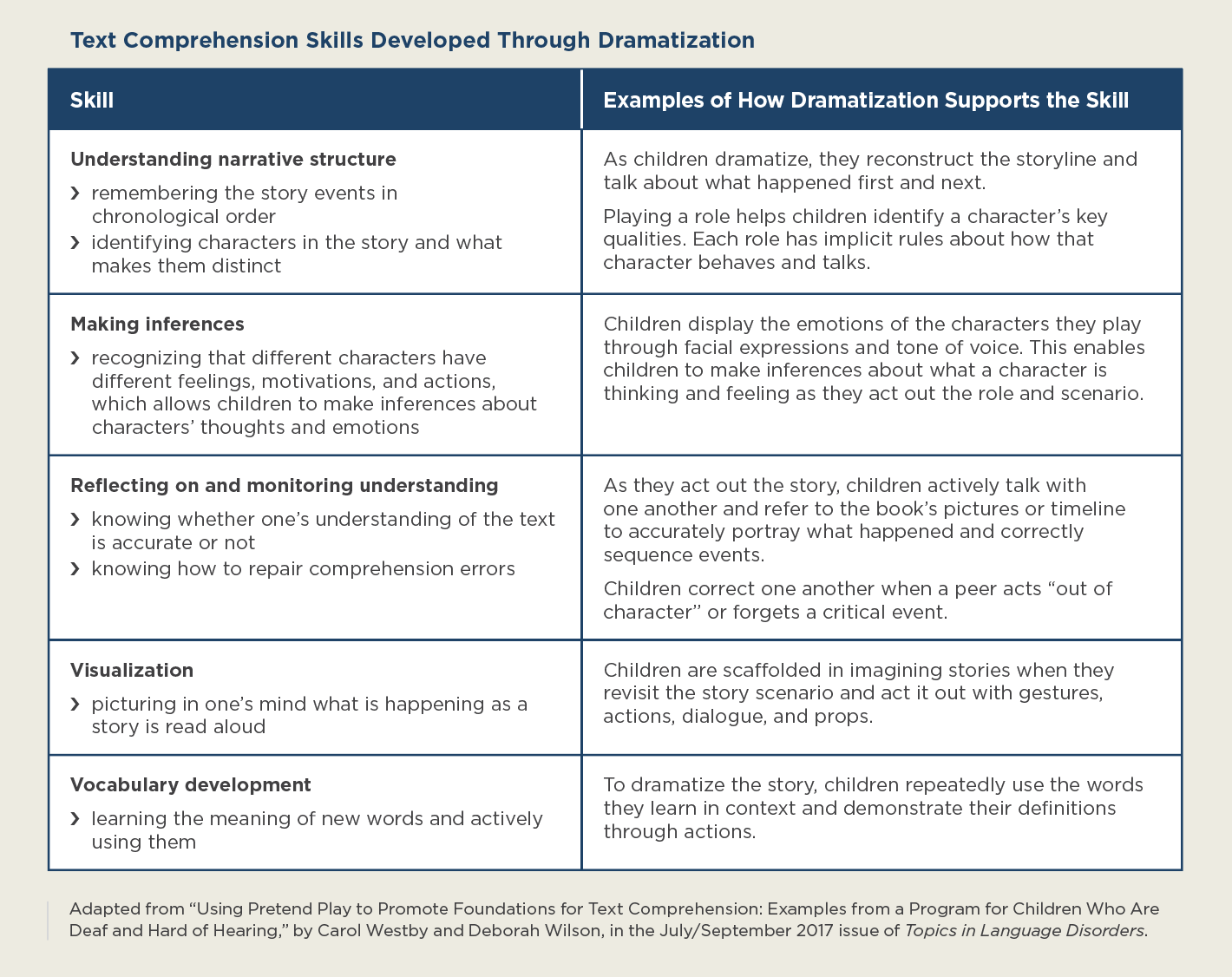
Strategies to Support Dramatization in Kindergarten
Research has shown positive outcomes in classrooms that include dramatization as part of their approach to literacy. For example, studies conducted by Blair and Raver (2014) and Diamond and colleagues (2019) focused on teachers who began to intentionally use dramatization in their classrooms to build self-regulation and literacy skills. After doing this for one year, teachers in the studies described positive outcomes beyond the academic ones represented in assessments. They noted:
Children use rich, theme-related vocabulary in proper context. They also extend this language out on the playground and in other discussions. They make many connections with various texts and real-world situations.
The majority of students are able to regulate themselves better socially and emotionally. . . . They are able to sustain elaborate play scenarios with multiple characters for extended periods of time! They are able to wait for their next turn. The students’ growth in self-regulation and their excitement for learning [was the greatest reward of this year]!
These studies also found that end-of-the-year literacy scores were significantly higher in classrooms that used dramatization than in control classrooms that did not. Children grew in self-regulation as measured by executive function levels, and teachers reported increased feelings of efficacy in their ability to teach.
For dramatization to support both self-regulation and literacy, teachers must be intentional in how they plan for it, incorporate it in their read alouds, and support it as it unfolds. Through these experiences, teachers can facilitate equitable, joyful learning activities that simultaneously support children’s development of self-regulation and literacy skills (see “Equitable Approaches to Dramatization” below).
Equitable Approaches to Dramatization
As teachers begin to implement dramatization, they can ensure an equitable approach by fostering interactions that promote an inclusive community of learners. This way, every child is encouraged to actively participate and has the opportunity to practice self-regulation.
For example, by intentionally organizing small groups so that all children dramatize with all other children, teachers will avoid ability grouping or exacerbating any informal social cliques. Modifying roles so that a range of modes are included—such as speech, gesture, and pictures—will support all learners’ engagement. Emergent multilingual learners can use their home languages or be supported by peers in saying specific role speech in English. Teachers can pair children who have strengths in dramatization with children whose abilities are emerging to play the same role together so that peers can support each other’s play development.
Using a read aloud as the foundation for dramatization also supports equity in the kindergarten setting: all children are exposed to and build their knowledge of the same story, characters, and events, so every child can engage in the play that will build self-regulation and literacy skills.
The following sections describe key steps teachers can take to facilitate high-level dramatic play in their classrooms.
Plan for Dramatization
Intentional planning is important for effective dramatization. Two aspects to consider are the time available for the activity and the selection of read alouds for children to dramatize.
Set Aside Time
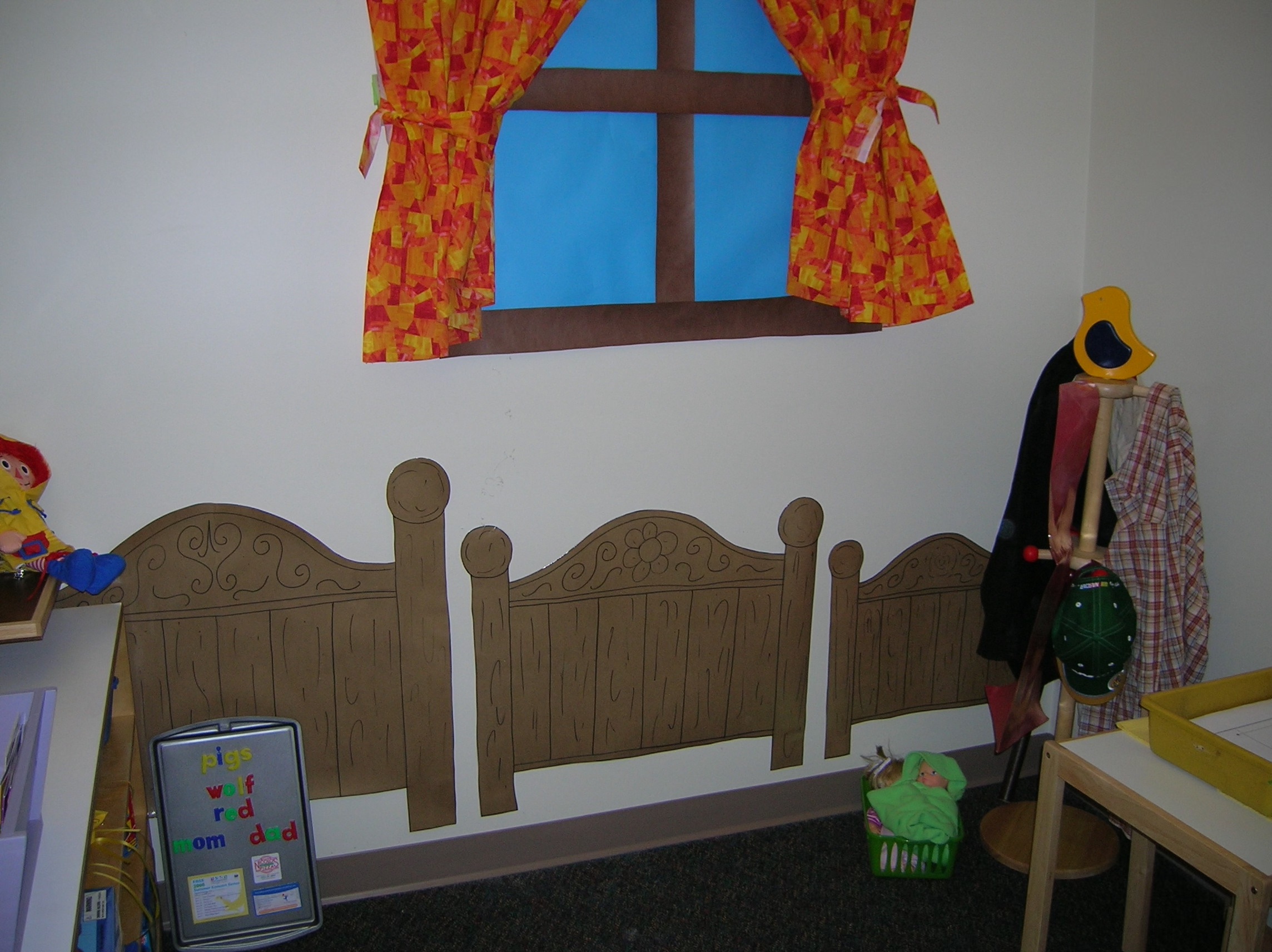 Teachers need to invest in planning and preserving time for small-group dramatization. Making one of the literacy centers a dramatization center works well in most classrooms. Teachers can also extend the opportunities for dramatization into other times of the day (making it an option when children finish their work, during free choice times, and indoor recess). The amount of time set aside for children to dramatize a story by themselves will affect the learning of both self-regulation and literacy skills. Trading roles and dramatizing a second time has significant additional benefits, so lengthening the available time can be valuable (30 minutes is optimal based on our work).
Select Books for Read Alouds
Read alouds create the foundation for dramatization. (For some tips on selecting books, see “How to Choose Books for Dramatization” below.) Teachers can begin with fiction, selecting literature with multiple events and three to five characters who interact. Beginning with fiction allows children to practice dramatization by acting out short scenarios with well-defined characters. Later on, children will be able to dramatize longer and more complex scenarios drawing on what they learned from both fiction and nonfiction texts. Fairytales are a great place to start because these are familiar stories for many children, and remembering the plot does not overload their still developing working memory. Stories should speak to children’s interests and their diverse perspectives or cultural backgrounds while also exposing them to new cultures and experiences. For example, there are multiple versions of the Three Little Pigs, from the traditional version to those like Jon Scieszka’s The True Story of the 3 Little Pigs! or Jan Brett’s The 3 Little Dassies. When children act out different characters’ perspectives, they practice cognitive flexibility.
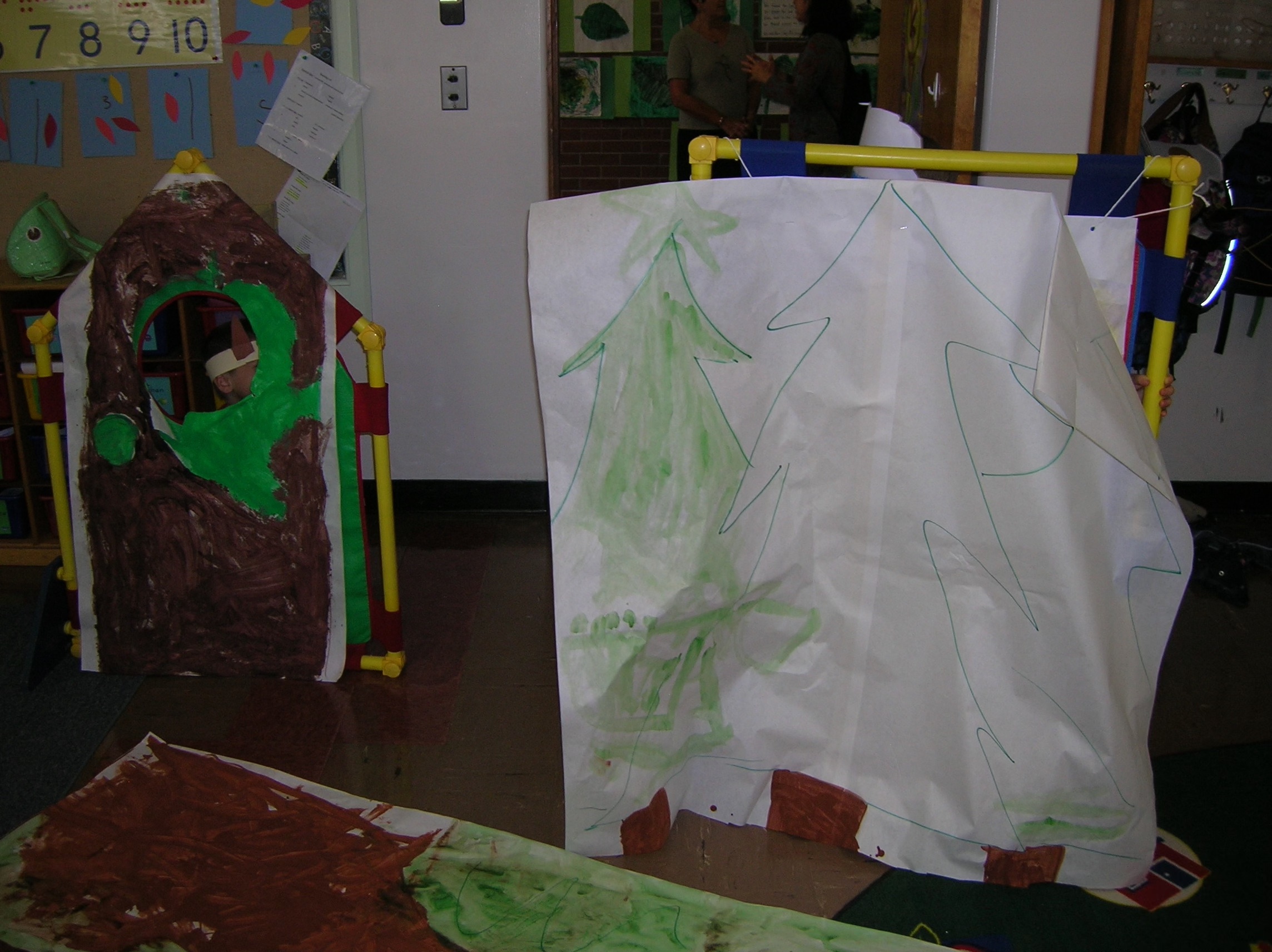
Nonfiction, which includes informational, biographical, and procedural texts, among others, can also serve as the inspiration for dramatization. For example, children can listen to a book about the ocean and recreate what it would be like to be an ocean animal and the adventures it might have. Many nonfiction books contain enough information for children to convert the ideas in them into a storyline.
Later, moving on to dramatize chapter books is a good goal: chapter books have more complex stories, and children’s play can include dramatizing all of the chapters a teacher has read to date as well as what they predict will happen in the next chapter. Remembering multiple scenarios and role speech produced by multiple characters provides a great workout for children’s working memory.
How to Choose Books for Dramatization
Here are a few things to keep in mind when selecting books for dramatization.
For both fiction and nonfiction texts:
- Across the year, the topics should vary to address children’s multiple interests and contexts.
- The book does not have to be a picture book, but it should have pictures that are detailed enough to inspire/support prop making as well as dramatizing.
For fiction texts:
- Children should find the story appealing.
- The story should include action and characters with unique personalities.
- The story should have some kind of conflict (problem, challenge, suspense) that gets resolved, resulting in a happy ending.
- There should be enough dialogue for multiple turns for each of the characters or enough action so dialogue can be created.
For nonfiction texts:
- An informational text can be used to build background knowledge before reading a fictional story (reading a book about marine life prior to reading a story about characters traveling in a submarine).
- An informational text can be used to supplement a fictional text to help children develop more complex and extended scenarios.
- The book focuses on real-life people, places, and/or things that children find appealing or inspiring (such as explorers or inventors).
- The book has enough information to allow teachers to identify key details (such as roles and characters) and to invent dialogue to model for children.
Guidelines for fictional texts are adapted from Picture Books Plus: 100 Extension Activities in Art, Drama, Music, Math, and Science, by Sue McCleaf Nespeca and Joan B. Reeve (2003).
Set the Stage
It is essential that children have a place to dramatize and the props to dramatize with, so planning for dramatization should include space and materials. Dramatization can take place in a corner of a classroom set up to represent the setting of the story and with dress-up clothes for playing certain characters. If space is an issue, it can happen around a table with children using small figurines for the story characters and a poster board with a picture of a setting for the background. (We share more details on prop making below.)
Use Read Alouds as an Opportunity to Practice Dramatization
To familiarize children with dramatization, teachers can incorporate aspects of it into the read aloud and can lead the whole group to dramatize together afterward.
Introduce Dramatization During Read Alouds
During the read aloud, teachers can encourage children to use gestures and language to dramatize the story. Before long, children will often do this without any prompting. For example, children may make a character’s facial expressions, create the “sound effects” of what is happening (drumming on their laps to “run”), or use gestures (pretending to open a door). Teachers can also prompt children to dramatize nonfiction texts: “Pretend to climb up the vines and into a tree. What can you see and touch in the rainforest?”; “Pretend you’re a prairie dog. What do you do to build your burrow home?” This supports focusing children’s attention and helps them remember the most salient things to dramatize.
Facilitate Whole-Group Dramatization
After the read aloud, teachers can facilitate whole-group dramatization. This can begin with the teacher sketching a visual storyline to capture the sequence of events in the story or chapter read aloud. The teacher does this by eliciting the children’s active use of oral language to identify key points in the narrative to represent on the timeline, inviting children to contribute suggestions for how to represent it.
Teachers then engage children in discussing what happened first and what the characters said and did, asking how they can use gestures, expressions, and language to dramatize the story together. All the children can play every role (“Now let’s pretend we are all Grandma lying in bed feeling a little sick.”), or roles can be assigned to different groups of children (“Children sitting over here all play Little Red Riding Hood; over here, the Wolf.”). This helps children learn how to plan their play when they dramatize later in small groups. The teacher then takes on the role of the director to coach children’s dramatic play: “Let’s pretend we are all Grandma lying in bed feeling a little sick, waiting for Little Red Riding Hood to arrive with some goodies. What happens next? Oh—you are right, the Wolf comes in. Let’s all pretend we are the Wolf. We’re walking up to the door. . . . Are we being noisy or quiet? What do we do next?” This provides a model of how to act the story out and, at the same time, reinforces what is important to remember.
Scaffold Independent Dramatization
As children begin to independently dramatize in small groups, teachers can observe the process and offer support as needed. In addition to helping children use materials that support dramatization, teachers can scaffold the quality of children’s dramatization and their self-regulation as they engage in dramatization.
Help Children Prepare the Setting and Materials
Teachers can help children prepare to independently dramatize stories by discussing what they could make or use for props and to create the setting. Props act as manipulatives to facilitate comprehension in the same way that manipulatives enable young children to practice addition and subtraction. Props help children remember key story events and what to say and do when playing different roles in multistep scenarios.
Simple props will help children recognize and remember which character each of their peers is playing. These could include headbands decorated to indicate different characters, small figures that represent the characters, paper bag puppets, or characters that children draw, cut out, and attach to popsicle sticks. As children are creating props for their dramatization, they have an extra opportunity to use decontextualized language: “The octopus has to have eight arms and be gigantic because it wraps its arms all around the minisub. And we have to add the suckers on the arms that stick to the sub!” (For more on how to engage children in thinking about props and how to use classroom materials and objects in creative ways, see “Beyond the Art Center: How Prop Making Merges Art and Make-Believe Play” in the Winter 2023 issue of Teaching Young Children.)
In addition, putting copies of the book or a visual storyline where children dramatize the story provides resources they can use to refresh their memories or settle a dispute over what happens next.
Scaffold the Quality of the Dramatization
As teachers observe children’s play, they can ask themselves the following questions to help scaffold the quality of the dramatization:
- Are children in clear roles from the story?
- Do they know what role they are playing and what roles their peers are playing?
- Are they able to remember and play the story events in sequence, or do they need support remembering, acting like the characters, or using props to act out events?
Teachers can encourage children who need more support to act out one part of the story at a time and then return to the visual timeline to talk together about what happens next.
Scaffold Self-Regulation
Teachers can set up opportunities for “other-regulation” so that children direct and monitor each other as they pretend. Children can take turns being the director in charge of ensuring peers remember their roles and what to do and say during important events. Teachers can model what the director does to help the actors engage in dramatization (“Let’s think together; what would Kayla, who is playing Annie, do when we are here in the story?”).
Teachers can also help children learn how to be fair when they work out who will play each role. What if no one wants a specific role? A stuffed animal or small figurine can be used to play it. What if everyone wants a particular role? Teachers can write the names of the roles on craft sticks, and children can pull these at random, or each child can be given the first choice of roles on a rotating basis. Children should exchange roles and play the same scenario several times, so they have the opportunity to play more than one role. A fair system for distributing roles empowers children to manage their emotions and delay gratification because they know their turn to play a desired role will come in the future.
Conclusion
Kindergarten children who dramatize at least 30 minutes a day have the opportunity to engage in intrinsically motivating play, practice comprehension skills, and develop vocabulary. At the same time, they develop foundational self-regulation skills, increase their working memory capacity, sustain attention, and flexibly shift attention in response to peers, story events, and differing roles (Blair & Raver 2014; Diamond et al. 2019). Dramatization in a kindergarten classroom is worth the investment: children thrive and develop more than just literacy skills through dramatization. It is an approach in kindergarten that, as Goldilocks said, is “just right.”
Photographs: © Getty Images; courtesy of the authors
Copyright © 2024 by the National Association for the Education of Young Children. See Permissions and Reprints online at NAEYC.org/resources/permissions.
References
Baldwin, P., & K. Fleming. 2003. Teaching Literacy Through Drama: Creative Approaches. London, UK: Routledge.
Bassok, D., S. Latham, & A. Rorem. 2016. “Is Kindergarten the New First Grade?” AERA Open 2 (1). doi.org/10.1177/2332858415616358.
Bestwick, M.A. 2021. “Children’s Literature as a Means to Provide Time for Playful Learning While Meeting Academic Standards.” In Play and Literacy: Play & Culture Studies, vol. 16, eds. M. Han & J.E. Johnson, 49–66. Washington, DC: Rowman & Littlefield.
Blair, C., & C.C. Raver. 2014. “Closing the Achievement Gap Through Modification of Neurocognitive and Neuroendocrine Function: Results from a Cluster Randomized Controlled Trial of an Innovative Approach to the Education of Children in Kindergarten.” PloS One 9 (11): e112393.
Blair, C., & R.P. Razza. 2007. “Relating Effortful Control, Executive Function, and False Belief Understanding to Emerging Math and Literacy Ability in Kindergarten.” Child Development 78 (2): 647–63.
Bodrova, E., & D.J. Leong. 2024. Tools of the Mind: The Vygotskian Approach to Early Childhood Education, 3rd ed. London, UK: Routledge.
Bredikyte, M., & A. Brandisauskiene. 2023. “Pretend Play as the Space for Development of Self-Regulation: Cultural-Historical Perspective.” Frontiers in Psychology 14: 1186512.
Brown, C.P., & D.P. Barry. 2020. “ ‘Kindergarten Isn’t Fun Anymore. Isn’t That so Sad?’ Examining How Kindergarten Teachers in the US Made Sense of the Changed Kindergarten.” Teaching and Teacher Education 90: 103029.
Brown, V. 2017. “Drama as a Valuable Learning Medium in Early Childhood.” Arts Education Policy Review 118 (3): 164–71.
Cantor, P., D. Osher, J. Berg, L. Steyer, & T. Rose. 2021. “Malleability, Plasticity, and Individuality: How Children Learn and Develop in Context.” In The Science of Learning and Development, eds. P. Cantor & D. Osher, 3–54. New York, NY: Routledge.
Cavanaugh, D.M., K.J. Clemence, M.M. Teale, A.C. Rule, & S.E. Montgomery. 2017. “Kindergarten Scores, Storytelling, Executive Function, and Motivation Improved Through Literacy-Rich Guided Play.” Early Childhood Education Journal 45 (6): 831–43.
Cole, P.M., N. Ram, & M.S. English. 2019. “Toward a Unifying Model of Self-Regulation: A Developmental Approach.” Child Development Perspectives 13 (2): 91–96.
Costantino-Lane, T. 2019. “Kindergarten Then and Now: Perceptions of Ten Long Term Teachers.” Early Childhood Education Journal 47 (5): 585–95.
Colliver, Y., L.J. Harrison, J.E. Brown, & P. Humburg. 2022. “Free Play Predicts Self-Regulation Years Later: Longitudinal Evidence From a Large Australian Sample of Toddlers and Preschoolers.” Early Childhood Research Quarterly 59: 148–61.
Curby, T., E. Berke, J. Blake, D. Demarie, G. DuPaul, et al. 2018. “Kindergarten Teacher Perceptions of Kindergarten Readiness: The Importance of Social–Emotional Skills.” Perspectives on Early Childhood Psychology and Education 2 (2): 115–37.
Diamond, A. 2002. “Normal Development of Prefrontal Cortex from Birth to Young Adulthood: Cognitive Functions, Anatomy, and Biochemistry.” In Principles of Frontal Lobe Function, eds. D. Stuss & R. Knight, 466–503. New York, NY: Oxford University Press.
Diamond, A. 2014. “Executive Functions: Insights into Ways to Help More Children Thrive.” ZERO TO THREE 35 (2): 9–17.
Diamond, A., C. Lee, P. Senften, A. Lam, & D. Abbott. 2019. “Randomized Control Trial of Tools of the Mind: Marked Benefits to Kindergarten Children and Their Teachers.” PLoS ONE 14 (9): e0222447.
Diamond, A., & D.S. Ling. 2016. “Conclusions About Interventions, Programs, and Approaches for Improving Executive Functions that Appear Justified and Those That, Despite Much Hype, Do Not.” Developmental Cognitive Neuroscience 18: 34–48.
Dickinson, D.K., & P.O. Tabors, eds. 2001. Young Children Learning at Home and School: Beginning Literacy with Language. Baltimore, MD: Paul. H. Brookes Publishing Co.
El’konin, D.B. 1978. Psychologiya Igry [The Psychology of Play]. Moscow, Russia: Pedagogika.
El’konin, D.B. 1999. “The Development of Play in Preschoolers: Roles and Pretend Situations: Their Significance and the Motivation of Play Activity.” Journal of Russian & East European Psychology 37 (6): 31–70.
Flannery, M.E. 2018. “The Epidemic of Anxiety Among Today’s Students.” neaToday. March 28, 2018. Washington, DC: National Education Association.
Harmon, F., & R. Viruru. 2018. “Debunking the Myth of the Efficacy of ‘Push-Down Academics’: How Rigid, Teacher-Centered, Academic Early Learning Environments Dis-Empower Young Children.” Journal of Family Strengths 18 (1): 11.
McClelland, M.M., G.J. Geldhof, C.E. Cameron, & S.B. Wanless. 2015. “Development and Self-Regulation.” In Handbook of Child Psychology and Developmental Science, eds. W.F. Overton, P.C.M. Molenaar, & R.M. Lerner, 1–43. Hoboken, NJ: Wiley.
Miller, P., L. Betancur, L. Coulanges, J. Kammerzell, M. Libertus, et al. 2022. “Time Spent Playing Predicts Early Reading and Math Skills Through Associations with Self-Regulation.” Journal of Applied Developmental Psychology 83: 101470.
Montroy, J.J., R.P. Bowles, L.E. Skibbe, M.M. McClelland, & F.J. Morrison. 2016. “The Development of Self-Regulation Across Early Childhood.” Developmental Psychology 52 (11): 1744.
Moffitt, T.E., L. Arseneault, D. Belsky, N. Dickson, R.J. Hancox, et al. 2011. “A Gradient of Childhood Self-Control Predicts Health, Wealth, and Public Safety.” Proceedings of the National Academy of Sciences 108 (7): 2693–98.
Nesbitt, K.T., L. Baker-Ward, & M.T. Willoughby. 2013. “Executive Function Mediates Socio-Economic and Racial Differences in Early Academic Achievement.” Early Childhood Research Quarterly 28 (4): 774–83.
Pyle, A., E. Danniels, N.E. Larsen, & R. Martinussen. 2022. “Supporting Children’s Self-Regulation Development in Play-Based Kindergarten Classrooms.” International Journal of Educational Research 116 (4): 102059.
Rademacher, A., & U. Koglin. 2019. “The Concept of Self-Regulation and Preschoolers’ Social-Emotional Development: A Systematic Review.” Early Child Development and Care 189 (14): 2299–317.
Rand, M.K., & L.M. Morrow. 2021. “The Contribution of Play Experiences in Early Literacy: Expanding the Science of Reading.” Reading Research Quarterly 56 (S1): S239–48.
Rimm-Kaufman, S.E., R.C. Pianta, & M.J. Cox. 2000. “Teachers’ Judgments of Problems in the Transition to Kindergarten.” Early Childhood Research Quarterly 15 (2): 147–66.
Robson, D.A., M.S. Allen, & S.J. Howard. 2020. “Self-Regulation in Childhood as a Predictor of Future Outcomes: A Meta-Analytic Review.” Psychological Bulletin 146 (4): 324–54.
Spiegel, J.A., J.M. Goodrich, B.M. Morris, C.M. Osborne, & C.J. Lonigan. 2021. “Relations Between Executive Functions and Academic Outcomes in Elementary School Children: A Meta-Analysis.” Psychological Bulletin 147 (4): 329.
Veraksa, N., D. Bukhalenkova, & E. Smirnova. 2020. “The Relationship Between Different Components of Role Play and Executive Function Development at Preschool Age.” International Research in Early Childhood Education 10 (2): 16–29.
Vygotsky, L.S. 1967. “Play and Its Role in the Mental Development of the Child.” Soviet Psychology 5 (3): 6–18.
Waters, N.E., S.F. Ahmed, S. Tang, F.J. Morrison, & P.E. Davis-Kean. 2021. “Pathways from Socioeconomic Status to Early Academic Achievement: The Role of Specific Executive Functions.” Early Childhood Research Quarterly 54: 321–31.
Wesarg-Menzel, C., R. Ebbes, M. Hensums, E. Wagemaker, M.S. Zaharieva, et al. 2023. “Development and Socialization of Self-Regulation from Infancy to Adolescence: A Meta-Review Differentiating Between Self-Regulatory Abilities, Goals, and Motivation.” Developmental Review 69: 101090.
Westby, C., & D. Wilson. 2017. “Using Pretend Play to Promote Foundations for Text Comprehension: Examples from a Program for Children Who Are Deaf and Hard of Hearing.” Topics in Language Disorders 37 (3): 282–301.
Zachariou, A., & D. Whitebread. 2022. “The Relation Between Early Self-Regulation and Classroom Context: The Role of Adult Presence, the Task’s Source of Initiation, and Social Context.” British Journal of Educational Psychology 92 (3): 861–80.