Honoring Home Languages: Strategies to Encourage Preschoolers’ Translanguaging Practices
You are here
Over 20 years ago, I began teaching kindergarten at an international school in Singapore. The children in my class represented a multitude of ethnicities and cultures and spoke many different languages. I found this diversity exciting but also challenging: Because I believed that the best and most efficient way to help children learn and integrate quickly was to immerse them in English-only speaking environments, I encouraged children to speak English (“In school, we speak English”; “I can’t understand you? Could you repeat that in English, please?”). Speaking their home languages, I worried, would delay and hinder their English language acquisition.
This approach reflected the once prevalent idea that language learning is sequential and separate. Like many others, I believed that languages were learned one after another and in isolation from each other. However, research has revealed that language learning is far more complex and nuanced. A new language is not acquired in isolation; rather, children leverage the language (or languages) they already know to develop and build an understanding of a new one. They translanguage, or use all of the languages in their linguistic repertoires to communicate and make meaning.
Today, I teach at a multilingual international school in Frankfurt, Germany. Sometimes more than eight different languages are spoken in my classroom. Although the main language of instruction is English, I try to honor the identities of the children and their families, model inclusivity and collaboration, and nurture a deeper understanding of concepts, vocabulary, and language through a stance of curiosity and joy that welcomes all languages. In this article, I offer strategies to foster and encourage children’s translanguaging practices.
Translanguaging as an Equitable Practice
Young children translanguage naturally. In early learning settings, this often looks and sounds like a child using a mixture of their home language and English during play or when talking to a peer or adult (see “Common Ways Children Translanguage” below). As children translanguage, they develop a deeper understanding of concepts in both their home and new languages.
By encouraging children’s translanguaging, educators recognize the linguistic and academic transfers that occur between languages. They also create learning settings that honor children’s cultures, languages, families, and identities—key elements of equitable and developmentally appropriate practice. When I discouraged the use of home languages at the start of my career, I unintentionally communicated to children and families that without English, they could not be contributing, valuable members of our community. I did this even though I valued children as agents of their own learning and believed that long-lasting, impactful learning happens when we co-construct meaning together. My actions and words also inadvertently perpetuated the stereotype that English is the best and most valuable language.
When teachers recognize and support translanguaging, we foster multilingual early learning spaces. This creates a sense of belonging for all and nurtures dispositions of open-mindedness and curiosity that can lead to more inclusive, just, and equitable learning communities.
Common Ways Children Translanguage
During the early years, translanguaging occurs most commonly in two ways:
- At the interword level, words from different languages are put together, such as “More agua, please” or “Está raining.”
- At the intraword level, grammatical conventions from two different languages may be blended. For example, a child might say, “Look, I’m brinking,” which combines the root of the verb brincar (play in Portuguese) with -ing (a suffix to indicate a present participle in English).
Educators must recognize their own understandings about multilingualism and shift so that this sophisticated knowledge about words is not ignored or misunderstood.
Source: Literacy Learning for Infants, Toddlers, and Preschoolers: Key Practices for Educators, by Tanya S. Wright, Sonia Q. Cabell, Nell K. Duke, and Mariana Souto-Manning (2022)
Strategies for Encouraging Translanguaging
As educators, we can encourage and build learning environments that promote curiosity, open-mindedness, and risk taking. Collaborating with families and the community, leveraging technology and books, and using the arts to nurture communication are means that promote these attitudes and encourage translanguaging.
Modeling Translanguaging
If you hear children combining or moving between languages, do not correct them. When considering how to respond, think about the level of the language learner and your own language practices. If, for example, you’re a multilingual speaker, model translanguaging by thinking aloud in another language or by using a word from another language. I often refer to my mom as amma, the Tamil word for mother, even when I’m primarily speaking English (“I can’t wait to see my amma this weekend. She is going to make puttu—I love to eat puttu!”).
If you’re a monolingual English speaker, show children that you’re curious about their languages. You can do this by
- asking questions (“How do you say hello to your family?”)
- sharing nursery rhymes and songs—both popular ones and those used for transitions and other parts of the day—that have been translated into different languages
- making children the experts and asking them to teach words to the class or group, including yourself
If a child frequently uses a word in their home language, make an effort to find out what it means. You can ask a family member for help or use online resources. Above all, don’t be afraid of making mistakes; mistakes are, after all, part of the learning process. Modeling curiosity shows that we’re all learners, that learning is lifelong, and that not knowing a language is an exciting opportunity for growth, discovery, and connection.
Involve Families and the Community
Young children’s identities are closely tied to their families. Studies have shown that encouraging children to speak only English can make it difficult for them to communicate in their home and community settings. It can also impact future learning.
Celebrate families and their home languages by partnering with them to build bridges. For example, during an exploration of “Who We Are,” I invited families to share how they give thanks. Families used books, food, and photographs to share longstanding family traditions and even new ones they’d created. This activity deepened children’s understanding of gratitude and challenged stereotypical images of cultures while including ample opportunities for translanguaging practices—whether done in person, virtually, or by sending emails, texts, or artifacts.
Leverage Technology
You can tap digital communication apps and portfolios to honor children’s home languages and support translanguaging. Consider posting pictures of daily activities on family communication apps or portfolio platforms to provide glimpses into your setting. Families can use these photos to spark conversations at home. This will encourage home language use; it can also help strengthen children’s academic understandings and allow them to reflect on any social and emotional tensions of the day.
You can also use apps and platforms to post questions for families to answer. For example, you could ask, “How do you greet someone when they come to your home?” Most apps allow families to leave their responses as a voice recording (which helps you to hear correct pronunciations). They may also automatically translate information into a variety of languages. This further eases reciprocal communication and partnerships between the early learning setting and home.
Integrate Dual Language and Non-English Books
A few years back, one of the children in my class brought The Very Hungry Caterpillar, by Eric Carle, to share. This set into motion a chorus of “I have that book at home too!” In the end, we had readings of The Very Hungry Caterpillar in German, Turkish, Dutch, Korean, Chinese, and Italian.
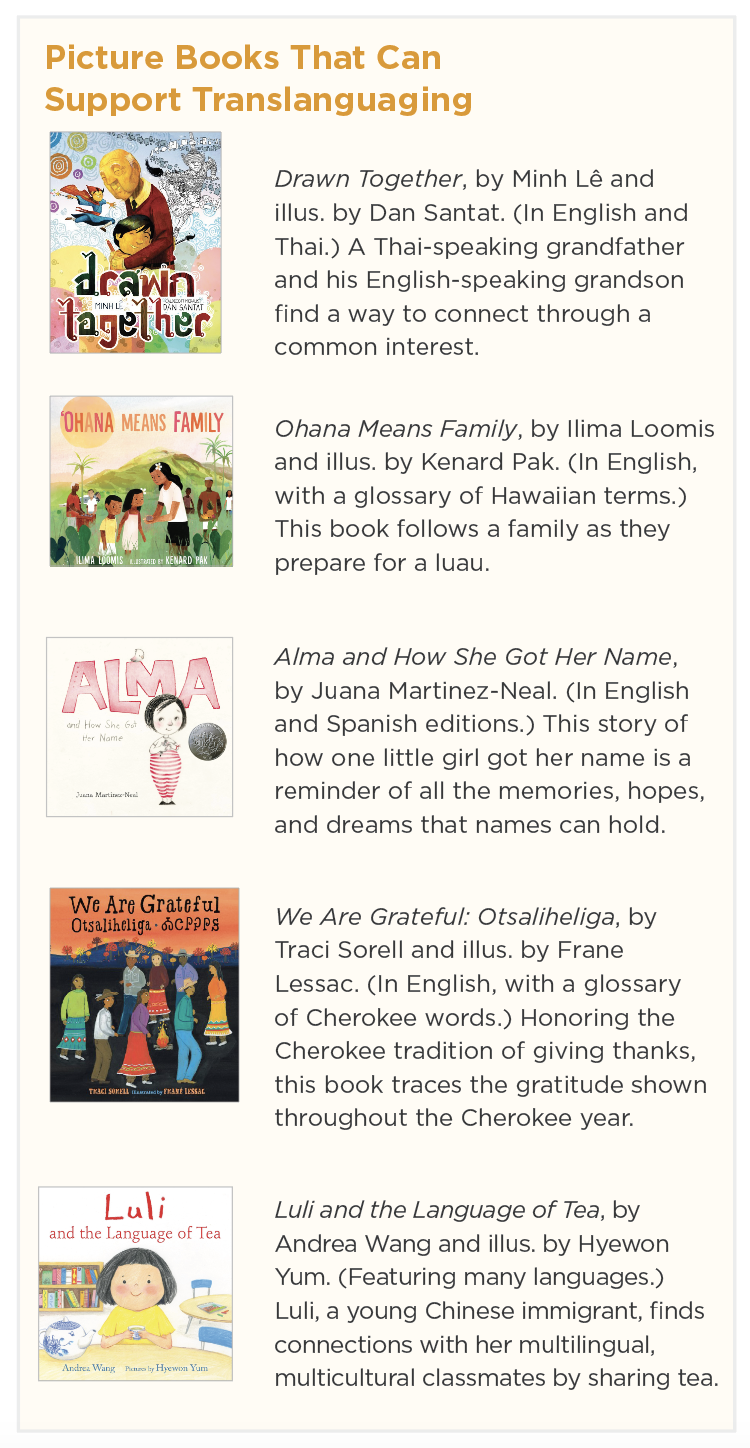
Hearing their home languages in the classroom creates a sense of pride in children’s identities and a feeling of belonging there. Reading books in other languages also nurtures critical thinking, literacy, and communication skills: children who don’t speak the language of the book must closely analyze pictures and make inferences. You can build a class or program library that includes multiple translations of the same book, dual language books, non-English books, and books that model translanguaging (see “Picture Books That Can Support Translanguaging” below).
 Use Art and Play to Encourage Storytelling
Children express themselves through their artwork and play. Encourage them to share the stories and thinking behind their creations in whatever language they’re comfortable. You can voice- or video-record them, then seek translations from families, community connections, or online resources. Very often, children’s stories will have recurring themes. Translations offer a glimpse into a child’s interests and thoughts. You can work to build a child’s English vocabulary by providing English words the next time they tell a similar story.
Conclusion
In an increasingly transnational world, multilingualism is a reality in many spaces, including early learning settings. It brings with it a myriad of social and intellectual benefits—not only for the multilingual speaker but also for the learning community. When teachers create space for and encourage multilingualism, including children’s translanguaging, they positively nurture children’s sense of identities and belonging; foster open-minded, reflective, and lifelong learners; and create more inclusive, equitable learning communities.
Reflection Questions for Educators
Our beliefs and assumptions as educators often drive our actions, lessons, and instructions and create an overall culture for our learning settings. Taking time to think and reflect about our practices can help us uncover and address unconscious biases and move toward a more inclusive, multilingual classroom. Ask yourself:
- How do I perceive emergent multilingual learners and their families?
- Have I made assumptions about their capabilities based on their English language skills or practices?
- Do I engage with or call upon fluent English speakers more often?
- How do I react when children translanguage or use their home languages in other ways in my setting?
- Am I curious about languages and cultures? Am I open to learn from others?
- Do I collaborate with colleagues, families, and the wider community to incorporate multiple languages and cultures into the learning day and curriculum?
- What do my assessments really evaluate? Are they culturally and linguistically responsive?
- How do I evaluate my own teaching practices in terms of effectively supporting multilingual children? Am I willing to address and reflect on potential biases that may surface from this feedback?
Photographs: © Getty Images
Copyright © 2024 by the National Association for the Education of Young Children. See permissions and reprints online at NAEYC.org/resources/permissions.

 This article supports the following NAEYC Early Learning Programs standards and topics
Standard 7: Families
7B: Sharing Information Between Staff and Families
Standard 8: Community Relationships
8A: Linking with the Community