Still on Stage! Engaging Children in Telling and Acting Out Stories to Impact Learning
You are here
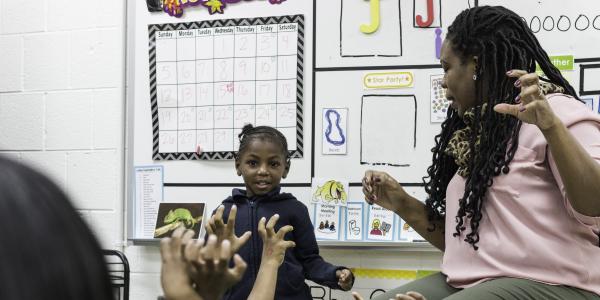
Nearly forty years ago, attendees at NAEYC’s 1987 Annual Conference were invited to visit Vivian Gussin Paley, the teacher and writer who contemplated children’s stories and fantasy play and who popularized the idea of children dictating stories to their teachers and acting them out. As described in a September 2011 interview in Young Children, Paley believed that the combination of story dictation (children telling stories, and teachers writing them down) and story acting (dramatizing the dictated stories without props) gives children opportunities to express themselves, grapple with their concerns, and shape events (Paley 2011). Paley described make-believe (which is inherent to story acting) as a key “thinking tool” for children (91).
Story dictation was not unique to Paley’s setting. Yet she was novel in making it a central activity and pairing it with children’s enactments of their stories (Wiltz & Fein 1996). Long before she passed away in 2019, Paley predicted that these joint practices would endure the passage of time (Lindfors & Paley 2004). Indeed, they continue to be adopted by teachers and explored by researchers like us (the authors) in the United States, Canada, the United Kingdom, and other countries.
Already a NAEYC Member? Log into your NAEYC Membership Portal to read the full article!
Not a member yet? Join now to read the full article!
Diane Pesco, PhD, formerly associate professor in the Department of Education at Concordia University in Montreal, Canada, retired in 2025. This article is inspired by Diane and Andréanne’s collaboration with teachers in initiating story dictation and story acting in their classrooms and research emanating from that project. [email protected]
Andréanne Gagné earned a PhD in Communication Sciences and Disorders from McGill University in Montreal, Canada. She is now a full professor in the Department of Teaching and Learning Studies at Laval University and a researcher with the Quality of Early Childhood Education Services research team. [email protected]