Nurturing Healthy Habits Within the STEAM Curriculum: A Guide for Teacher Planning
You are here
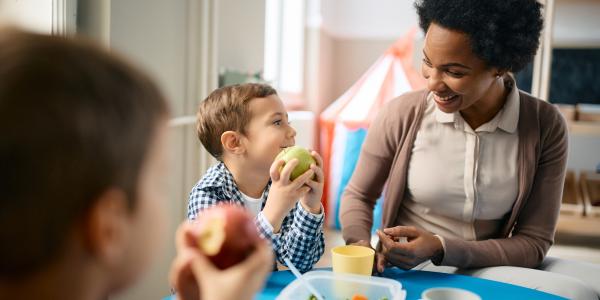
The 4-year-olds in Ms. Sarah’s Mississippi preschool class are using their senses to learn about fruits and vegetables. During small-group time, Ms. Sarah guides the children as they peel and prepare mangoes, kiwis, sweet peppers, and snow peas. As they work, Ms. Sarah talks with them about how these foods contain vitamins and minerals that help their bodies grow and stay healthy.
“Ha-Yoon, which one is easier to peel? Snow peas or kiwi?” she asks. “Lucia, your lips are squished together. How did the kiwi taste? All these yummy foods have lots of fiber and vitamin C. They help keep our tummy bugs happy and help our bodies fight off the yucky germs that make us sick!”
After everyone has had a chance to prepare and taste the food, they create a chart to document their favorites. Besides introducing children to different fruits and vegetables, this activity supports several state learning standards, including for science (compare, sort, classify), physical development (fine motor skills), and math (counting).
Early childhood educators are responsible for ensuring children’s well-being. This includes teaching them about healthy habits, such as eating well and getting enough exercise. Because children learn in an integrated fashion, lessons about health can be threaded into other content areas and developmental domains.
Research shows that active, hands-on science, technology, engineering, arts, and mathematics (STEAM) activities boost children’s creativity, critical thinking, and problem-solving skills. When educators introduce health concepts into STEAM activities, they create holistic learning environments that support children’s cognitive development and physical well-being.
We (the authors) are trainers who work with the WannaBee Healthy curriculum. This program, funded by the National Institutes of Health and the Partnerships to Promote Healthy Lifestyles for Children and Communities, is part of a Science Education Partnership Award designed to assist young children in developing healthy food and activity habits. The curriculum engages young children in playful activities that allow them to explore, express themselves, and think critically as they learn about healthy habits. While designed for preschoolers, activities can be adjusted for other age groups, including toddlers and kindergartners.
In this article, we share ways that educators can adapt their own curricula to integrate health-focused topics into STEAM activities. We also share lesson ideas in a planning document designed to deepen both children’s and families’ engagement and well-being.
Nurturing Healthy Behaviors Early
The healthy habits children develop in the early years have lifelong benefits. Yet despite the importance of young children’s health and well-being, the US Centers for Disease Control and Prevention (CDC) suggests that preschool children spend between 50 and 70 percent of the day sitting down. This increases their risk for developing serious health conditions, like metabolic disorders. The lack of physical activity coupled with poor nutrition has contributed to a rise in childhood obesity. According to a 2024 report by the CDC, 12.7 percent of children in the United States between the ages of 2 and 5 are considered obese.
Early childhood educators can intentionally plan lessons and activities that promote healthy routines and behaviors. Although health and STEAM are often thought of separately, they can be integrated easily. For example,
- Children learn about science and nutrition when they plant, care for, and grow food in a garden.
- They investigate technology when they use magnifying glasses to examine fruits and vegetables or when they engage in digital storytelling around a nutrition or exercise theme.
- Engineering activities with ramps and building materials allow for the exploration of physics concepts in ways that involve movement.
- Asking children to create food-focused art (illustrating a cooking activity, creating playdough models of their favorite fruits and vegetables) helps them to organize and execute ideas, engage in self-expression, and learn about foods that may be new to them.
- Using pretend food items from the dramatic play center to sort or create patterns encourages children to practice math concepts like sequencing and classifying.
Educators can also collaborate with families so that healthy behaviors become habits. For example, in our work, we share ideas with families through a family resource booklet, which includes suggestions for engaging in physical activities and choosing healthy foods. To nurture reciprocal relationships, educators can ask families how they include movement and healthy foods in their daily lives.
Following, we focus on two healthy habits—nutrition and exercise—and show how educators can plan active, hands-on experiences by building on children’s current understanding, creativity, and problem-solving skills. The charts we present are intended as planning documents and include suggestions for family engagement. We also offer instructional adaptations based on each child’s strengths and areas for growth.
Nutrition and STEAM
Early, frequent, and low-pressure opportunities to engage with a variety of foods can support children as they develop healthy eating habits. Educators can weave nutrition into STEAM instruction and the learning environment, often leveraging a single activity (like planting a garden) to support skills across multiple learning areas. As they plan lessons and activities, educators must consider each child’s unique strengths, needs, and goals and opportunities to partner with each family.
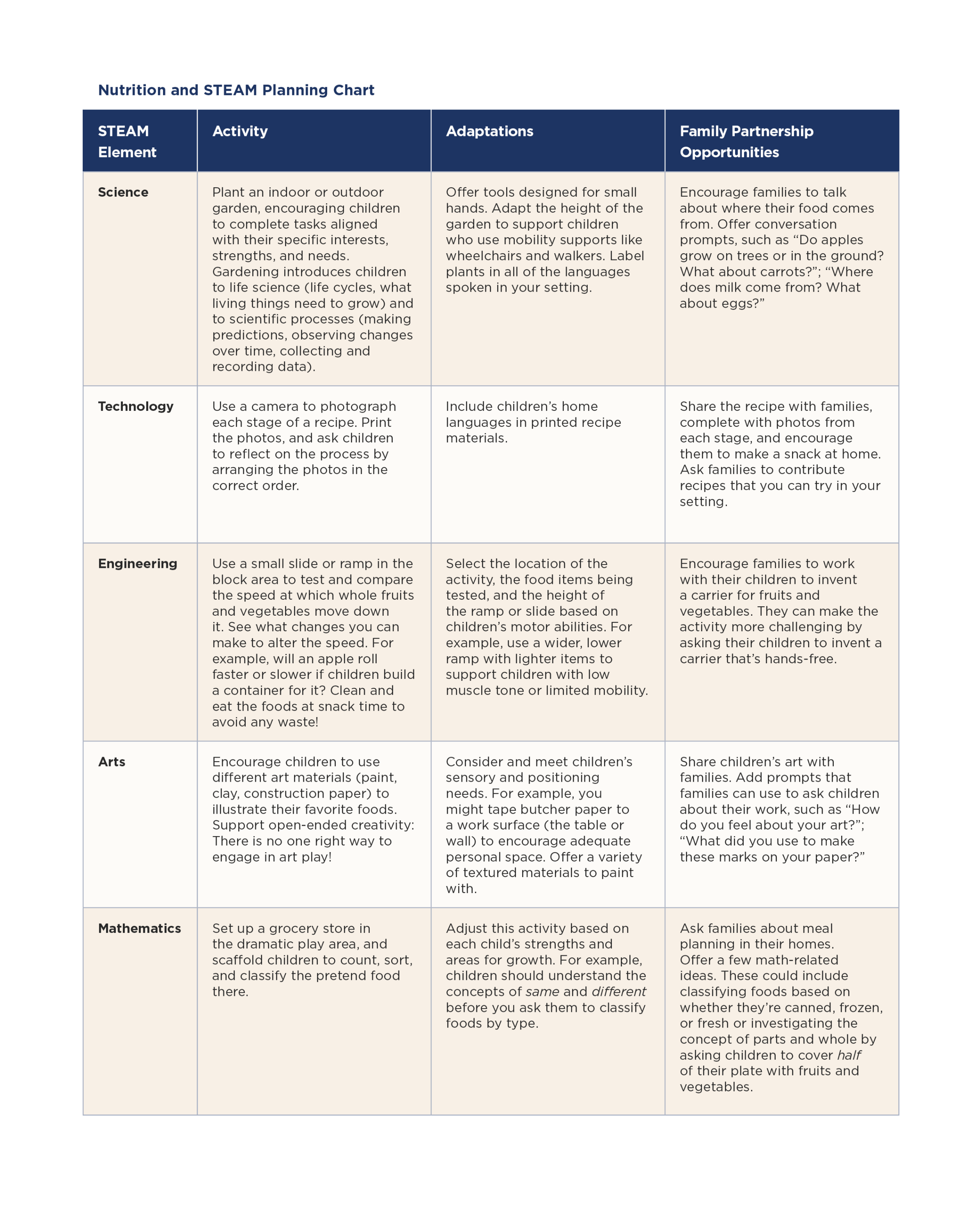
(Click chart to enlarge)
Physical Movement and STEAM
The Society of Health and Physical Educators America recommends preschoolers participate in 60 minutes of planned movement and 60 minutes of unstructured movement daily. To help meet these benchmarks, educators can look for ways to incorporate physical movement into STEAM lessons. They can tailor experiences for children with different abilities by adapting movement and activity locations based on children’s interests and needs. Families can also offer ideas about how their children like to engage in both structured and unstructured movement as they play.
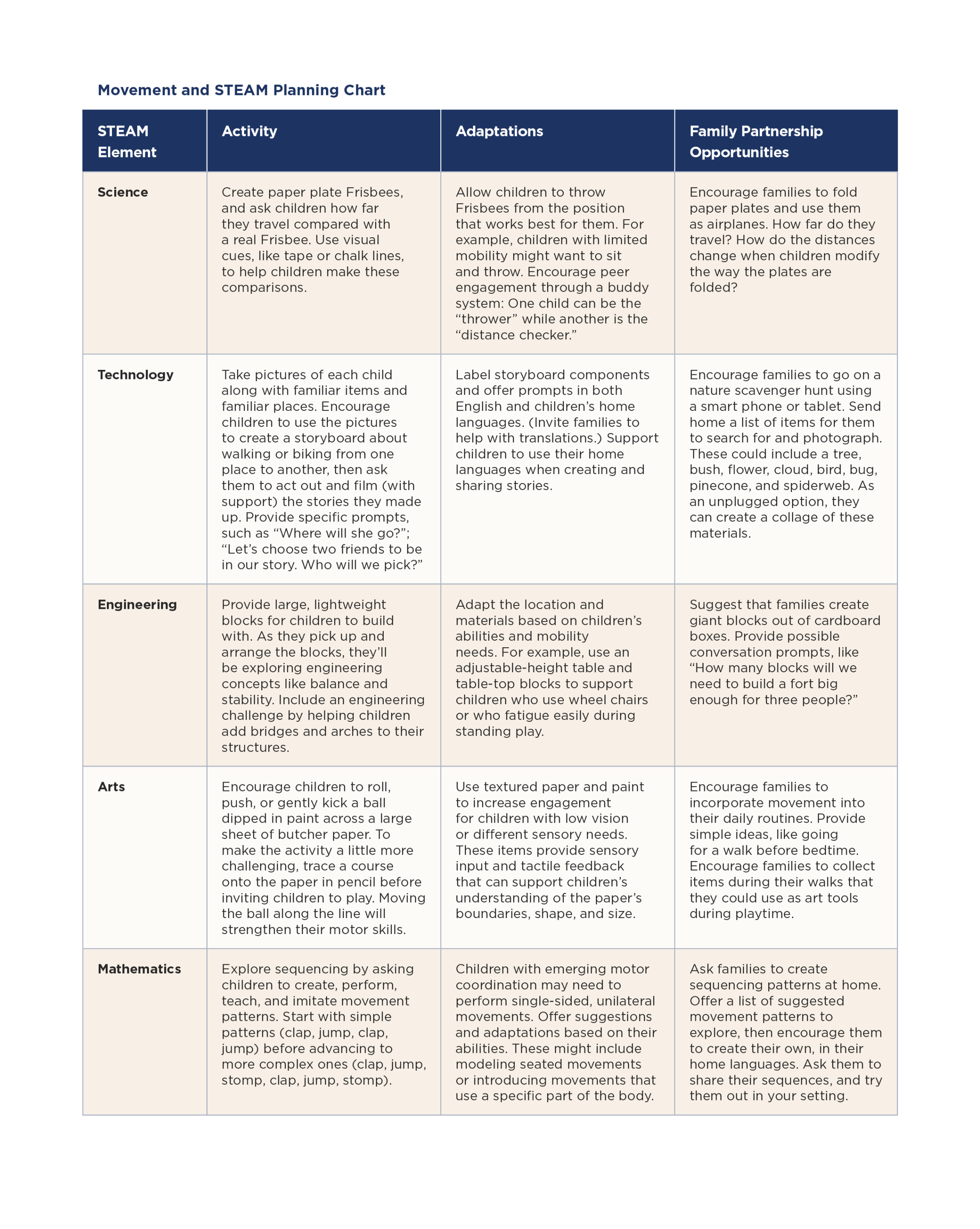
(Click chart to enlarge)
Download and print a blank Healthy Habits and STEAM Planning Chart and integrate movement and/or nutrition into your STEAM curriculum.
Reflecting on Your Setting
Early childhood educators can promote healthy behaviors while also incorporating STEAM concepts that will prepare young children for future learning. To get started in your setting, consider the following questions:
- How can I model healthy behaviors for the children I teach?
- How can I incorporate STEAM explorations into my daily plans?
- How can I use the materials I have to foster healthy eating and active play while exploring STEAM concepts?
- How can I collaborate with families and community partners to support children’s healthy habits?
Further Resources
Healthy Young Children, 6th edition, by Alicia L. Haupt and colleagues. NAEYC, 2024. This book, developed by pediatric physicians, health care providers, and early childhood educators, focuses on how education and health care professionals can work with children and families to promote physical and mental health and provide safe and healthy environments.
“Get Up and Move! Encouraging Physical Activity During the Learning Day,” by Amy August and colleagues. Teaching Young Children, Spring 2023. This article highlights ways that early childhood educators can incorporate fine and large motor skills into daily learning experiences.
“Snack Math! Ideas You Can Taste,” by Rowan Machalow. Teaching Young Children, Summer 2022. The author, a former preschool director and a math and literacy curriculum manager, offers several mathematical explorations teachers can guide during snack and mealtimes.
NAEYC Accreditation
This article supports the following NAEYC Early Learning Programs standards and topics.
Standard 3: Curriculum
Planning and Implementing an Engaging Curriculum to Meet Meaningful Goals
Standard 4: Teaching
Teaching to Enhance Each Child’s Development and Learning
Photograph: © Getty Images. Copyright © 2026 by the National Association for the Education of Young Children. See permissions and reprints online at NAEYC.org/resources/permissions.