Walking Hand-in-Hand on Shared Pathways: A Pedagogical Narrative of Empathy and Multiage Collaboration

You are here
Can we bring kindergartners and toddlers together for meaningful learning experiences? What happens when toddlers and kindergartners are brought together for multiage peer mentorship? What can educators learn from children engaged in multiage peer mentorship experiences?
We (the authors) explored these questions during an experience at an Ohio-based university-affiliated laboratory school. Abbey (first author) and Sara (second author) were previously coteachers in a kindergarten classroom at the school. Currently, Abbey is a PhD candidate and has a research role at the university while Sara is pursuing a master’s degree in education at the university and has remained in her position as a kindergarten teacher. They have continued to collaborate as colleagues. They met Jennifer (third author) when she joined the school as a toddler teacher. Jennifer previously taught for over 15 years in public pre-K and kindergarten classrooms and holds a master’s degree specializing in curriculum and instruction.
We all share a passion for child-led learning and play-based pedagogy infused with outdoor education and inquiry-based exploration. Our school, which serves children ages 18 months to 6 years, believes that children have a right to spend time outdoors each day. One of the ways we as teachers support this belief is by facilitating experiences beyond our school grounds, such as navigating the parks, ponds, and woods surrounding our campus. These spaces have been procured and used by our school over many years. They have become beloved and familiar spaces for the children, who immerse themselves in learning through inquiry and play while there.
In this piece, Jennifer and Sara reflect on an outdoor learning experience that led to increased interactions among kindergartners and toddlers, fostering empathy and belonging for both age groups. After hearing about this experience, Abbey noted that this story could be a powerful vignette to call for further investigation of multiage peer mentorship that focuses on very young children. She then served as a pedagogical investigator and research consultant to help craft this piece.
One School, Many Islands
Through alternating contributions, Jennifer and Sara offer different perspectives on the same experience and share how it affected their own sense of belonging as teachers.
Jennifer
I remember when I was new to the school and wanted to be involved with other teachers in the building but was unsure of how to join the wider school community. I later learned that Sara felt similarly, as if she existed on her own island, apart from the rest of the school. I worked in one of the two toddler rooms, and Sara was now the sole teacher in the only kindergarten room in the school. Despite our shared instructional interests, we seldom had opportunities to collaborate. Due to licensing stipulations, we often found ourselves and our children separated, even though our classrooms were just down the hall from each other. For example, Ohio Administrative Code requires indoor and outdoor spaces for toddlers that are separate from those for older children, thereby limiting interactions between toddlers and other age groups. The seclusion became more apparent as the school year progressed and planning meetings were separated by age groups.
Sara
I began to see that separation shift one spring day, when my kindergarten class and Jennifer’s toddler class passed each other hiking along a path behind our school. As we approached one another, the toddlers were instructed to move over a bit to make way for the “faster kindergartners.” In that moment, I thought about how the toddlers had just as much of a right to be on the path as the kindergartners. What if instead of pushing past and continuing in separate directions, we all walked together?
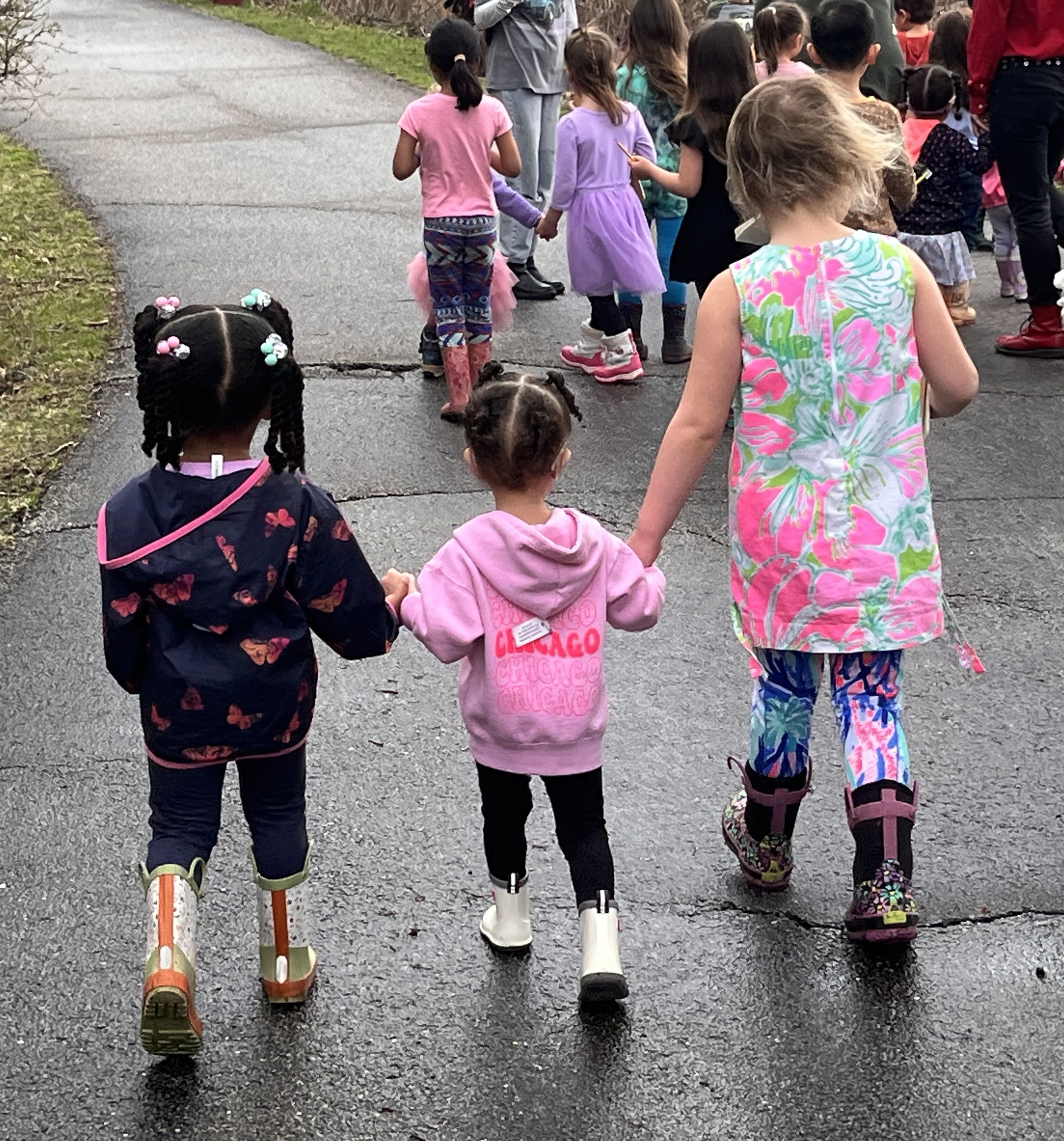
So I asked Jennifer if her class of toddlers would like to come with us to our destination, an established outdoor area our school called the log playground. Jennifer, both surprised and pleased at the invitation, agreed to join us. I then turned to my kindergartners and asked if we could help the toddlers make their way to the log playground, and they immediately and eagerly agreed. The kindergartners instinctively held the toddlers’ hands and walked along at their younger peers’ pace, guiding the group to the log playground.
Jennifer
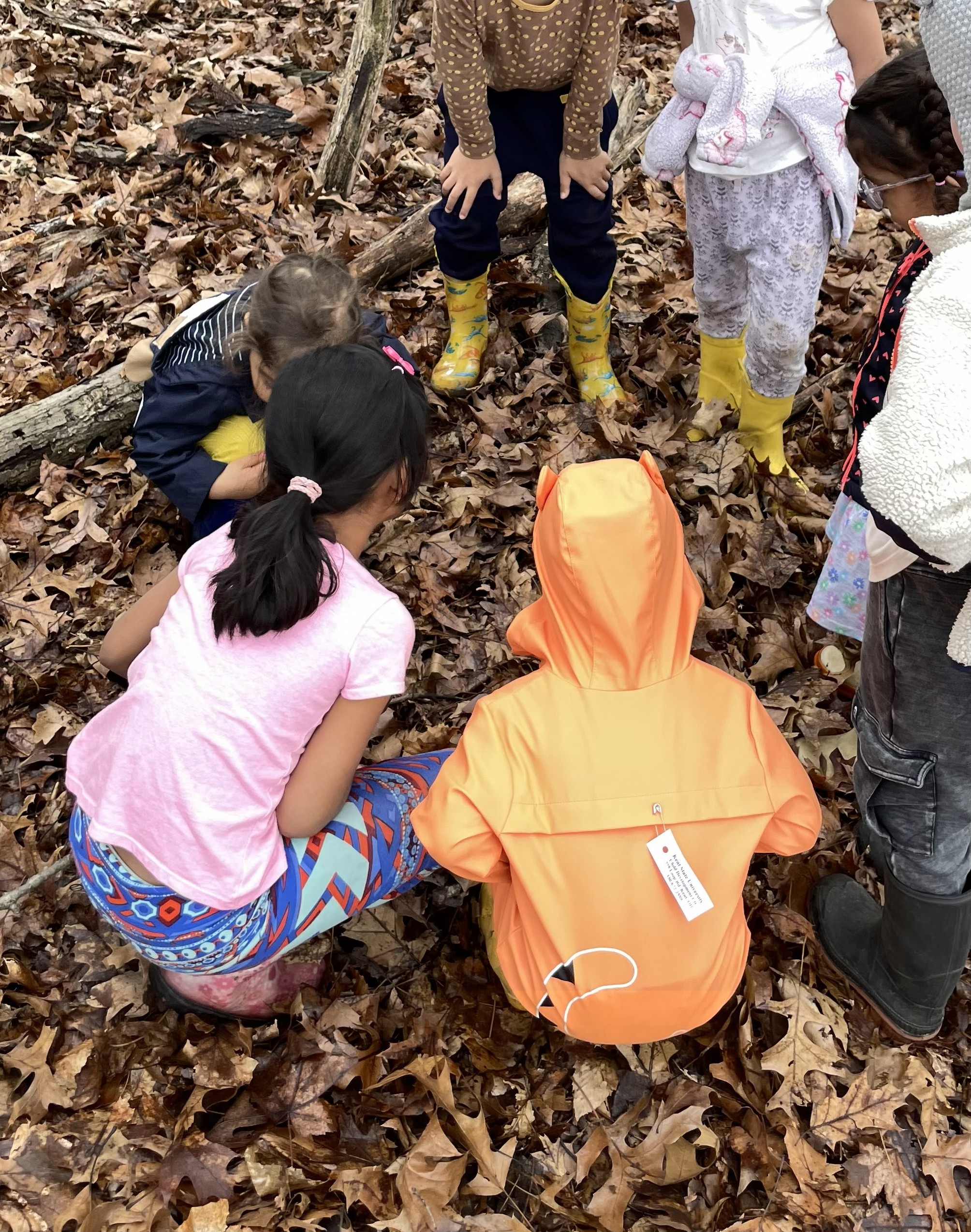 During this walk, we noticed moments of deep empathy and understanding between the two groups of children.
This was a new venture for everyone involved—children and teachers alike. Toddlers are generally not seen as equal participants who can enhance learning partnerships with their older peers. In my experience as a toddler teacher, I had come to expect that the children I work with would simply be brushed by. In this instance, I was ready to do what I always did and move the toddlers out of the way of the kindergartners. So when Sara invited us to come along, it felt like a revelation—a seldom offered, but sincere and welcome invitation.
Community Building Beyond the Classroom
 This experience aligns with existing research regarding the positive impact that multiage peer mentorship has on children’s self-esteem, expression of empathy, interpersonal relationships, sense of belonging, and academic achievement (Karcher 2008; Coyne-Foresi & Nowicki 2020; Howell et al. 2024). Certain curriculum approaches, like Montessori, include children of varying ages in the same setting, which facilitates multiage mentorship among peers (American Montessori Society 2025).
Additionally, enacting peer mentorship in the context of outdoor spaces aligns with other approaches, such as the Reggio Emilia approach, where regular visits into outdoor areas surrounding the school are utilized to develop children’s identity as autonomous and engaged members of their community (Davies 2014; McCann 2014; McCree et al. 2018; Trew & Squires 2019; Heslop & Friedman 2025). While the existing research focuses on peer mentorship with middle and high school students (Karcher 2008; Coyne-Foresi & Nowicki 2020) or mentorship between young children and adults (Heslop & Friedman 2025), our work centers around the possibilities of peer mentorship with young children acting as both mentors and mentees.
Walking Forward Hand in Hand
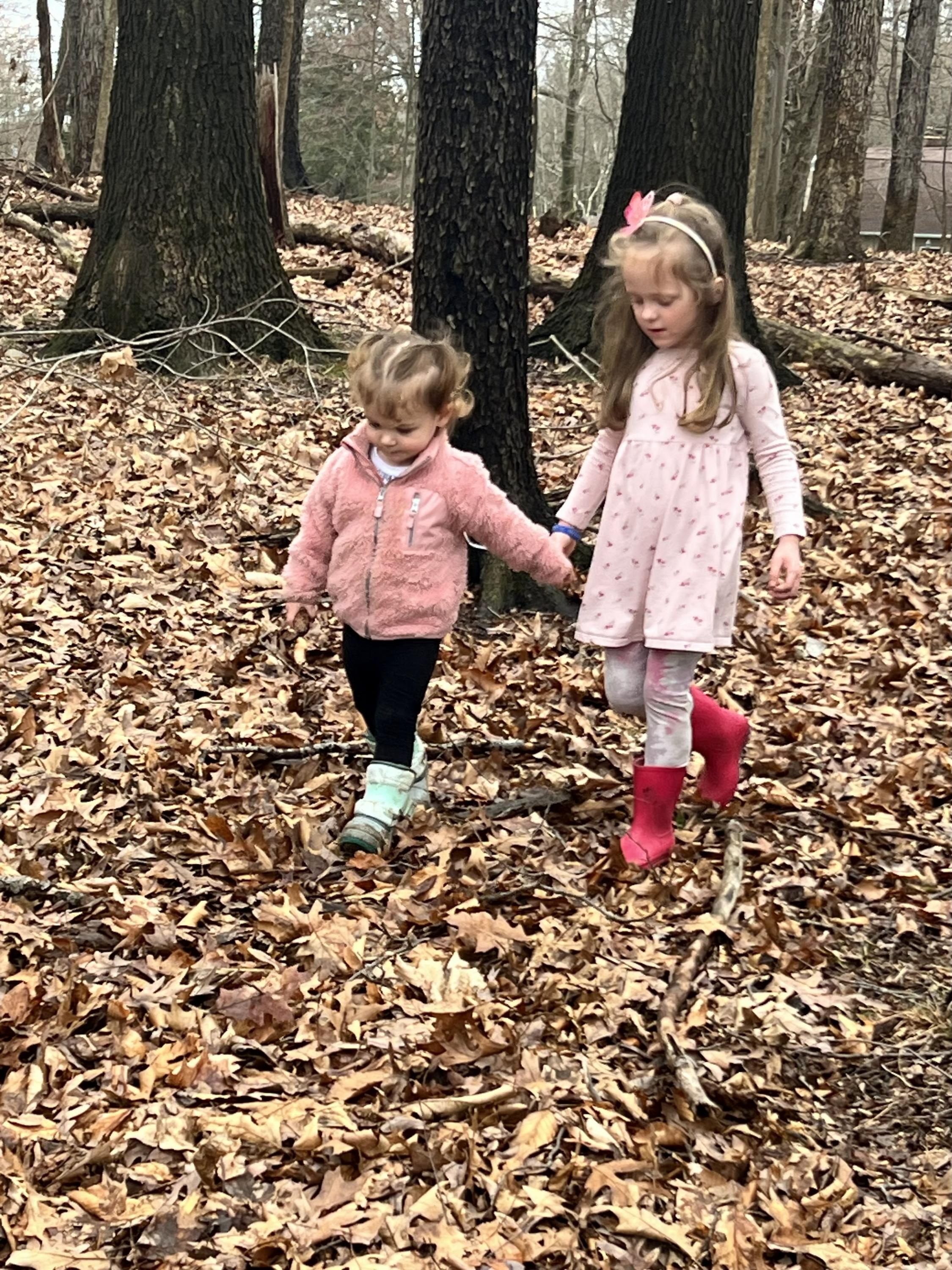
 During their time walking together, the children exhibited a deep sense of understanding and empathy and accommodated their young peers. Kindergartners and toddlers took one another’s hands, with the older children walking at a comfortable pace for the toddlers.
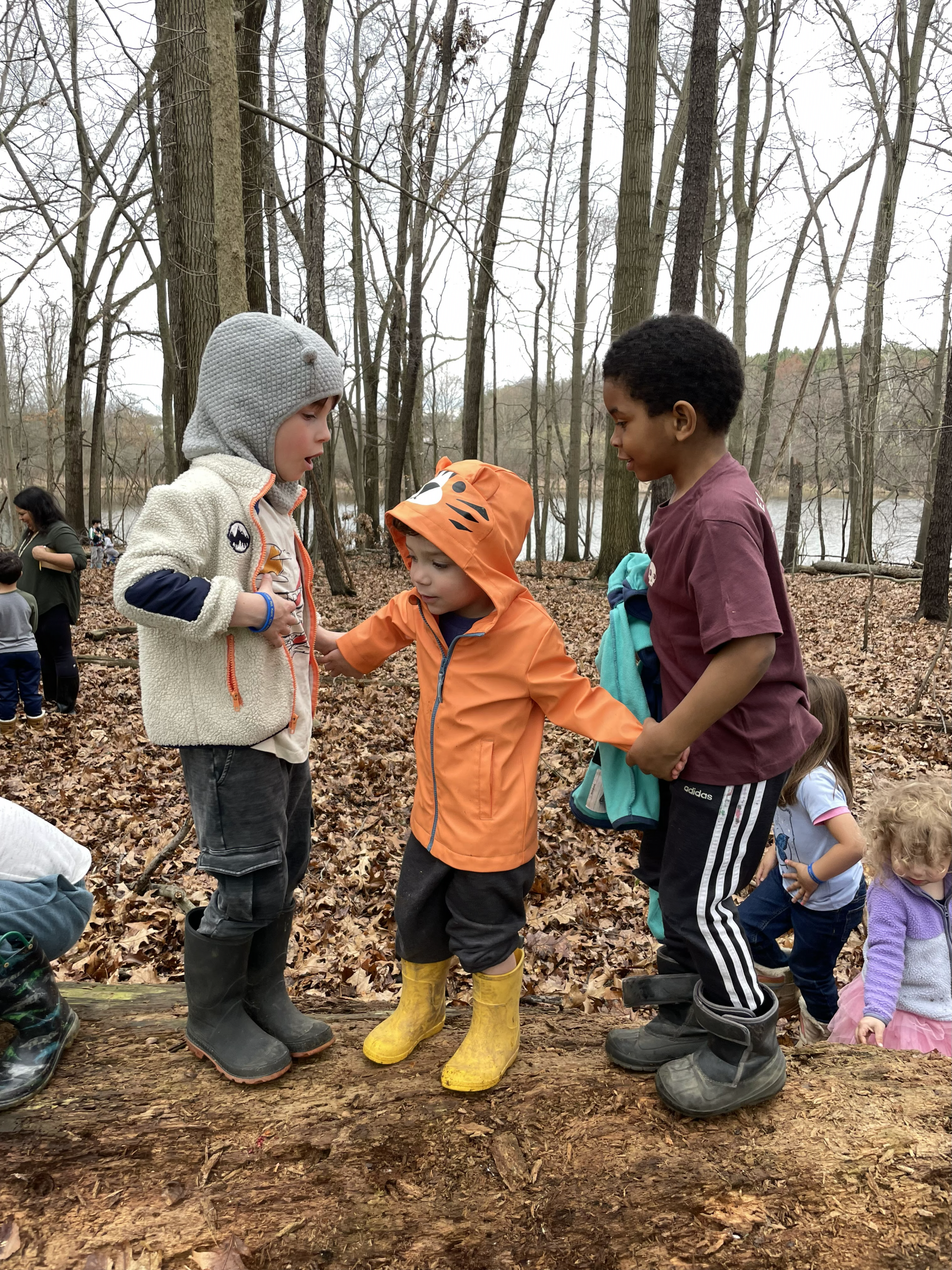
As they explored, the kindergartners took on a natural mentorship role, facilitating safety stops along the walk and modeling how to navigate the outdoor space. The kindergartners aided in the toddlers’ physical safety by holding their hands and acting as guides. The kindergartners also provided psychological safety with warm and enthusiastic words of encouragement. When conversing with the toddlers, kindergartners got down to speak at face-to-face level, changed their voices to a softer tone, and even asked consent to aid the toddlers in taking risks, such as observing bumblebees or balancing on a log. One kindergartner, Dash, said, “It’s okay. I will help you up; it’s not scary.” The kindergartners exhibited empathy by wondering about and acknowledging the feelings and needs of the toddlers and accepted the toddlers as they were.
Through their words and actions, both groups of children showed they were impacted by this experience. Later, many of the kindergartners asked when they could go visit the toddlers again. Chris wanted to know when he could “pick them up” again, as he frequently asked to hug and gently lift the younger children up from the ground. Sabrina shared the memory with her family. She pointed to Lynne, one of the toddlers in the hallway, and said, “Look Mom, that’s my buddy. They were really scared, but we helped them.”
The toddlers were also transformed by this encounter. Although they were hesitant around Sara and her teaching assistants, when the kindergartners approached them, they held out their hands to walk with them.
Not only were they welcomed by the older children, but with their encouragement the younger children traveled farther from the school than they had ever been before and experienced a new area of our beloved meadow. This area, the log playground, was an established outdoor play area that older students often visited. However, each time the toddlers had attempted to visit prior, they would become fussy, cutting the trek short of their destination. On this day the toddlers exhibited newfound stamina not experienced until this moment with the kindergartners.
Throughout the year, the kindergarten class had participated in many lessons about empathy. During this experience at the end of the school year, the children displayed their deep understanding of empathy by enacting it autonomously. The kindergartners were no longer following their teacher; they were the teachers, and they did not take that role lightly. They became dedicated guides, acting based on their feelings of caring. We had not considered how such interactions would spur empathetic engagement and extend learning opportunities.
Expanding Our Expectations for Meaningful Engagement
 This moment went beyond what felt like an unlikely partnership and served as the catalyst for bonding within our school community. This work, then, is an example of teacher research: We followed our inquiries, and we gained insight about ourselves and our students that eventually led to changes in our practice. We wondered whether toddlers and kindergartners could collaborate, despite assumptions that toddlers are too developmentally different for meaningful collaborations with their older peers. The Ohio Administrative Code requirement that indoor and outdoor spaces for toddlers are separate from those for older children may contribute to such assumptions. Additionally, research reflects this assumption, as studies regarding multiage peer mentorship focus on children of elementary school age and older (Karcher 2008; Coyne-Foresi & Nowicki 2020; Heslop & Friedman 2025). However, the partnership between Jennifer’s class and Sara’s class challenged our own expectations about collaborations between kindergartners and toddlers. It made us wonder what was possible—when and how multiage interactions could occur while ensuring each child’s physical and psychological safety.
This walk also brought us (Sara and Jennifer) together and enabled us to realize our challenges were mutual, especially feelings of loneliness and isolation. Inspired, we have continued thinking about other opportunities for continued collaboration, including more walks, reading buddies, and playground visits. We are also considering how the kindergartners’ empathetic engagement can offer support during the toughest part of the year, when toddlers enter the classroom for the first time. Our hope is that other educators will consider the possibilities of multiage peer mentorship and embrace collaboration with very young children in their settings.
Although our minds are filled with possibilities, we know one thing for certain: We no longer want to be in isolation. Our partnership enabled us to reimagine who can collaborate, regarding teachers and students alike. Our laboratory school setting gives us the freedom to implement innovative ideas. Still, it took courage for us, as teachers, to advance into uncharted territory. We acknowledge that teachers may feel apprehensive when faced with uncertainty or undefined outcomes. But through inquiry and reflection, we can explore new approaches and improve our practice.
We wonder how many opportunities for such collaboration may be overlooked, especially in a national climate that may lead some to underrecognize the work of early childhood professionals and disregard what can be learned from our youngest children. We believe that children of all ages are curious and capable learners. We invite teachers to consider taking the path they previously thought inaccessible and to walk hand-in-hand with the youngest members in their settings.
Photographs: Photos courtesy of authors
Copyright © 2025 by the National Association for the Education of Young Children. See Permissions and Reprints online at NAEYC.org/resources/permissions.
References
American Montessori Society. 2025. "5 Core Components of Montessori Education." AMSHQ. amshq.org/the-ams-difference/core-components-of-montessori.
Coyne-Foresi, M., & E. Nowicki. 2020. “Building Connections and Relationships at School: Youth Reflect on Mentoring Their Younger Peers.” The Journal of Early Adolescence 41 (2): 332–62.
Davies, B. 2014. Listening to Children: Being and Becoming. Routledge.
Heslop, K., & S. Friedman. 2025. “ ‘I Want to Go to the Bat Den . . . Are You Coming?’ Investigating Opportunities for Intergenerational Participation in Forest School.” Journal of Early Childhood Research 23 (3): 252–67. doi.org/10.1177/1476718x251318880.
Howell, J., M. Kellogg, M. Youssef, & S. Zeffler. 2024. Reflection, Perspective-Taking, and Social Justice: Stories of Empathy and Kindness in the Early Childhood Classroom. Redleaf Press.
Karcher, M.J. 2008. “The Cross-Age Mentoring Program: A Developmental Intervention for Promoting Students’ Connectedness Across Grade Levels.” Professional School Counseling 12 (2).
McCann, L.A. 2014. “Mapping the School: A Reggio Emilia-Inspired Activity Helps Children Learn About Their Community.” Young Children 69 (1): 16–20.
McCree, M., R. Cutting, & D. Sherwin. 2018. “The Hare and the Tortoise Go to Forest School: Taking the Scenic Route to Academic Attainment via Emotional Wellbeing Outdoors.” Early Child Development and Care 188 (7): 980–996. doi.org/10.1080/03004430.2018.1446430.
Trew, V., & K. Squires. 2019. “Encounters with Reggio Emilia: Relationships, Equality, and Citizenship in our Early Learning Setting.” Journal of Childhood Studies 44 (5): 13–23. doi.org/10.18357/jcs00019329.