Creating a Sense of Belonging in a Toddler Classroom (Voices)
You are here
Observing and Reflecting to Support Children’s Interactions
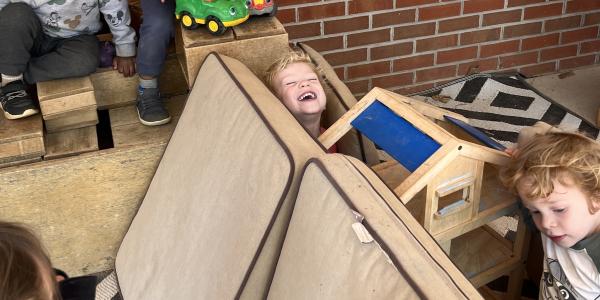
Ben, age 3, is a collector. One Monday morning, Ben starts collecting on a large scale. He dumps out all of the available scarves, places a chair on top of them, and pushes them all around, saying “My moppah! Ook, Iz, I moppin juze,” with a huge smile on his face. The play takes up a lot of space as Ben moves from one end of the classroom to the other. It also creates a lot of joy. Ben’s happiness when he pretends to mop radiates through his big smile and giggles as he pushes his “mop.” This action spreads to the other children, including Liam, Amy, and Greg. They join in with Ben, grabbing their own “mops” (chairs) and pushing them around the room.
I have been an educator of young children for eight years. In my current role, I work at the University of Tennessee, Knoxville’s Early Learning Center for Research and Practice as a looping infant and toddler teacher, which means that I remain with the same group of children for several years. For the past three years, my co-teacher, Jess, and I have looped with the same group of 12 children, ages 2 and 3.
Photographs: courtesy of Liz Braddock. Copyright © 2026 by the National Association for the Education of Young Children. See Permissions and Reprints online at NAEYC.org/resources/permissions.
Liz Braddock holds a master’s degree in child and family studies with a concentration in early childhood education and currently works as a looping infant/toddler educator at the University of Tennessee, Knoxville Early Learning Center. [email protected]