Guided Play as a Tool to Support Children Experiencing Trauma
You are here
Stressful and traumatic events, such as violence, weather disasters, family separation, and racism, affect almost half of all children nationally. These adverse occurrences can happen during a single event, or they can be ongoing. They disproportionately affect children from historically marginalized groups, further compounding the systemic inequities these children and families already face (Sacks & Murphey 2018; Allwood et al. 2021).
Researchers have linked early adverse experiences to negative outcomes as children grow, particularly if they experience multiple stressors or ongoing trauma. Their sense of safety, power, and personal value can be negatively affected (SAMHSA 2014). If not addressed, children who have experienced ongoing trauma are more likely to experience future mental health issues, substance abuse, physical health issues, and diminished professional and educational opportunities (SAMHSA 2014; Erdman & Colker, with Winter 2020).
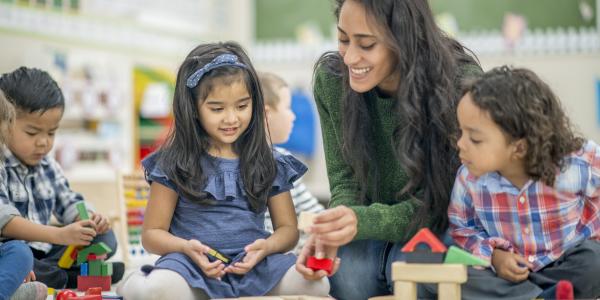
Photograph: © Getty Images. Copyright © 2026 by the National Association for the Education of Young Children. See permissions and reprints online at NAEYC.org/resources/permissions.
Katie Fields, PhD, is an assistant professor of early childhood education at the University of Central Oklahoma in Edmond, Oklahoma. Her research focuses on trauma-responsive teaching practices. She is a foster parent and co-author of From Breakdowns to Breakthroughs. [email protected]
Emily Spivey, PhD, is an assistant professor of early childhood at the University of Central Oklahoma in Edmond, Oklahoma. As an early childhood and preservice teacher educator, her passion for play leads her teaching and research.
Barb Carter, DEdM, is assistant chair and early childhood education faculty in curriculum and instruction at the University of Central Oklahoma in Edmond, Oklahoma. She has extensive experience ranging from preschool to university classrooms, and her expertise includes family engagement and partnerships.