“The Pedagogy Bends Around Each Child”: Reflections on Incorporating Guided Play Throughout the Day
You are here
Editors’ Note
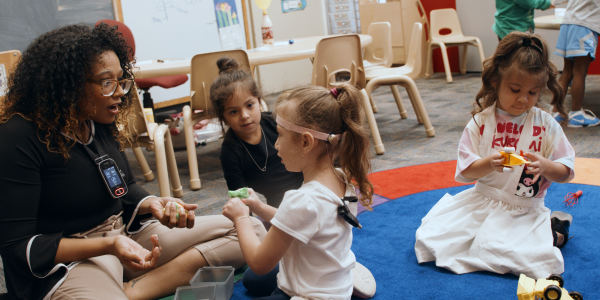
Lauren Fleming works with Deaf and hard-of-hearing children in a prekindergarten classroom in the Dallas Independent School District in Texas. She teaches to a variety of strengths and areas of growth: Children enter the program on their third birthdays; some wear cochlear implants or hearing aids, some use American Sign Language, and many are acquiring language through multiple modalities.
Guided play is a key way that Lauren addresses children’s language, academic, and Individualized Education Program (IEP) goals. Following, she shares how she designs guided play experiences to scaffold children’s learning, how she assesses children’s progress, and how she embeds guided play into a prescribed curriculum.
How do you use guided play to support learners’ unique strengths, interests, and needs in your setting?
When I set up a guided play environment, I am thinking about three or four specific children’s goals at once, not a generic group plan. For example, the dramatic play center might be supporting a vocabulary goal for one child, an executive function goal for another, and a peer interaction goal for a third. The materials are shared; however, the scaffolding I plan and the data I track shift depending on which children are in the center at a given time.
When planning these experiences, I draw on three sources: Formal evaluation data, ongoing classroom observation, and information shared by families.
Evaluation data like speech and language assessments, developmental screenings, and a child’s IEP give me a starting picture. This information is useful, but it often measures performance under very specific conditions. (Think about the child who can communicate in the classroom but who scores below age expectation on a standardized set of questions given in an unfamiliar room with an unfamiliar adult.)
Classroom observation fills in what evaluations can miss. I watch a child during arrival, during transitions, and during play. I notice what they reach for, who they orbit toward, what frustrates them, and what they return to again and again. That observational work is the strengths picture, and I plan from strengths whenever I can.
The family is the third key source. Families see their children in contexts I don’t have the opportunity to witness. As an early childhood Deaf educator, I have learned to ask families specific questions, like “What does she love right now?”; “What is something he does at home that surprises you?”; “What is hard for them?” Families’ answers shape my planning sometimes even more than evaluation data because they tell me where a child’s intrinsic motivation lives.
How do you plan for and set up guided play experiences?
Intentionality is the difference between guided play and free, or self-directed, play: Guided play always has a learning goal attached to it that teachers support with scaffolding. The materials look the same. The preparation does not.
For example, before I open the grocery store dramatic play area, I have already decided on several things:
- The first is the vocabulary I’m targeting. I usually identify six to eight words for the week, mapped to specific children’s IEP goals. For the grocery store, these might include spatial words like inside, on top, and next to; categorical words like produce, dairy, and bakery; and functional phrases like how much, can I have, and thank you. The words go on a small reference card I keep nearby, so I don’t drift away from them as children’s play unfolds.
- The second is the social interactions I’m setting up. The grocery store needs at least two roles to function—customer and cashier or stocker. That structural requirement means children have to negotiate roles, which supports those who are working on peer initiation and those who are working on conflict resolution.
- The third is the problem-solving moments I’m seeding. I deliberately place items where children will have to ask for help to reach them. I leave the cashier station with a “broken” register that prompts a workaround. I include items that are not on anyone’s shopping list. These are not accidents in the environment; they are provocations.
How do you individualize for each child within that broad plan?
Individualization happens through scaffolding. If a child is working on three-word combinations, I use parallel talk that models that structure: “You found the milk. The milk is cold.” With a child working on peer initiation, I pretend to be a customer and direct my questions to a peer. With a child working on auditory comprehension, I wait to introduce visual cues until the child asks for one.
I also respond to individual needs by closely observing the play. If a child appears over-stimulated, I pull back my scaffolding and let the play settle into its own rhythm. If a child is under-engaged, I bring in a prop or take on a role that invites them in. If a peer interaction is breaking down, I narrate what I’m seeing—not to fix the situation but to name what is happening, so the children can recognize what’s happening and decide what to do.
When compared to self-directed play, the activity is the same, and the materials are the same. But the pedagogy bends around each child. This is what makes guided play sustainable for me as an early childhood Deaf educator. I’m not running three different lessons for three different children. I’m running one well-designed center and scaffolding it three different ways.

You teach in a specific context. What are the benefits of guided play in your work with Deaf and hard-of-hearing children?
Hearing children learn enormous amounts of language by overhearing the world around them. They pick up turns of phrase, social conventions, emotional vocabulary, and problem-solving language from the ambient classroom and the real world.
Deaf and hard-of-hearing learners in my setting often cannot rely on this kind of incidental learning. Guided play is one of the most powerful ways I have of intentionally integrating that learning into their environment.
For example, we had a moment in the dramatic play area where two children wanted to be the cashier at the grocery store. The conflict was real, and the language was breaking down. One child grabbed the register; the other started to cry. I sat down between them and narrated what I was seeing: “It looks like you both want the cashier job. What could we do?” I made the social problem visible, but I didn’t solve it. After a few seconds, one child said, “I be cashier first. You next.” This allowed for the solution to emerge from the children themselves.
A critical detail is that this exchange happened in front of three other children playing in the same center. They learned language to reduce conflict by witnessing it in a play context that mattered to them. By the end of the week, I had heard “I be _____ first; you next” used two more times by children who had not been directly involved in the original conflict. The incidental learning channel was working. It was just engineered rather than accidental.
This is one of the most important things guided play does in my setting. It makes social thinking visible, models language in functional contexts, and gives my children the same exposure to social problem solving that hearing children get without as much effort.

How do you assess children’s learning during these guided play activities?
I do two things at once. The first is a brief language sample: I sit nearby with a notepad and tally targeted language structures (spontaneous, elicited, prompted, absent) during a three- to five-minute window. The second is anecdotal: I make a quick note after the session about anything notable a child did. Over weeks, the tallies and the notes together produce strong evidence of progress.
Your school uses a prescribed curriculum. How do you embed guided play within it?
Our curriculum gives me the what: The themes, the targeted skills, and the suggested activities. It provides a general order in which to do the activities. But it doesn’t dictate the how. That is where guided play lives.
For example, a unit on community helpers might suggest a structured whole group lesson that uses picture cards to introduce vocabulary. I take the same vocabulary and concepts and incorporate them into a dramatic play center themed around the post office, the doctor’s office, or the grocery store. I will pre-teach key vocabulary, then add tangible items or picture cards to the center. The children meet the curricular vocabulary targets through play that they direct themselves. The curriculum’s scope and sequences are honored, but the pedagogy is mine.
You currently work with preschoolers, but you have worked in the primary-grade space. How did you ensure that guided play was part of children's experiences in kindergarten through grade 3?
The pressure to abandon play in these grades is real. Standardized assessments, pacing guides, and a common assumption that children past kindergarten are past play all push toward an overemphasis on direct instruction. The research, however, doesn’t support that move. Guided play benefits K–3 learners as well as preschoolers.
What worked for me as a primary-grades educator was being deliberate about three things:
- The first was using standards-aligned language. A center where children built and compared structures while exploring community helpers wasn’t labeled “block play” in my lesson plans. It was “geometry and spatial reasoning practice with manipulatives and thematic vocabulary integration.” The activity didn't change, but the framing did. Administrators reading my plans needed words that mapped to the standards we were accountable for.
- The second was making the connection between play and learning outcomes visible to families. I sent home a brief newsletter every other week with a photograph of one center activity, the standard it targeted, and a short note on the learning I had observed. Families who initially worried that their children were “just playing” began asking when the next themed center rotation would happen.
- The third was documenting learning in ways that would hold up at family-educator conferences and grade-level meetings. For example, in a winter-themed geometry center, children built shapes from toothpicks and sugar cubes, then sorted the structures by attribute. I observed their sorting groups and asked the children to explain their reasoning. I transcribed what they told me and recorded a brief, anecdotal note for each child. The evidence of learning was authentic, and families could see what I was assessing as well as the fun their children were having. Both administrators and families came to trust these guided play practices once they saw children’s learning.
How can early childhood educators apply what you’ve learned to their own settings?
My advice to educators is to reframe: Rather than seeing a prescribed curriculum as the enemy of guided play, think about the curriculum as the menu of what needs to be taught. Guided play is one method of teaching it. Both can coexist. A both/and perspective is supported by research, and my classroom data support it clearly too.
In the same way, “play versus rigor” is the wrong framing. Rigor is not about how hard something looks; it’s about how durable the learning is, how generalizable or transferable it is to other contexts. Children can hit serious academic goals while still being curious and engaged and having agency in their day. Some of the strongest language and problem solving I see comes out of guided play, and I think that’s because the children are invested—what they’re doing feels real to them.
Photographs: courtesy of Lauren Fleming. Copyright © 2026 by the National Association for the Education of Young Children. See permissions and reprints online at NAEYC.org/resources/permissions.