Family Asset Tests Need More Clarity and Consistency Across States

You are here
Under the Child Care and Development Block Grant Act (CCDBG), families are eligible for child care subsidies only if their assets do not exceed $1 million, as self-certified by the applicant. However, federal statute or regulations do not further specify which assets should be included or excluded when applying this limit, leaving states to make these determinations. As a result, approaches to defining and assessing countable assets vary widely across states, leading to inconsistency in both policy and implementation.
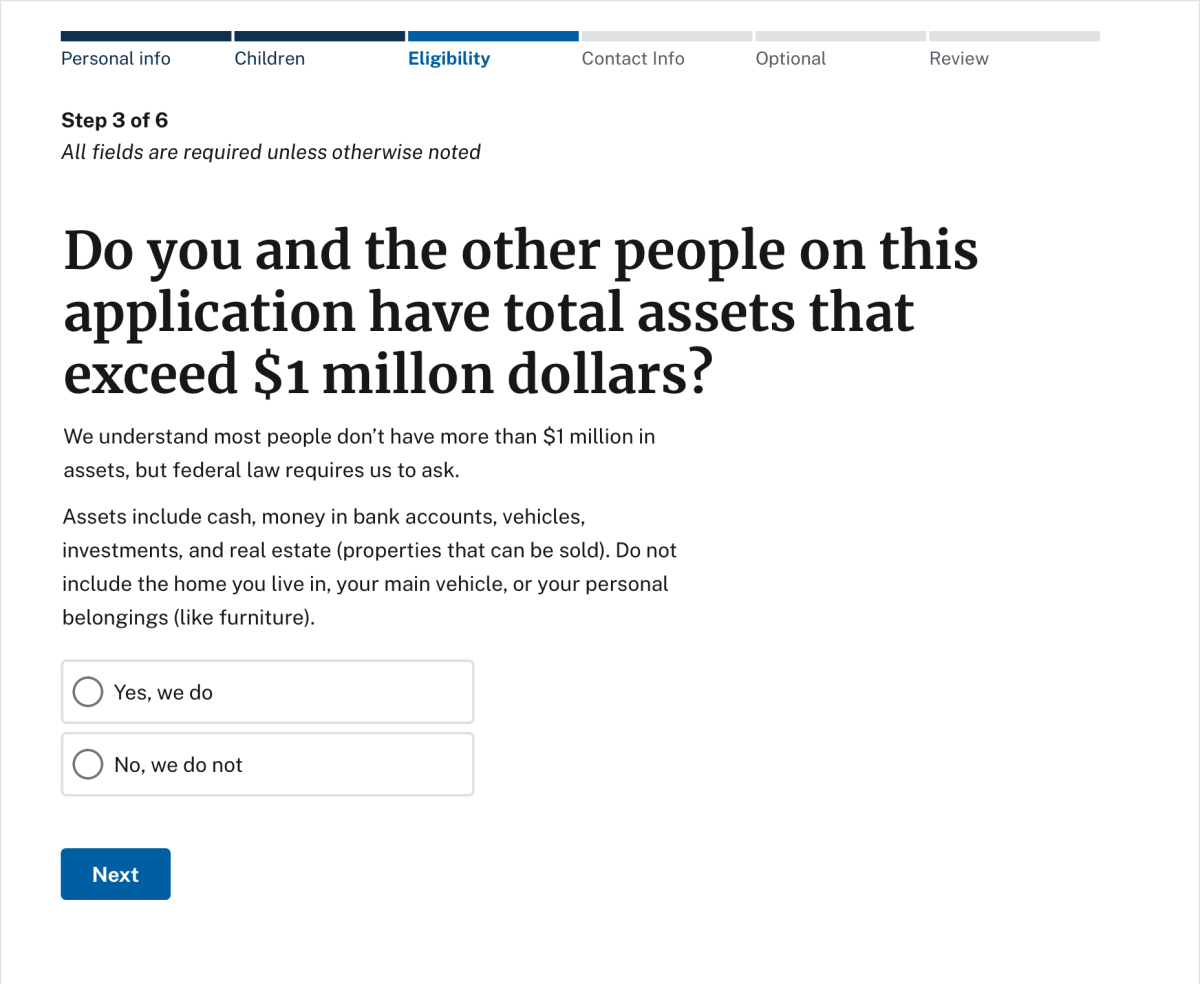
Current guidance from the Administration for Children and Families (ACF) recommends including assets such as cash, bank accounts, vehicles, investments, and real estate (i.e., properties that can be sold), while excluding a family’s primary residence, primary vehicle, and personal belongings such as furniture (see photo). Because this guidance is not codified in federal statute or regulation, states lack clear and consistent direction on what asset information to collect from families and how to apply it in determining eligibility. In practice, these inconsistencies can lead to requirements that stray from ACF’s guidance. For example, Idaho requires applicants to report all household resources, including homes and vehicles, contrary to ACF recommendations to exclude these assets. Massachusetts requires families to certify that total household assets—including real estate, vehicles, equipment, jewelry, and livestock—do not exceed $1 million, and Rhode Island asks applicants to report details about vehicle ownership.
Transparency for applicants is also uneven. Some states provide detailed explanations of countable assets in subsidy flyers (like Washington), under the eligibility section of their website (like New Jersey), or in publicly accessible program memos (like Vermont). In others, this information is difficult to find in family-facing materials and may appear only in a single application question asking applicants to certify that their assets fall below $1 million, often without clarifying what qualifies as an asset. This lack of clarity can create confusion for families.
Despite these challenges, recent policy discussions have focused less on clarifying asset definitions and more on lowering the overall asset threshold. In 2026, draft legislation has been shared at the federal level and a bill moved in Idaho (which ultimately failed) that would reduce the asset limit from $1 million to $500,000. Lowering the asset threshold to $500,000 could disproportionately harm low-income families—particularly those in high cost-of-living areas, rural families who own farmland, and those in communities with rising home values—where non-liquid assets, especially housing, may make families appear asset-rich despite having incomes low enough to qualify for child care subsidies.
This concern is especially relevant given current housing market conditions across the country. According to Redfin Monthly Housing Data from May 2025, there are 16 states with median home prices over $500,000 (listed in the chart below). In these states, families may exceed a lower asset threshold due to home values alone, despite having incomes low enough to qualify for child care subsidies. Similar challenges may arise for families in rural areas who own farmland or for those in rapidly appreciating housing markets.
This variation underscores the need for clearer federal standards to ensure consistent, transparent, and equitable implementation of asset limits across states. Rather than lowering the asset threshold, policymakers should prioritize codifying clear asset exclusions in federal statute or regulation, such as a family’s primary residence, primary vehicle, and personal belongings, to ensure these assets are not counted toward eligibility limits. Establishing these standards is an easy fix that would promote greater consistency across states and prevent families with non-liquid assets from being inaccurately deemed ineligible for child care subsidies.
Family Home Prices and Child Care Subsidy Asset Test Questions
| State | Median Single-Family Home Price (2025) | Child Care Subsidy Asset Test Application Prompt |
| CA | $906,500 | Applications vary by county, unable to verify application questions around asset tests. |
| $671,100 |
Do you or your additional guardian/spouse have any liquid resources? YES/NO. Liquid resources are cash assets that may include (but are not limited to): cash on hand, money in checking or savings accounts, saving certificates, stocks or bonds, or nonrecurring lump sum payments, etc. If YES, you’re required to provide the amount of your liquid resources in dollars $______________ REQUIRED: Do you or your additional guardian/spouse have any non-liquid resources? YES/NO. Non-liquid resources are non-cash assets that may include (but are not limited to): licensed/unlicensed automobile, RVs, real property, etc. If YES, you’re required to provide the current dollar value of your non-liquid resources $_______________ |
|
| CT | $523,600 | Does your household have assets that exceed $1 million in value? Select YES/NO |
| DC | $1,360,000 | Does your household have assets (i.e. real estate, bank accounts) in excess of one million dollars ($1,000,000)? YES/NO |
| HI | $957,800 | Total assets in Applicant and/or Co-applicant’s names, including ownership or partial ownership of property located in Hawaii and elsewhere, business or corporations, vehicles, jewelry, etc., but excluding any equity value in the home which is the usual residence of the household and excluding any equity for one vehicle.) TOTAL ASSETS value exceeds $1-Million U.S. dollars YES/NO |
| ID | $505,300 | Tell us about all resources your household owns, including cash on-hand, stocks, bonds, mutual funds, 401Ks, IRAs, trusts, CDs, life insurance policies, burial funds, etc. Tell us about all other property (including your home) owned by anyone in your household. This includes land, buildings, rental properties, etc. Tell us about everyone in your home who has sold, transferred, or given away cash, property, vehicles, or other assets within the last five years. |
| MA | $702,400 | (Initial) I certify that my household does not have assets with a combined value of more than $1 million. Assets are valuables including, but not limited to, all houses or other buildings, real property, vehicles, cash, bank accounts, cash value of life insurance policies, trusts, stocks, bonds, and overall business value, including equipment, jewelry, livestock, or other goods. |
| MD | $552,300 |
Do you have assets of one million dollars? YES/NO Note: this form is from 2023, and Maryland has frozen subsidy applications since 2025, so this form may no longer be in date. |
| MT | $538,300 | Does your household have family assets over one million ($1,000,000)? YES/NO |
| NH | $541,400 | Provide details on the following assets within the application: checking/savings, life insurance, stocks/bonds/CD, annuity, trust, IRA, cash on hand, vehicle, other assets like Venmo, Pay Pal, and Cash App. Within 10 calendar days after the change happens, you must notify the Department about the following changes: resources (e.g., cash, stocks, bonds, money in a bank or savings account, real property) of all members of the AG exceeds a combined $1 million; |
| NJ | $575,000 | Do your family’s assets exceed $1,000,000.00?: Yes/No |
| NV | $500,700 |
Does your household have assets with a value over one million dollars ($1,000,000)? If yes, type of asset? Online application includes more detailed questions about assets, including property and housing. |
| NY | $586,400 | RESOURCES – I confirm that my family resources are not more than $1,000,000. |
| OR | $543,600 | My family assets do not exceed one million dollars ($1,000,000). Check box it true. |
| RI | $528,600 |
Do you, your spouse, or anyone in the household own, and/or have registered in his/her name any vehicle? YES/NO. If yes, complete the boxes of information for each vehicle Certain resources/assets such as bank accounts may count toward your eligibility depending on which program you are applying for. Certain resources/assets may not count, such as a home and lot where you live and the resources of people who receive Supplemental Security Income. Examples of things you own include, but are not limited to: Cash on hand, checking account, savings account, trust(s), CD –Certificate of Deposit, royalties, life or burial insurance, stocks or bonds, retirement account, livestock, house/land - not occupying, life estate, mutual funds. Do you, your spouse, or anyone in the household have any resources/assets? YES/NO. If yes, complete the boxes below for each resource/asset owned by you and anyone in your household. |
| UT | $636,400 |
Do your total assets exceed one million dollars? Yes/No Note: The only paper/PDF application found was last revised in 2016, and this may include outdated information, as Utah child care subsidy applications are primarily managed online through a portal. |
| WA | $690,100 | Do you have available assets valued at $1,000,000.00 or more? Yes/No. Examples of available assets are: cash, bank accounts, stocks / bonds, investment accounts, investment real estate. |