Fostering Preschool Children’s Spatial Thinking with Books and Movement
Editors’ Note: An integrated curriculum nurtures children’s development across content areas. This includes literacy and math. The authors of this blog researched and developed activities with the Education Development Center and the WGBH Educational Foundation. Here they outline ways that early childhood educators can use books to strengthen and advance children’s spatial visualization, orientation, and language. It is a companion piece to the literacy-themed Winter 2026 issue of Educating Young Children, which offers practical ideas for supporting early literacy development, birth to 8.
In a brightly decorated preschool classroom, a teacher reads Piggies in the Pumpkin Patch, by Mary Peterson and Jennifer Rofé. In the book, adventurous piggies sneak away to explore the farm, wandering “under crinkly, clean sheets,” “over growing, green beans,” and behind, into, along, across, and around other interesting spots. The teacher traces the piggies’ movements on the page with her finger and asks children to mimic their movements—wiggling their fingers under their chins, raising their hands over their heads—to help them understand the meaning of the spatial words. At the end of the book is a map of the farm, which the children use to review the route the piggies took. On another day, the teacher sets up an obstacle course in the classroom and asks children to crawl under a table, around the bookshelf, and between two chairs.
Spatial thinking is a key concept in early childhood. Research suggests that it is related to later learning outcomes in science, technology, engineering, and math (STEM) and that it improves both spatial and numerical skills (Gunderson & Hildebrand 2021). Yet spatial thinking is often neglected in the early years (Pritulsky et al. 2020), and few resources are available to support preschool educators to engage children in learning its components, which include:
- Spatial visualization: The ability to mentally visualize and rotate objects
- Spatial orientation: Using words to describe spatial concepts and using relationships between objects to move through maps and follow directions
- Spatial language: Using spatial vocabulary (over, under, between) to help children describe, represent, and understand spatial relationships
Luckily, spatial thinking lends itself to the use of multimodal materials and activities that are readily available to preschool educators. As described in this article, teachers can guide children to experience spatial concepts across the curriculum by combining books that are rich in spatial ideas and vocabulary with physical movement activities that embody these concepts.
Resources for Developing Children’s Spatial Thinking
The WGBH Educational Foundation offers free resources to help educators develop lessons and activities to support children’s developing spatial thinking. Its teachers guide outlines an eight-week sequence in which children first learn spatial language, then explore and create maps, navigate routes, and consider different perspectives of space. A free family guide includes a variety of activities that help families integrate spatial thinking into daily routines. These include books, on-the-go activities, and paper play.
Using Books to Cultivate Spatial Language
Spatial language plays a crucial role in the development of spatial reasoning. Talking about where and how things relate in space gives children valuable practice in understanding spatial ideas. Although spatial language isn’t the only factor to influence children’s spatial abilities, it provides an essential foundation for helping them begin to understand and describe spatial relationships (Clements & Sarama 2020). This is important because research suggests that children who frequently hear and use spatial words develop stronger spatial reasoning (Verdine et al. 2019; Casasola et al. 2020).
Books are an effective way to introduce children to a broad range of spatial vocabulary they might not regularly encounter (Pritulsky et al. 2020). Books can situate spatial words within meaningful contexts, allow children to practice and use spatial language, and connect spatial concepts to the use of maps and other representations. Pairing a book with hands-on materials can help children identify landmarks, practice new words, and navigate from landmark to landmark using their own maps.
Consider Henry’s Map, by David Elliot. In this story, children meet Henry, a pig who methodically draws a map of the landmarks on his farm to show the animals where they belong. Educators can help children understand spatial language and map navigation by encouraging them to compare Henry’s map drawing (on the left-hand pages) to illustrations of the farm (on the right-hand pages).
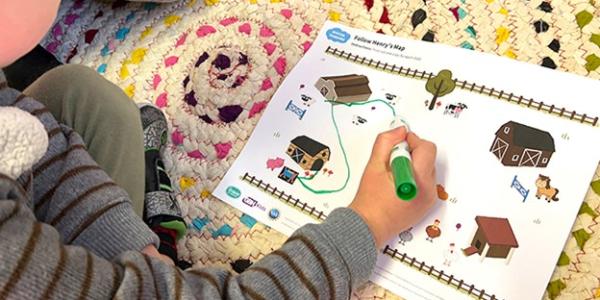
In subsequent readings, teachers can give children a printed map of the farm and ask them to draw the route Henry took around it. They can then set up a “walkable map” of Henry’s farm, taping printouts of its five landmarks to chairs in a large semicircle. Children follow their maps (from the previous activity) to walk around the “farm.” Together, these activities introduce children to navigating a route on a paper map and in a real space.
Educators can use books and related activities to support children’s spatial vocabulary in several ways. These include:
- Pointing out why spatial vocabulary is helpful in the context of a story. In Henry’s Map, for example, the characters used the map and spatial words like landmark, route, up, and down to get from place to place on the farm.
- Supporting children’s exploration of new spatial words. Spatial vocabulary may be new to children. During interactive read alouds, educators can pause to talk about what each word means. This helps to ensure that all children get a chance to learn the vocabulary.
- Connecting vocabulary to physical movement. Children connect words to meaning in multimodal ways. They can explore spatial ideas by enacting them physically with manipulatives and their bodies. For example, as children navigate Henry’s farm in their own space, they can state the route that they take and the relationship between landmarks.
Educator Tips: What to Look for when Selecting Spatial Thinking Books
Educators should consider the following features when selecting books to promote children’s developing spatial awareness.
- Spatial words. Spatial vocabulary (above, below, under, over, on, in, inside, outside, next to, beside, between, behind, in front of, near, and far) should be emphasized in the text.
- Spatial visualizations. Illustrations should demonstrate spatial concepts. For example, pictures might show characters moving over a bridge, under a table, or between two trees so that children can connect the words to what they see.
- Integrated spatial topics. Spatial ideas should be woven throughout the narrative. For example, characters might use spatial language to describe where animals live around a farm or how a character moves from one place to another.
- Elicits spatial movements. Hand and body movements should be encouraged while reading, so children can practice spatial and positional relationships (Burte et al. 2017). For example, teachers can invite children to act out what the characters in the book do, such as go behind, beside, or under something to illustrate key spatial words.
Linking Physical Movement to Spatial Thinking
Multimodal experiences can facilitate young children’s content learning. This includes in math and literacy (Hirsh-Pasek et al. 2015; Burte et al. 2017). To build upon and enhance spatial vocabulary and thinking related to the books they read, educators can ask children to embody spatial concepts, movements, and words during games and other activities. For example, they can play a version of the high-energy game Freeze Dance: When the music stops, children must freeze and name who is in front/behind/to the left/to the right of them. Because this is a movement activity, children will begin to notice that their spatial relationships to others can change.
Learning to differentiate left from right can take years to master and requires repetition (Shusterman & Li 2016). It’s helpful to introduce children to quick, short activities that give them a physical feel for the positions. In the game Play Paddleboat, children sit on the ground, one behind the other, and use their arms to pretend to paddle in unison. They begin by paddling on their left side. After about 10 seconds, they stop and begin again, this time on their right side. Frequent stops and starts keep the game lively and allow children to think about left and right.
Children can also practice spatial concepts and words using props, like the activity Gracie and the Goat, developed by WGBH Educational Foundation in collaboration with researchers at EDC. Children choose a picture card of Gracie and her goat, then place cardboard character props in the position shown on the card (next to each other, far away from each other, or close to each other). Physically moving the props deepens children’s understanding of spatial relationships and helps them connect what they see on the two-dimensional cards to the three-dimensional props.
Educators can weave spatial movement and language throughout the learning day by
- Pairing spatial words and movements. Regularly using spatial words to describe children’s physical movements helps solidify spatial learning (Burte et al. 2017; Casasola et al. 2020; Clements & Sarama 2020).
- Incorporating spatial movement into daily routines. Consider using spatial words as children line up (“Let’s line up behind Sam”; “Who is in front of you?”) or as they clean up the classroom (“Put the blocks on the shelf”; “Put the books next to each other on the table”).
- Giving children agency. Let children give spatial directions that educators must follow. This will help them connect the words to real life.
Linking Language and Spatial Learning
Books can serve as a first step in linking language to spatial representations and real-world navigation tasks. Integrating physical movement—of both objects and their bodies—helps children learn and practice concepts that develop spatial thinking. Thoughtfully combining the two can build a foundation for future spatial, numerical, and STEM success.
As you plan for integrating spatial learning into your setting, consider the following questions:
- What books am I already using that include spatial concepts, and how can I use those to focus more on spatial ideas?
- What physical activities and games can I introduce that will allow children to explore their spatial positions or describe where they are in relation to other objects or children? How can those be paired with books?
- What spatial vocabulary can I use during daily activities?
- How can I learn about the ways families are exploring these ideas with their children, and how can I share with them ways to nurture spatial thinking through books and movement?
Photograph: courtesy of the authors
Copyright © 2026 by the National Association for the Education of Young Children. See Permissions and Reprints online at NAEYC.org/resources/permissions.
REFERENCES
Burte, H., A.L. Gardony, A. Hutton, & A. Taylor. 2017. “Think3d! Improving Mathematics Learning Through Embodied Spatial Training. Cognitive Research: Principles and Implications 2 (13). doi.org/10.1186/s41235-017-0052-9
Casasola, M., W.S. Wei, D.D, Suh, P. Donskoy, & A. Ransom. 2020. “Children’s Exposure to Spatial Language Promotes Their Spatial Thinking.” Journal of Experimental Psychology: General 149 (6): 1116–36.
Clements, D.H., & J. Sarama. 2020. Learning and Teaching Early Math: The Learning Trajectories Approach. Routledge.
Gunderson, E.A., & L. Hildebrand. 2021. “Relations Among Spatial Skills, Number Line Estimation, and Exact and Approximate Calculation in Young Children.” Journal of Experimental Child Psychology 212 (105251). doi.org/10.1016/j.jecp.2021.105251.
Hirsh-Pasek, K., J.M. Zosh, R.M. Golikoff, J.H. Gray, M.B. Robb, et al. 2015. “Putting Education in ‘Educational’ Apps: Lessons from the Science of Learning.” Psychological Science in the Public Interest 16 (1): 3–34.
Pritulsky, C., C. Morano, R. Odean, C. Bower, K. Hirsh-Pasek, et. al. 2020. “Spatial Thinking: Why It Belongs in the Preschool Classroom.” Translational Issues in Psychological Science 6 (3): 271–82.
Shusterman, A., & P. Li. 2016. “Frames of Reference in Spatial Language Acquisition.” Cognitive Psychology 88, 115–61. doi.org/10.1016/j.cogpsych.2016.06.001.
Verdine, B.N., L. Zimmerman, L. Foster, M.A. Marzouk, R.M. Golinkoff, et al. 2019. “Effects of Geometric Toy Design on Parent-Child Interactions and Spatial Language. Early Childhood Research Quarterly 46: 126–141.
Ashley Lewis Presser is a senior research scientist who studies effective strategies for enhancing STEM learning, especially among young children, and applies these insights to the development of educational interventions.
Jillian Orr Daglilar was an executive producer at WGBH Educational Foundation while contributing to this article. She engages in participatory design with multidisciplinary teams to create resources that support young children’s healthy development.
Borgna Brunner is an editorial project director in the Education Department at WGBH, where she develops and writes content for early childhood programs and initiatives.