Cooking It Up with 3-Year-Olds
You are here
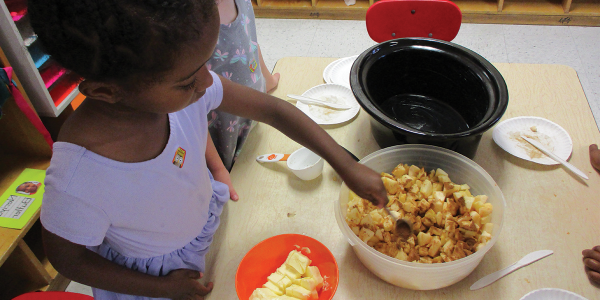
It’s the beginning of a new school year, and Ms. Mary is getting to know her new class of 3-year-olds. She spends many weeks observing and talking with the children. She notices that they gravitate to the dramatic play center, where they pretend to cook different types of meals. One day Ms. Mary asks the children as they play, “What do you know about cooking?”
“I like to stir the pasta sauce with Dad,” Lily says.
“I like to make rice at home with a spatula,” says Bob.
“I like to use an apple cutter and use a blender for milk shakes,” Johnny adds.
Observing the conversations and play surrounding cooking, Ms. Mary decides to build on her children’s interests and prior experiences. Her class soon begins a yearlong inquiry into cooking.
This experience took place at the Louisiana State University Early Childhood Education Laboratory Preschool, where educators embrace the Reggio Emilia Approach. This approach promotes a flexible environment and a curriculum that builds upon children’s interests. Teachers act as researchers, examining what children are interested in rather than teaching from a static curriculum. (For more information, see “Inspired by Reggio Emilia: Emergent Curriculum in a Relationship-Driven Learning Environment,” by Mary Ann Biermeier, in the November 2015 issue of Young Children.)
In this article, I share one teacher’s intentional planning and responsiveness to children’s interests that led to playful, engaging cooking experiences throughout a year and that promoted cross-curricular learning. As director of this full-day, 12-month program, it is exhilarating to watch teachers and children gain knowledge by exploring their interests. While we follow the Reggio Emilia approach, the observations, planning, and implementation of these activities can be adapted for a variety of settings.
From Observation to Action: An Inquiry into Cooking
Learning can emerge from children’s questions, thoughts, and conversations. Coupled with their knowledge of early learning standards and goals, teachers can incorporate key concepts and skills while deeply exploring children’s interests and experiences.
Ms. Mary’s class engaged in numerous cooking investigations during their school year. These included eating and cooking foods (scrambled eggs, red beans and rice, chicken fajitas). The class also examined where different foods come from and how they are distributed. Each activity built on children’s prior knowledge, experiences, and new learning across the curriculum. This kind of meaningful learning can be missed when teachers only offer one-time or disconnected cooking activities.
Following are snapshots of two cooking explorations.
“How Do I Make Pasta?”
The day after Ms. Mary’s children posed this question, she collected a pound of dry pasta and a large pot, then took her class to the school kitchen to figure out how to cook it. The children knew their families used water to cook pasta, but how much? Johnny said they needed to use the measuring cups from the sand table. Cecilia said they needed to read the directions on the pasta box. Drawing on children’s prior knowledge of measurement and past experiences following recipes during other class activities, Ms. Mary guided them as they solved their cooking problem.
Ms. Mary read the recipe on the pasta box and explained that the children would need 24 cups of water. The kitchen had several types of measuring cups to explore, and children noted the differences in size and volume. Once they filled the pot, Ms. Mary turned on the stove. The kitchen’s chef explained he would watch for the water to boil and add the pasta. The class set a timer to return in 20 minutes.
Upon returning, the pasta was cooked, and Ms. Mary asked the children, “How are we going to get the pasta out of the water?” The children said she needed to pour it, and she introduced them to a strainer. The children noticed immediately that the cooked pasta looked different from the dry pasta, and scientific discussions evolved. Acting as a facilitator, Ms. Mary embedded language, science, and math into this activity, and the children’s collaboration supported their social development—with the added bonus of an afternoon snack.
The children continued talking about kitchens for weeks. Ms. Mary contacted a local industrial kitchen on campus and scheduled a field trip. During it, children compared the differently sized utensils and appliances in industrial, school, and home kitchens. Once they returned to the classroom, they created their own kitchens from loose parts.
Ms. Mary had easy access to an industrial kitchen. Alternatively, she could have asked families to send in videos or pictures of their home kitchens, including utensils and appliances. The children could have compared the similarities and differences of each kitchen while learning about the foods and meal preparation happening in their homes.
Gardens and Garbage Trucks
As children began showing an interest in produce, Ms. Mary’s class walked to a farmers’ market on campus to view what was being grown locally. Children used their senses to explore the produce and to sample freshly made smoothies.
After this visit, the children wanted to grow their own plants. A school garden was created, beginning with bean and pepper seeds. As the plants grew, the children drew pictures of them, measured their growth, weeded the garden, and created plants with loose parts.
One day, a child told Ms. Mary about seeing a garbage truck on the way to school. The children began talking about garbage trucks, and Johnny asked, “What would happen if we planted a garden in a garbage truck?” This question prompted recycling to emerge as a topic. New activities began revolving around recycling items (newspaper, orange peels). The children learned the term compost and that this material could help their garden grow better. They began collecting compostable items after meals and placing them in the garden.
Conclusion
When early childhood educators pay close attention to children’s questions and interests, they can create playful environments that support and build on those interests. Ms. Mary planned learning experiences that went beyond one single cooking activity to expand over weeks. This kind of close attention is essential when planning and implementing activities that deeply engage children.
Photograph: © Lakshini Wijeweera
Copyright © 2023 by the National Association for the Education of Young Children. See permissions and reprints online at NAEYC.org/resources/permissions.
Michelle Grantham-Caston is the director at Louisiana State University Early Childhood Education Laboratory Preschool in Baton Rouge, Louisiana.