Belonging Blooms in the Quiet: What Can Happen When a Child Feels Seen and Heard?

You are here
I’m packing up my materials after a busy morning facilitating forest explorations with infants, toddlers, and their families. As I put a card in my basket, I glance up and see 2-year-old Noli standing in front of me. I stop what I’m doing, look at her face, and say, “Ah, you have a pinwheel!” She looks back at me and smiles as her eyes flick to her extended arm, which holds the pinwheel in the air. I look at her arm and see the pinwheel moving. “Oh! The pinwheel is moving! How are you doing that?” Noli looks at my face, then puts her arm down. The pinwheel stops. She raises it again, and the pinwheel starts to spin again. “The wind is moving your pinwheel!” I say with excitement. She smiles, watching the pinwheel spin, then wraps her arms around me in a hug before returning to her mother.
Later that night, Noli’s mother sends me a few photos she captured of our interaction and writes, “Thank you for always making sure she feels seen and safe.” This message brings tears to my eyes. The heart of my work is ensuring that every child I interact with feels truly seen and heard. This moment spurred me to reflect on how my practices have changed over time to support each child’s sense of belonging.
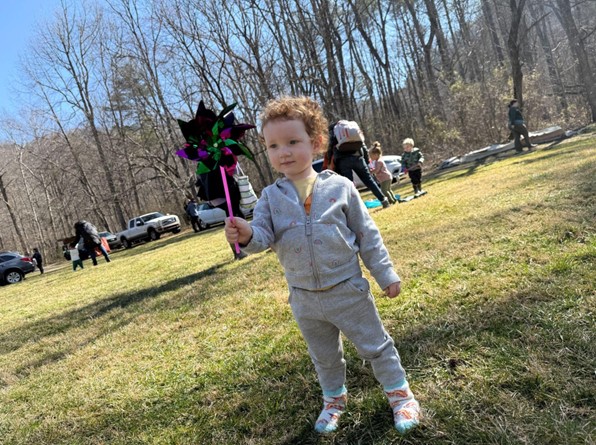
I serve as a facilitator in a one-day-a-week forest program for infants and toddlers, their families, and other home caregivers. The families who attend have diverse circumstances (some stay home with their children, some work full time, some are grandparents), parenting styles, and experiences with outdoor play. Some travel over an hour to join us, seeking connection, community, and a different kind of learning environment for their children. Our program is intentionally designed to be open-ended, nature-based, and rooted in relationships—among children, families, and the natural world. It’s within this context that seemingly small interactions, like a child raising a pinwheel, become invitations to pause, notice, and reflect. These moments may appear ordinary, but they hold the seeds of belonging, presence, and transformation.
Practice in Presence
Developmentally appropriate practice (DAP) calls for educators to engage in ongoing reflection that supports responsive and intentional interactions. It also recognizes how important relationships are for children’s development and learning: When educators nurture their relationships with children, they create caring communities where every child feels safe and welcome. An environment that fosters belonging, purpose, and agency motivates children to learn (NAEYC 2020).
When I pause to observe a child—what they are doing and what they may be thinking or feeling—I’m often just as aware of what is stirred within me. This reflective stance matters because it shapes the choices I make in the moment. These moments of connection are pedagogical and deeply personal. Vygotsky’s (1978) theory of learning as a socially mediated process reinforces this idea: Meaning is co-constructed through relationships, and every interaction carries the potential to shape both the learner and the educator. In my practice, I’ve found that the more present I am with children, the more I am invited to explore my own beliefs, habits, and assumptions—a key tenet of NAEYC’s position statement on advancing equity (2019).
As I reflect on my moment with Noli (and many others like it), I realize that the work of truly seeing and hearing children requires a kind of sustained presence that isn’t always easy to maintain. Educators wear many hats: Facilitator, nurse, photographer, translator, caregiver. Amid licensing rules, curriculum mandates, and time pressures, it’s easy to become disconnected from the small, sacred moments that create belonging.
But these moments are critical. I think the ability to make a child feel seen begins with a commitment to curiosity—about the child, yes, but also about ourselves. I have found that when I pause and really look at a child, not just for what they’re doing but for what they might be thinking or feeling, I open the door to mutual recognition. I’ve come to understand that this sense of presence is something I can practice and model. Reflection and intentionality are daily choices educators make that shape how children experience being truly seen. While it may feel counterintuitive to focus on our relationship with ourselves as we educate others, that internal work is what makes space for children to be heard and understood (Cigala et al. 2019).
What Changes When We Pause and Reflect
In our pinwheel experience, Noli demonstrated important scientific thinking. She actively investigated cause and effect by lifting and lowering her arm, observing changes in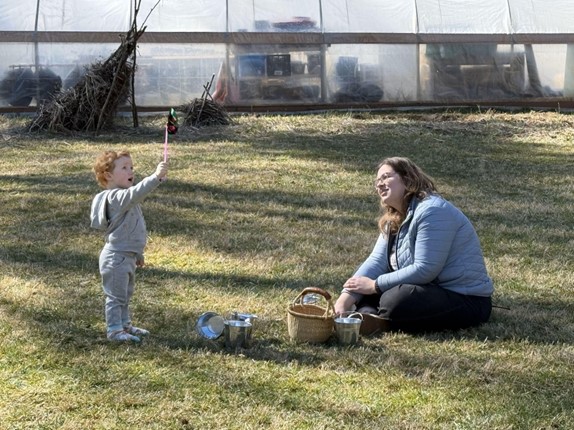 the pinwheel, and adjusting her actions in response to what she observed. She noticed the wind’s impact, formed a hypothesis, tested it, and confirmed it. An entire cycle of inquiry, conducted with her body and senses! This embodied learning is at the heart of science learning for infants and toddlers, who are more than capable of forming early understandings of big concepts like force, motion, and transformation through their play (Perry & Lange 2024). My role in the moment was to notice, narrate, and affirm the brilliance unfolding in front of me.
If this moment had happened a few years ago, the experience would have been much different. I probably would have said, “Ah, you have a pinwheel! Let’s blow on it!” Then, I likely would have blown air directly onto Noli’s pinwheel, showing her how to make it move. I never would have known that Noli already knew how to make the pinwheel move. I would have been thinking about what I should do or say, rather than pausing and observing what she knew and could do.
Over time, I have learned that one of the most powerful practices we can cultivate as educators is the discipline of waiting, which for me means creating intentional pauses that let children show us what they already know and what questions they are carrying. I have found that this small shift can transform learning experiences. Giving myself permission to wait has also allowed me to better recognize how children need to be heard, even when no words are exchanged. Did you notice in the pinwheel story that Noli never said anything? And yet, her thinking was vibrant and clear. I offered language to accompany what I observed but not to direct her learning in that moment; rather, to affirm it. I gave voice to her thought process. The interaction also provided me with important information I could use for future moments, both planned and spontaneous, teacher-guided and child-guided.
The Transformative Work of Teaching
So, what happens when we allow children to truly be seen and heard? I have found that they begin to believe that their questions matter, that their ways of thinking have value, and that their voices—even before they have all the words—are worth listening to.
This inquiry began with a small, joyful moment and grew into a deeper question about how we as educators create conditions for empathy and children’s sense of belonging, which can bloom in the quiet spaces between an educator and child. When a child feels that their joy matters to someone else, that their discoveries are noticed, they begin to feel at home in the world.
I recall as a child hearing the phrase, “Children should be seen and not heard.” That message lingered in me far longer than I’d like to admit—constricting my voice and convincing me to align with a story that was never mine to begin with. My work with young children has helped me reject that belief entirely. Children must be seen and must be heard—through their bodies, their gestures, their silences, and their laughter. I carry that with me every day, ensuring that no child I encounter feels written into the same story I once believed. In embracing this truth, I’ve learned not only how to support children’s growth, but how to reclaim my own. This is the quiet, transformative work of teaching.
Photographs: header © Getty Images; other photos, courtesy of Amie A. Perry
Copyright © 2025 by the National Association for the Education of Young Children. See Permissions and Reprints online at NAEYC.org/resources/permissions.
References
Cigala, A., E. Venturelli, & M. Bassetti. 2019. “Reflective Practice: A Method to Improve Teachers’ Well-Being. A Longitudinal Training in Early Childhood Education and Care Centers.” Frontier Psychology 10. doi.org/10.3389/fpsyg.2019.02574.
NAEYC (National Association for the Education of Young Children) 2019. “Advancing Equity in Early Childhood Education.” Position statement. NAEYC. naeyc.org/resources/position-statements/equity.
NAEYC (National Association for the Education of Young Children) 2020. “Developmentally Appropriate Practice (DAP).” Position statement. NAEYC. naeyc.org/resources/position-statements/dap/contents.
Perry, A., & A.A. Lange. 2024. “Exploring STEM with Infants and Toddlers: A Long-Term Study of Bubbles.” Exchange 274.
Vygotsky, L.S. 1978. Mind in Society: The Development of Higher Psychological Processes. Harvard University Press.