Creating a Sense of Belonging in a Toddler Classroom
You are here
Ben, age 3, is a collector. One Monday morning, Ben starts collecting on a large scale. He dumps out all of the available scarves, places a chair on top of them, and pushes them all around, saying “my moppah! Ook, Iz, I moppin juze,” with a huge smile on his face. The play takes up a lot of space as Ben moves from one end of the classroom to the other. It also creates a lot of joy. Ben’s happiness when he pretends to mop radiates through his big smile and giggles as he pushes his “mop.” This action spreads to the other children, including Liam, Amy, and Greg. They join in with Ben, grabbing their own “mops” (chairs) and pushing them around the room.
I have been an educator of young children for eight years. In my current role, I work at the University of Tennessee, Knoxville Early Learning Center for Research and Practice as a looping infant and toddler teacher, which means that I remain with the same group of children for several years. For the past three years, my coteacher, Jess, and I have looped with the same group of 12 children, ages 2 and 3.
The story of how our learning community engaged with Ben’s large-scale pretend play (physically, socially, and emotionally), described in the opening vignette, shows how we fostered a sense of belonging in our toddler classroom. This story, along with reflections from Jess and from Ben’s family, illustrates the importance of getting curious, pausing, observing, and then reflecting on what a child’s behavior can offer the child and the group as a whole. This reflection can lead to more responsive planning and interactions that help everyone feel they belong. Indeed, nurturing a sense of belonging is an important part of developmentally appropriate practice, helping to motivate children to learn and connecting to their sense of purpose and agency. A sense of belonging stems from not only physical safety but also psychological safety (NAEYC 2020).
Navigating Space, Materials, and Emotions
At the beginning of the 2024–25 school year, my class of 2- and 3-year-olds was experiencing consistent conflicts between Ben and a few others: Liam, Amy, and Greg. Ben would often hit or bite these children whenever he felt overwhelmed or frustrated or when he was attempting to take materials from them. He would also “collect” as many toys as possible into the biggest container he could find, and Liam, Amy, or Greg would scream at him if Ben had something they wanted. Several times a day, Ben would take a whole basket of materials that were meant for sharing and either dump them on the floor or take them to another area where he was “collecting” other materials. Jess and I began documenting observations to try to better understand Ben’s behaviors during play.
During professional development before the beginning of the school year, Jess and I had learned a lot about consistency, routine, and maintaining structure in the classroom. We decided to set expectations about where materials should stay because we thought this would be helpful for children and adults in our setting. After a few weeks of trying to maintain what we thought were helpful boundaries around materials, we realized that approach wasn’t working for Ben. There was something he was trying to communicate. We needed to pause, observe, and reflect in order to understand him better.
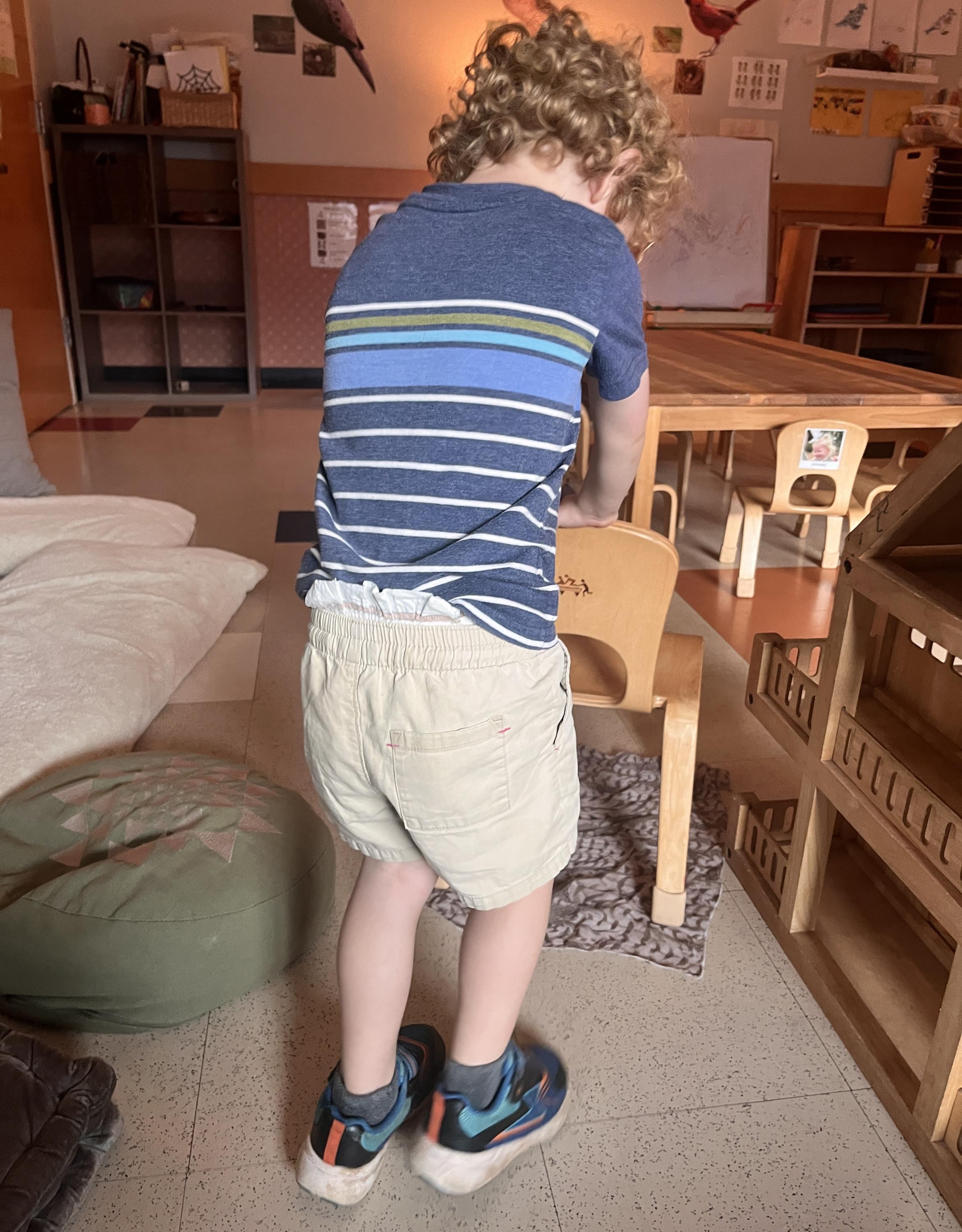 I frequently observed Ben collecting so many materials that there would not be enough left for other children to play with, as in the mopping anecdote in the opening vignette. However, the mopping scenario is a perfect example of how Ben’s approach to pretend play could provide opportunities for children to navigate space, materials, and emotions to reach a desired outcome. In this case, it was a continuous process of dump “juice,” mop “juice,” repeat. Some conflicts arose in this moment because of the intricacies of this play, like Amy screaming because Liam had a scarf she wanted. However, because their interest in the play was so high, Ben, Liam, Amy, and Greg seemed more willing to negotiate with each other.
After pausing to observe, I kneeled down close to Amy while Liam watched. I said, “I noticed that Liam has a pink scarf. I wonder if you want a pink scarf too.” Amy nodded, and Liam walked over to the box of scarves, grabbed another pink scarf, and handed it to Amy. After this mopping scenario, I noticed that many of the children were more consistently participating in large-scale pretend play as well as playing more cooperatively. Jess, Dani (our pedagogical coach), and I paused to reflect on what had worked well in this situation.
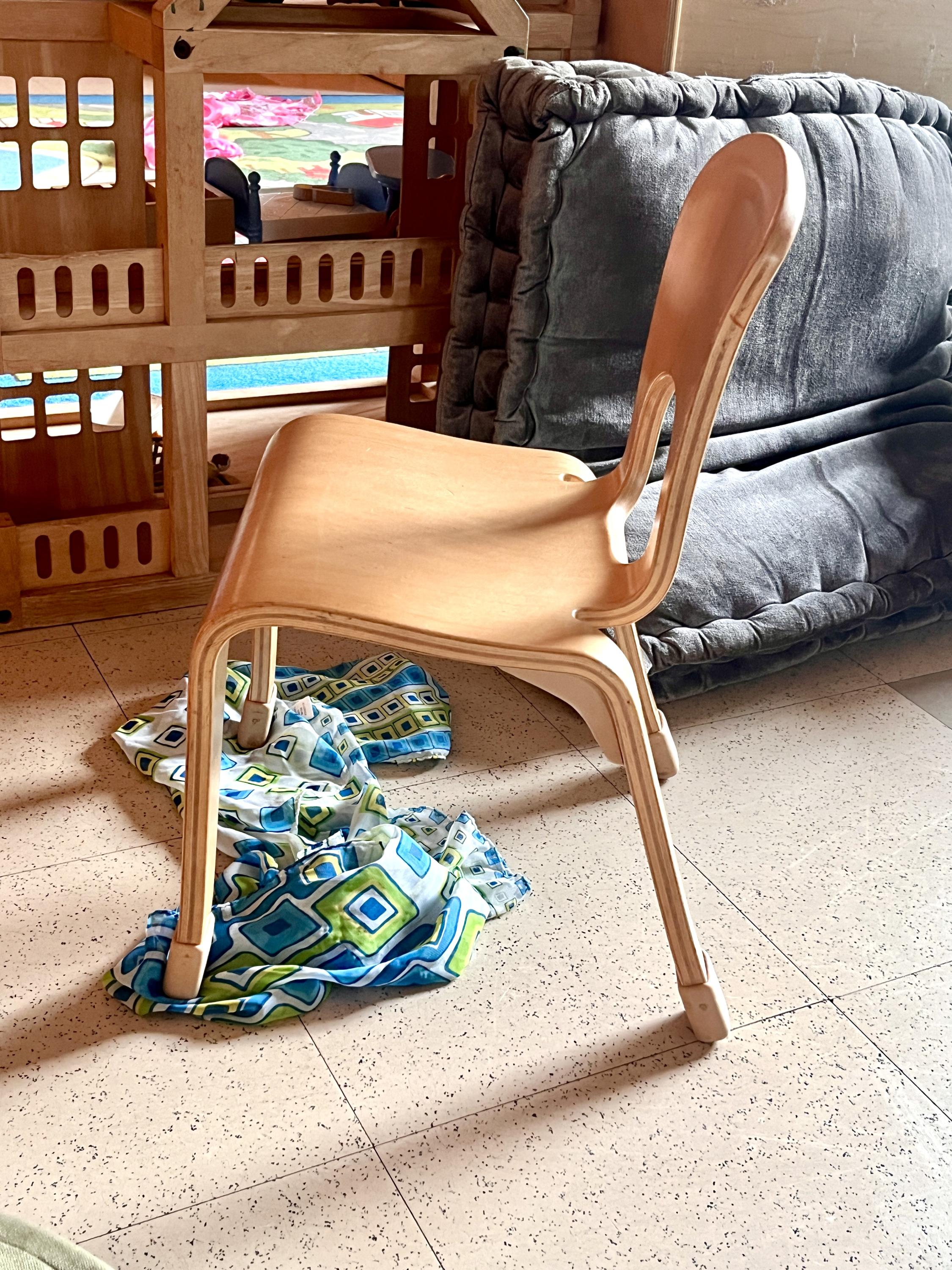 When Ben began using the scarves and chairs in an unexpected way, it felt disrespectful to his learning process and sense of belonging to make him stop. Instead of immediately stopping the play because Ben was using the scarves and chairs “incorrectly,” we looked at this scenario through a lens of inquiry and curiosity. We wondered what Ben was getting out of using these materials in a different way than we had intended and what the other children could potentially get out of it as well. This pretend play scenario had a lot of moving parts and required patience, sharing, and consistent resetting of expectations and rules among the children and teachers to ensure both physical and psychological safety. It was obvious that Ben had a clear vision for his play, and we wanted to understand it first before reacting. We realized that this was a perfect opportunity to facilitate play and learning for Ben and the other children who were intrigued by this scenario.
At pickup that day, we told Ben’s family about what had occurred and how exciting it was for Ben and the other children. They told us that they had witnessed a scenario just like that at the grocery store the previous weekend. This gave us insight into where Ben had seen a mopping scenario and insight into his interests. By pausing and observing Ben’s play, we were able to provide more opportunities for complex pretend play scenarios that were meaningful to him and the other children and created a sense of belonging.
Expanding on and Inviting Others into Play Scenarios
Ben redefined how children and educators create belonging and engagement in our classroom community. His approach to pretend play scenarios became an invitation to the other children to participate in this shared expression of their thoughts and ideas about the world. It reminded Jess and me to consider our goals for children’s play, the amount of time for self-directed play, and our observations and reflections about play. As Ben engaged in this type of play more frequently, a child named Chris started to participate with Ben or create his own scenarios. This was particularly notable because Chris was generally capable of engaging in all different types of play with every child in our class, although he mostly preferred playing with vehicles and big body movement. Chris expanded on the large-scale pretend play scenarios by bringing in his love of vehicles. He built large structures to represent a train, garbage truck, or lawn care truck. This play automatically invited other children to engage, furthering the opportunities for building relationships among all children, creating meaning and belonging together, and self-expression.
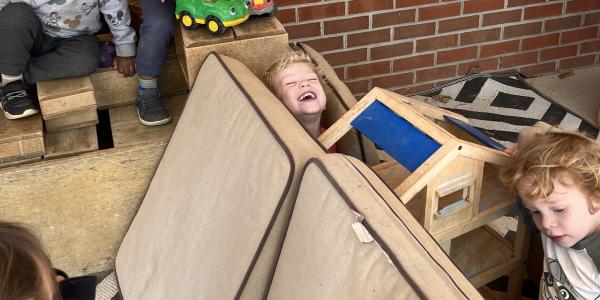
Several months after the initial mopping scenario and lots of practice in sharing materials and space with others, Ben, Chris, Liam, Rachel, and Max were playing on a back porch that connects to our classroom, using a large open container filled with big wooden blocks. Chris, Liam, Rachel, and Max helped each other stack the blocks, so they could have a safe place to sit. Once Chris and the other children sat on the blocks, Chris began saying “Choo choo! Get on da train!” Ben saw this and added to the train. He brought a doll house and pillows over and took some blocks down to make a conductor’s chair. Ben and Chris worked together to create different scenarios for the train. Ben told children when to get off the train at different stops, like the grocery store, school, or their homes. Children got off the train, walked around the porch, then walked back to the train and sat down. At one point, Ben stood up and said, “Stop! Stop sign! Oh no ate, it blinkin!” Chris responded, “Hey, there’s a car coming over the track!” Ben said, “It OK. We stop.” This was an example of an experience that built a sense of belonging since so many children participated—either sharing their ideas of how to continue the play scenario or following the cues of other children. Through their participation in this large-scale pretend play scenario, the children created a situation where they could safely share their knowledge of and possibly learn something new about trains and cars. This helped to affirm that all of their thoughts and knowledge are valued and respected in our classroom.
Moving Forward with Curiosity
The small choice to move forward with curiosity rather than judgment has shaped the way I approach almost every aspect of my teaching now. Approaching my work through a lens of curiosity and inquiry has allowed for deeper understanding and connections among the children, my coteacher, the families, and me, resulting in an environment that values, respects, and utilizes everything each individual has to offer. Moving forward, I will continue to support inclusive play. I will help children understand that while I will maintain boundaries around playing safely, I want them to feel like they can use our classroom materials in open-ended ways. This means allowing for free (or self-directed) play—that is, where there are no predetermined rules or outcomes that dictate the play time or materials being used. This will offer the children increased opportunities to express their knowledge, ideas, and understanding of the world with the freedom, flexibility, and respect they deserve.
Insights on Ben’s Play: A Family’s Reflection
The insights that were gained from the mopping scenario were collected through a collaboration between me, Jess (my coteacher), and Ben’s family. At the beginning of the school year, we noticed that Ben engaged in similar play patterns and social and emotional behaviors at school and at home. Following is a reflection written by Ben’s family. They note that providing Ben with the time and space to engage in his large-scale pretend play scenarios at school directly impacted the way he engaged with play and interacted with his brother and friends outside of school.
When we reflect back on the mopping scenario, it dawns on us that this was also a pivotal moment at home and when playing with friends outside of school. Before this moment, Ben played at home almost entirely by recreating house or yard tasks but without his own spin. This made it harder for him to play with his older brother, 5-year-old Nolan. When we were out with school friends, Ben mostly clung to a parent and engaged less with his peers.
However, since the mopping scenario, Ben has created all kinds of big, creative play scenarios that others, including his friends and Nolan, join. He welcomes them into these scenarios. This has opened up a beautiful friendship with his brother and a much more enjoyable playdate experience with his peers. In contrast, if we go somewhere like the zoo, where there isn’t room for [large-scale] play scenarios, he doesn’t know how to play with his peers or brother as much. This is a good reminder to us that if we are striving for collaborative and engaged play outside of school, we need to ensure we are going to places that facilitate open-ended, creative play. As parents, it has been essential and amazing that we have had these open lines of communication with Ben’s teachers over the years. By sharing these moments back and forth, we are better able to facilitate peer and sibling relationships now and into the future.
A Coteacher’s Perspective on Ben’s Play: Jess’s Reflection
My coteacher, Jess, was a huge part of a collaborative effort to develop a new way to create a sense of belonging and engagement in our classroom. While we both experienced the same situation, her unique perspective helps illustrate where we started and the process we went through to get to a place where large-scale play scenarios became an everyday occurrence in our classroom. Following is Jess’s reflection.
This period of time in our classroom was indeed pivotal. We were in the thick of data collection and observation, trying to navigate and support challenging behaviors that we knew Ben was using to communicate and we weren’t quite able to interpret. I remember feeling pretty overwhelmed at the notion of trying to maintain “control” of the classroom around this time. Everything that we had discussed during in-service training at the beginning of that school year was focused on directness, consistency, and visual cues, essentially maintaining predictability of expectations in the classroom. It felt like the harder we tried to maintain the rules of the classroom, the more amplified these challenges seemed. We knew that Ben needed us to listen closely, and we were trying our best.
I remember the first time I saw Ben create the mop from a chair and scarves to mop up the juice. His mom mentioned that Ben had seen someone using a mop to clean spilled juice at a grocery store, and it had made an impression on him. After drop-off, he fashioned his own very quickly. He began pushing the chair around the table. Some peers stood back for a while and watched, and I could see their minds working. I was worried that the class would burst into chaos with all 12 children pushing chairs around the room. I debated about how to guide (or end) the moment, and I chose to lean in—in part because Ben was so joyfully focused. I wanted to give him a really great day, to fill his bucket and to let his peers experience him at his best. Liz agreed. Choosing to break our own arbitrary rule about keeping chairs at the table was the best decision we could have made for our classroom. For weeks, Ben and his peers moved from the mopping scenario to lawn mowing with the chairs to building trains, garbage trucks, and delivery trucks. This play ended up influencing our children’s preferred play activities for most of a semester.
We realized, over time, that Ben was perhaps frustrated with having his big, creative, and complex ideas stifled. We came to understand and appreciate that his “collecting” wasn’t a symptom of egocentrism, but a kind of audition for the role of creative director. He wanted to play with others, and he was willing to do the planning and scaffolding of an experience for his peers if given the opportunity. Once we took a different approach—to pause, observe, and reflect—we saw Ben’s patterns in an entirely different way. Ben thrived in the role of creative director, his peers benefitted from his creativity, and we (the teachers) were gifted a profound lesson in what is required to support an authentic sense of belonging for each member of our community.
Photographs: Photos courtesy of Liz Braddock
Copyright © 2025 by the National Association for the Education of Young Children. See Permissions and Reprints online at NAEYC.org/resources/permissions.
Reference
NAEYC. 2020. “Developmentally Appropriate Practice.” Position statement. NAEYC. naeyc.org/resources/position-statements/dap/contents.