Growing with Play: Guided Play in the Primary Years
You are here
From a baby’s delight in shaking a rattle to a third grader’s determination to perfect a bridge design, the essence of play is the same across the years. In early childhood education settings, play refers to experiences that engage children in meaningful learning that is done with joy and allows them to interact with one another (Zosh et al. 2018, 2022). Research shows play advances children’s cognitive, social, and emotional growth (Zosh et al. 2018; Hirsh-Pasek et al. 2020). Although play is encouraged in the infant, toddler, and preschool years, once children enter elementary school, they tend to spend their days in teacher-led instruction (Bassok et al. 2016).
Play takes many forms and is viewed as a continuum (Miller & Almon 2009; Pyle & Danniels 2017). One form is guided play, which balances the agency, creativity, and joy of child-directed activity with purposeful teacher guidance (Weisberg et al. 2013, 2016; Hirsh-Pasek et al. 2022; Zosh et al. 2022). Guided play connects the experiences children need with the academic expectations they face in school, supporting rigorous, joyful learning through the primary grades (Takanishi 2016; Kauerz et al. 2021; NAEYC 2022). Neither child-guided play nor adult-guided instruction alone consistently supports this kind of learning (Weisberg et al. 2016). In guided play, children may initiate an activity or project, and teachers encourage them along the way to consider the decisions they are making and why they are making them. Children retain ownership of ideas, materials, and exploration while teachers shape the environment and introduce prompts that extend thinking toward meaningful academic goals (Weisberg et al. 2013, 2016; Zosh et al. 2022).
As a former preschool and kindergarten teacher and current early learning leader at the Buffett Early Childhood Institute at the University of Nebraska, I have spent my career in classrooms and alongside teachers exploring how guided play supports children’s learning from birth through the primary grades. In this article, I examine what guided play looks like in kindergarten through third grade, why it belongs in primary classrooms, and how teachers can engage with children before, during, and after play to sustain rigorous, joyful learning for every child.
Why Guided Play Belongs in Primary Grades
Early childhood extends through age 8 (NAEYC 2020), and during the primary grades, children make rapid gains in symbolic reasoning, social and emotional competence, and self-regulation, among other areas (Hirsh-Pasek et al. 2020). Guided play blends children’s initiative with intentional adult support that helps bridge what a child can do alone and what they can accomplish with guidance (Vygotsky 1978). Indeed, guided play supports the thinking, problem solving, and collaboration that help children in this age group thrive academically and socially (Fromberg & Bergen 2009). Too often though, primary-grade classrooms emphasize rote facts and basic skills rather than big ideas like reasoning through challenges and making meaningful connections (Clements & Sarama 2016; Ng et al. 2022).
When teachers thoughtfully connect playful experiences to learning goals, everyday activities become powerful opportunities for growth (Zosh et al. 2022; Pyle et al. 2024). Imagine a project in which first graders are asked to co-author a story about a city of animals. One group writes the narrative while another draws a matching map. As they decide whether the lion’s den should be near the zebra’s garden, the teacher asks, “What might happen if they lived next to each other?” The teacher’s question extends children’s storytelling, stretches thinking, and builds skills. At the same time, it preserves the children’s ownership of the narrative, creating opportunities for vocabulary development, reasoning, and collaboration; most importantly, it keeps curiosity and creativity at the center of the activity. This example illustrates both the qualities of guided play and its influence on children’s language, math, science, and collaboration skills (Clements & Sarama 2016, 2025; Hassinger-Das et al. 2017; Zosh et al. 2022). When teachers plan with this balance between child-directed play and teacher-led guidance, learning becomes something children choose with enthusiasm.
Creating Classrooms Where Every Child Belongs
Effective guided play considers each and every child, including multilingual learners and children with disabilities. It treats the languages, cultures, and experiences children bring to school as assets for learning (James & Iruka 2018; NAEYC 2019). More specifically, guided play
- Draws on children’s home languages, knowledge, and lived experiences as strengths
- Creates multiple ways for children to participate and contribute
- Replaces passive, one-size-fits-all instruction with active, meaningful teaching and learning
For instance, third graders designing signs for a community marketplace as part of their social studies unit asked their teacher how to write welcome in the languages of family members and friends. When one student added a greeting in Arabic to her booth’s sign, other teams followed, adding welcomes in Spanish, Vietnamese, and Somali. The students researched key words and phrases in multiple languages to support marketplace activities, such as price, thank you, and how much. They also created surveys in their home languages to find out what products friends and family would like to see.
These choices were not assigned. Children brought their full selves into the project, and their languages and community connections became strengths that enriched the experience for everyone in the room. By integrating material in multiple languages that reflected the students’ home and community contexts, the teacher invited their identities and experiences into the project, deepening engagement and meaning. The students’ exploration of ideas about community and economic exchange strengthened language, collaboration, and design thinking while also aligning with early learning standards focused on science and engineering (e.g., NCSS 2013; NGSS Lead States 2013). When learning is designed this way, classrooms become places where every child can see themselves in the work, contribute in ways that fit their strengths, and be challenged to grow.
How Teachers Facilitate Guided Play
In the primary grades, teachers in guided play are neither passive observers nor strict directors. They are thoughtful facilitators who listen closely, design with intention, and extend children’s thinking while keeping curiosity at the center. The following vignette shows how these moves unfold before, during, and after guided play.
Before Guided Play: Designing Open-Ended Environments
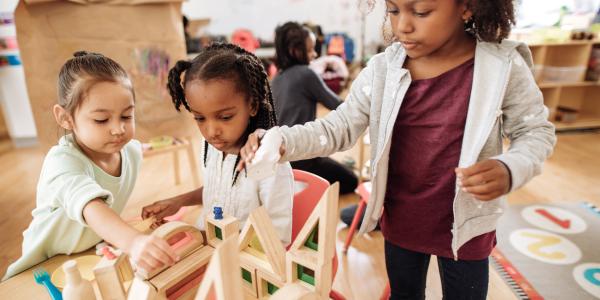
Ms. Hall is a first-grade teacher who is planning a guided play experience that corresponds with her state’s math learning standards on measurement. Rather than introducing this concept through a worksheet, she designs a space where children can discover these ideas on their own terms. She stocks the block area of her classroom with wooden planks, measuring tapes, clipboards, and photographs of local bridges.
Before children ever pick up a block or reach for a marker, teachers design environments that invite curiosity and connect to learning goals (Weisberg et al. 2013, 2016; Zosh et al. 2022). Ms. Hall’s block area is a good example: The materials were an invitation, not a set of instructions, and children’s explorations and content learning followed naturally. When the environment is ready, children’s explorations and content learning authentically follow (Zosh et al. 2018).
Standards play a quiet but important role in this planning. They help teachers clarify what children are working toward while leaving the path open for children’s interests and choices to shape the journey (Zosh et al. 2022). A second-grade math standard on measurement might come to life through designing a racetrack for toy cars. The destination is clear, but children’s interests and choices shape the path (Cavanaugh et al. 2017; Hirsh-Pasek et al. 2022). “Aligning with Standards: Two Paths to the Same Goal” below compares how educators can use early learning standards as they plan, teach, and assess. The examples illustrate how guided play can address the same goals as direct instruction. The Standards Statement column comes from the National Governors Association Center for Best Practices and Council of Chief State School Officers (2010a, b) and the Next Generation Science Standards (2013).

During Guided Play: Listening and Extending Children’s Thinking
When two children, Ben and Ava, begin balancing planks across block towers, Ms. Hall crouches beside them.
“Tell me about your design,” she says.
Ben explains, “It’s a bridge for bikes and people.”
“How will you make sure it’s safe for both?” Ms. Hall asks.
Ben and Ava measure the span and decide it might not be long enough. Ms. Hall shows them a photograph of a truss bridge. “What do you notice about this one?” she prompts.
They study the bridge. Based on what they see, they add angled supports and measure the bridge again.
“We made it longer and stronger!” they cheer.
Once play begins, one of the most important teaching tools is attentive listening. By watching closely and tuning in to what children are saying and doing, teachers find natural moments to step in with a question or a nudge that opens up new thinking (Weisberg et al. 2013, 2016; Dombro et al. 2020). In the vignette, Ms. Hall did not redirect the children’s bridge building; she asked what they noticed and let them apply that thinking themselves. These well-timed questions do not redirect children’s play; they deepen it, inviting children to think harder, test new ideas, and revise with purpose (Moomaw 2024; Pyle et al. 2024).
After Guided Play: Reflecting and Adapting Through Assessment
During closing circle, Ms. Hall notices most children can compare lengths but struggle to explain why one design worked better than another. The next morning, she adds a recording sheet to the block area and pulls aside one of the small groups.
“Can you walk me through what you did?” she asks.
“We wanted to fit more cars across the bridge,” one of the children explains. “We measured how wide the cars were and then added more blocks that way.” She indicates width with her hands.
The group demonstrates what they observed to Ms. Hall. What began as block play had shown their teacher exactly where the students were and where they needed to go next.
Teachers use observation, documentation, and conversation to help children make sense of what they discovered and to inform what comes next (NAEYC 2022). Ms. Hall used what she observed during bridge building to plan her next steps, adding a recording sheet and pulling a small group aside to extend the conversation. These responsive adjustments to the environment keep each child working at the edge of their growing understanding and emerging skills (Weisberg et al. 2013, 2016).
Guided Play as Intentional Teaching
Guided play is not an optional extra. It is an evidence-based, developmentally appropriate approach that belongs in every kindergarten through third-grade classroom (Weisberg et al. 2013, 2016; James & Iruka 2018; NAEYC 2022). By balancing children’s agency with purposeful guidance, educators support children’s development across domains and in their academic learning (Masterson 2019; Schmidtke 2025).
Guided play is also a pathway to access and opportunity. When classrooms build on children’s experiences, languages, and strengths, more learners can participate fully in challenging academic work (NAEYC 2019). Sustaining these opportunities requires supportive school conditions: Protecting time for open-ended exploration, resisting pressure to narrow the curriculum, and ensuring professional learning support teachers in designing guided play experiences that are responsive, rigorous, and joyful (NAEYC 2022; Schmidtke 2023).
References
Bassok, D., S. Latham, & A. Rorem. 2016. “Is Kindergarten the New First Grade?” AERA Open 2 (1): 1–31. doi.org/10.1177/2332858415616358.
Cavanaugh, D.M., K.J. Clemence, M.M. Teale, A.C. Rule, & S.E. Montgomery. 2017. “Kindergarten Scores, Storytelling, Executive Function, and Motivation Improved Through Literacy-Rich Guided Play.” Early Childhood Education Journal 45: 831–43. doi.org/10.1007/s10643-016-0832-8.
Clements, D.H., & J. Sarama. 2016. “Math, Science, and Technology in the Early Grades.” The Future of Children 26 (2): 75–94. doi.org/10.1353/foc.2016.0013.
Clements, D.H., & J. Sarama. 2025. “Systematic Review of Learning Trajectories in Early Mathematics.” ZDM – Mathematics Education 57: 637–50. doi.org/10.1007/s11858-024-01644-1.
Dombro, A.L., J. Jablon, & C. Stetson. 2020. Powerful Interactions: How to Connect with Children to Extend Their Learning. 2nd ed. NAEYC.
Fromberg, D.P., & D. Bergen, eds. 2009. Play from Birth to Twelve: Contexts, Perspectives, and Meanings. 2nd ed. Routledge.
Hassinger-Das, B., K. Hirsh-Pasek, & R.M. Golinkoff. 2017. “The Case of Brain Science and Guided Play: A Developing Story.” Young Children 72 (2): 45–50.
Hirsh-Pasek, K., H.S. Hadani, E. Blinkoff, & R.M. Golinkoff. 2020. “A New Path to Education Reform: Playful Learning Promotes 21st Century Skills in School and Beyond.” Policy brief. The Brookings Institution. brookings.edu/articles/a-new-path-to-education-reform-playful-learning-promotes-21st-century-skills-in-schools-and-beyond.
Hirsh-Pasek, K., R.M. Golinkoff, K. Nesbitt, C. Lautenbach, E. Blinkoff, et al. 2022. Making Schools Work: Bringing the Science of Learning to Joyful Classroom Practice. Teachers College Press.
James, C., & I.R. Iruka. 2018. “Delivering on the Promise of Effective Early Childhood Education.” National Black Child Development Institute. buildinitiative.org/wp-content/uploads/2021/06/Delivering-on-the-Promise-of-Effective-Early-Childhood-Education.pdf.
Kauerz, K., R. Ballard, M. Soli, & S. Hagerman. 2021. Leading Learning Communities: A Principal’s Guide to Early Learning and the Early Grades (Pre-K–3rd Grade). National Association of Elementary School Principals. naesp.org/wp-content/uploads/2021/03/llc2021-executive-summary.pdf.
Masterson, M.L. 2019. “Reflection.” In Serious Fun: How Guided Play Extends Children’s Learning, eds. M.L. Masterson & H. Bohart. NAEYC.
Miller, E., & J. Almon. 2009. Crisis in the Kindergarten: Why Children Need to Play in School. Alliance for Childhood. static1.squarespace.com/static/5d24bb215f3e850001630a72/t/5d37783aa47c990001d6cd96/1563916347932/Crisis+in+Kindergarten_complete+report.pdf.
Moomaw, S. 2024. Teaching STEM in the Early Years: Activities for Integrating Science, Technology, Engineering, and Mathematics. 2nd ed. Redleaf Press.
NAEYC. 2019. “Advancing Equity in Early Childhood Education.” Position statement. NAEYC. naeyc.org/resources/position-statements/equity.
NAEYC. 2020. “Developmentally Appropriate Practice.” Position statement. NAEYC. naeyc.org/resources/position-statements/dap/contents.
NAEYC. 2022. Developmentally Appropriate Practice in Early Childhood Programs Serving Children from Birth Through Age 8. 4th ed. NAEYC.
NCSS (National Council for the Social Studies). 2013. “The College, Career, and Civic Life (C3) Framework for Social Studies State Standards: Guidance for Enhancing the Rigor of K–12 Civics, Economics, Geography, and History.” NCSS. socialstudies.org/sites/default/files/c3/C3-Framework-for-Social-Studies.pdf.
Ng, A., S. Kewalramani, & G. Kidman. 2022. “Integrating and Navigating STEAM (inSTEAM) in Early Childhood Education: An Integrative Review and inSTEAM Conceptual Framework.” Eurasia Journal of Mathematics, Science and Technology Education 18 (7): em2133. doi.org/10.29333/ejmste/12174.
NGA (National Governors Association) Center for Best Practices & CCSSO (Council of Chief State School Officers). 2010a. “Common Core State Standards for English Language Arts and Literacy in History/Social Studies, Science, and Technical Subjects.” NGA Center & CCSO. learning.ccsso.org/wp-content/uploads/2022/11/ADA-Compliant-ELA-Standards.pdf.
NGA (National Governors Association) Center for Best Practices & CCSSO (Council of Chief State School Officers). 2010b. “Common Core State Standards for Mathematics.” NGA Center & CCSO. corestandards.org/wp-content/uploads/2023/09/Math_Standards1.pdf.
NGSS Lead States. 2013. Next Generation Science Standards: For States, By States. National Academies Press. doi.org/10.17226/18290.
Pyle, A., & E. Danniels. 2017. “A Continuum of Play-Based Learning: The Role of the Teacher in Play-Based Pedagogy and the Fear of Hijacking Play.” Early Education and Development 28 (3): 274–89. doi.org/10.1080/10409289.2016.1220771.
Pyle, A., H. Wickstrom, O. Gross, & E. Kraszewski. 2024. “Supporting Literacy Development in Kindergarten Through Teacher-Facilitated Play.” Journal of Early Childhood Research 22 (3): 428–41. doi.org/10.1177/1476718X231221363.
Schmidtke, A. 2023. “A Qualitative Study of Kindergarten Teachers’ Perceptions About the Influences of Professional Learning on Their Implementation of Guided Play.” Journal of Research in Childhood Education 37 (1): 49–76. doi.org/10.1080/02568543.2022.2064013.
Schmidtke, A., ed. 2025. The Intentional Teacher: Choosing the Best Strategies for Young Children’s Learning. 3rd ed. NAEYC.
Takanishi, R. 2016. First Things First! Creating the New American Primary School. Teachers College Press.
Vygotsky, L.S. 1978. Mind in Society: The Development of Higher Psychological Processes. Harvard University Press.
Weisberg, D.S., K. Hirsh-Pasek, & R.M. Golinkoff. 2013. “Guided Play: Where Curricular Goals Meet a Playful Pedagogy.” Mind, Brain, and Education 7 (2): 104–12. doi.org/10.1111/mbe.12015.
Weisberg, D.S., K. Hirsh-Pasek, R.M. Golinkoff, A.K. Kittredge, & D. Klahr. 2016. “Guided Play: Principles and Practices.” Current Directions in Psychological Science 25 (3): 177–82. doi.org/10.1177/0963721416645512.
Zosh, J.M., C. Gaudreau, R.M. Golinkoff, & K. Hirsh-Pasek. 2022. “The Power of Playful Learning in the Early Childhood Setting.” In Developmentally Appropriate Practice in Early Childhood Programs Serving Children from Birth Through Age 8. 4th ed. NAEYC.
Zosh, J.M., K. Hirsh-Pasek, E.J. Hopkins, H. Jensen, C. Liu, et al. 2018. “Accessing the Inaccessible: Redefining Play as a Spectrum.” Frontiers in Psychology 9: 1124. doi.org/10.3389/fpsyg.2018.01124.
Photograph: © Getty Images. Copyright © 2026 by the National Association for the Education of Young Children. See permissions and reprints online at NAEYC.org/resources/permissions.