Reimagining Infant and Toddler Preliteracy Programs: Mother Goose on the Loose
You are here
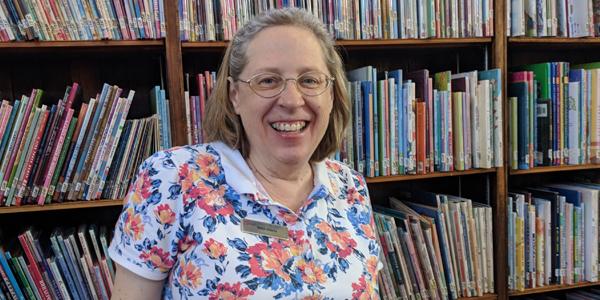
Gloria Bartas, an experienced children’s librarian, has a small group of 2-year-olds circled around her. During story time, she wants to help the children get moving and focused with a whole-body activity paired with a rhyme. She has designed a series of fun-but-challenging moves to go with “Wee Willie Winkie” (a Scottish nursery rhyme) to provide an outlet for the children’s excess energy and to eventually have them in a sitting-up position.
Gloria and the children lie faceup with their legs in the air. They bend their knees at their hips so their calves are parallel with the floor.
Wee Willie Winkie
Everyone kicks their feet.
runs through the town.
Continuing to kick their feet,
Upstairs,
they kick up toward the sky
Downstairs,
and down a little below knee level.
in his nightgown.
Gloria and the children sit up.
Tapping at the window
They clap three times.
Hollering in the lock,
They make noises by clicking
their tongues.
“Are the children in their beds,
Bringing their palms together, they lean their heads to the side to rest
on their hands.
it’s now eight o’clock.”
Gloria and the children bring their hands, with fingers wide open, in front of them and then move their thumbs in front of their palms so eight fingers are up.
Before starting the rhyme and movements again, Gloria takes a moment to show the children her 10 fingers and folds in her two thumbs to make eight. After repeating “Wee Willie Winkie” two more times, Gloria sees that the children are focused on her and are calm—ready to return to paying attention during story time.
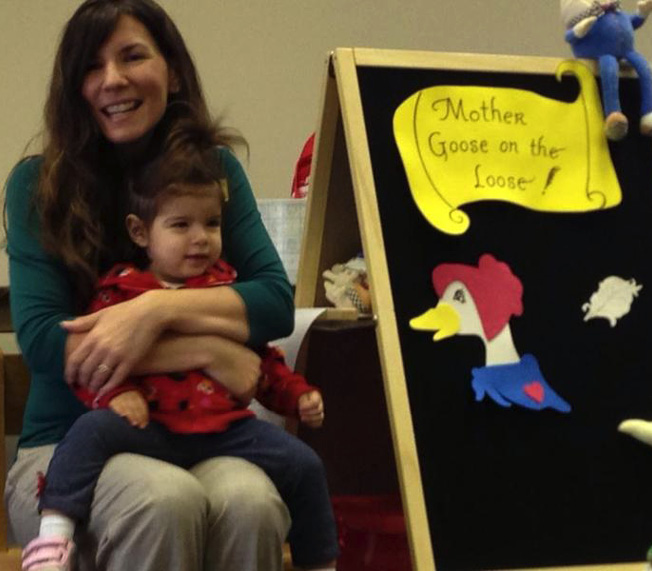 Gloria Bartas is a highly engaged children’s librarian dedicated to cultivating young readers. While her rendition of “Wee Willie Winkie” has a lot of her personality, it is an activity she learned by becoming a facilitator of Mother Goose on the Loose (MGOL). This research-based program is designed to be easy to implement in a wide variety of settings—from early childhood education centers to family child care homes to libraries. An educator uses nursery rhymes, songs, and related activities to help infants and toddlers develop oral language, preliteracy, social and emotional, and other kindergarten readiness skills in a nurturing environment. In 30-minute sessions, MGOL offers educators, parents, and other primary caregivers enjoyable ways to seamlessly incorporate various props into interactive rhymes designed to build self-esteem, connection, and curiosity. Based on the “Listen, Like, Learn” approach for teaching music to babies (which was designed by a retired opera singer, Barbara Cass-Beggs), MGOL focuses on the whole child while also promoting bonding (Cass-Beggs 1974, 1991). MGOL maximizes learning by incorporating repetition, rituals, movement, a joyful atmosphere, a safe environment, celebrations of successes, and individual recognition (Diamant-Cohen, Riordan, & Wade 2004). Core practices include talking, singing, reading, doing finger plays, and playing with infants and toddlers.
Although MGOL was originally designed as a public library program for parents with children from birth to 24 months, it has morphed into much more than that.
- Teachers of young children (birth through pre-K) use MGOL activities to enrich circle time, one-on-one time, and group activities.
- Early education centers and schools use MGOL activities to welcome new families into the school community and to give them fun educational activities that are easy to do at home.
- Programs support children with special needs and their families by adding sensory toys, braille picture books, and high-contrast felt pieces to MGOL activities.
- Programs serving homeless women who are suffering from traumatic experiences help young families find comfort by engaging in MGOL rhymes, songs, and movements (many of which do not require anything more than your voice and body).
How does MGOL work?
During standard MGOL sessions, a facilitator leads young children (or, in settings such as libraries or family workshops, children and their primary caregivers) through a variety of musical activities and finger plays. Rhymes—which are repeated twice and matched with fun activities—are accompanied by visual representations including book illustrations, flannel board pieces, and other props. Each session has the same 10 sequential sections, starting with passive finger plays and leading to musical instrument and colored scarf play. Approximately 80 percent of the program’s content is repeated from session to session, giving infants and toddlers a sense of stability that comes from knowing what to expect. The 20 percent of new activities keeps the program fresh and exciting. Following a predictable pattern, the musicality and repetition of rhymes and songs helps children to learn vocabulary, to easily recognize words, and to eventually feel like old friends (Diamant-Cohen 2019b).
MGOL facilitators strive to create a nurturing, nonjudgmental environment while forming positive connections with all participants (Diamant-Cohen, Riordan, & Wade 2004). Facilitators are encouraged to contribute their unique talents and personalities and to integrate their own interests into the program. Whether you are a guitar player or a dancer, MGOL is flexible and invites you to share yourself with the participants. This flexibility also means that you can easily adapt the program to incorporate songs and rhymes from your culture and the cultures of the children participating. Any rhyme, playground chant, camp song, or family heritage song that is short, rhythmic, and easy to chant or sing can qualify, allowing for a diverse selection of songs and rhymes.
MGOL activities
MGOL activities are designed to afford time for infants and toddlers to bond with their caregivers (including educators and family members), since all are active participants. Pleasurable interactions such as hugs, knee bounces, and peek-a-boo games stimulate children’s brains and strengthen relationships (Lally & Mangione 2017). Program facilitators often choose to teach MGOL to families (e.g., as welcoming activities for families who are new to an early education center or in parenting courses); they model early literacy practices and provide useful developmental tips, explaining the value of the activities and suggesting ways to implement them at home.
Playing fun language games in a group setting familiarizes children with sound patterns and syllables while promoting social engagement.
Playing fun language games in a group setting familiarizes children with sound patterns and syllables while promoting social engagement (Fisher et al. 2011). Games consisting of easily achievable tasks, such as pulling a felt character off of a flannel board, provide opportunities to practice turn-taking, following directions, and paying attention. Freeze games, such as flying like a bird until short music clips pause, help children practice stopping. Receiving positive reinforcement for successful completion of these challenges builds children’s sense of competence and enables them to experience the joy of following directions (NAEYC 2019). Giving positive reinforcement by clapping for others enables children to see beyond themselves to celebrate others’ achievements. Together, these purposeful play activities strengthen executive function skills by providing self-regulation practice and building self-esteem; both are important for school readiness, academic success, and future wellness (Diamond & Lee 2011; Jones, Greenberg, & Crowley 2015).
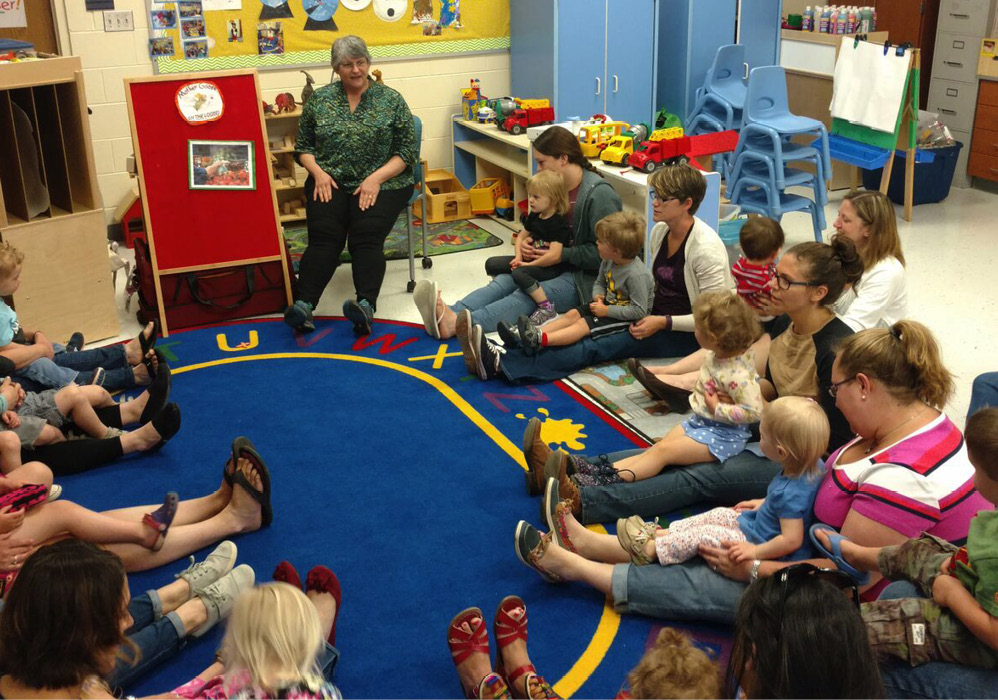
Rhymes about weather and animals build knowledge of the surrounding world (Mullen 2017). Playing with musical instruments and colored scarves allows for experimentation, observation of cause and effect, and creative expression (Diamant-Cohen et al. 2012). Music builds connections while nurturing children’s imagination and creativity (Lerner & Parlakian 2016). Tapping the syllables of one’s name on a drum helps children hear the sounds in words, which makes it easier for them to learn to write and read printed text (Winters & Griffin 2014). The age-appropriate listening, moving, and singing that takes place in MGOL activities exercises fine and gross motor skills, fosters speech development, and keeps children’s interest for an extended period of time.
What are the benefits of MGOL?
Studies have shown that children who enter kindergarten with large vocabularies and strong language comprehension are more successful in school (Morgan et al. 2015; Cartmill 2016). When children begin to identify flannel pieces, they learn that visual representations such as pictures or letters have meaning (Diamant-Cohen & Valakos 2007). The joyful exposure to rhymes and books in age-appropriate, multisensory ways helps children acquire a rich vocabulary, inspires them to want to learn to read, and builds reading readiness skills (Campbell, Helf, & Cooke 2008).
MGOL builds emergent literacy skills. For example, as a precursor to phonemic awareness, infants and toddlers are encouraged to pay attention to musical sounds and patterns such as fast/slow, high/low, and loud/soft. MGOL encourages language use and helps young children distinguish speech sounds by engaging them in reciting rhymes with alliteration; it introduces syllables through clapping to songs and playing musical instruments to the beat. MGOL nurtures appropriate responses to verbal cues, such as when an infant responds appropriately to a request to hit a drum or a toddler jumps over a candlestick. The applause they receive builds a sense of achievement. Children learn to be patient and take turns as well as to put toys away through cleanup songs. MGOL fosters motor coordination through interactive rhymes, movement games, and finger plays while simultaneously familiarizing children (and their families) with books and book illustrations. The social environment and participatory activities where very young children interact with other children of the same age build socialization skills.
Why nursery rhymes?
“Nursery rhymes are a socially engaging, playful, and developmentally appropriate way for young children to hear, identify, manipulate, and experiment with the sounds of language” (Harper 2011, 76). Studies indicate a direct correlation between nursery rhyme knowledge and phonological awareness in preschool children, and phonological awareness is essential for learning to read (Dunst, Meter, & Hanby 2011; Harper 2011). Knowing nursery rhymes before starting kindergarten is an indicator of early reading ability (Bryant et al. 1989; Bryant et al. 1990; Dunst, Meter, & Hanby 2011; Harper 2011). The rhyming patterns in nursery rhymes sensitize children to the sounds in words; being able to hear the smaller sounds in words is critical as children learn the sound–spelling correspondences that enable them to read (Moats & Tolman 2009; Huss et. al 2011).
The joyful exposure to rhymes and books in age-appropriate, multisensory ways helps children acquire a rich vocabulary and builds reading readiness skills.
Although nursery rhymes are short and easy to remember, they often expose children to new words that enrich their vocabularies. For instance, the lines “Jack be nimble, Jack be quick” and “I’m a little teapot, short and stout” use the words nimble and stout, which are not commonly heard. Through the context of the rhymes, children connect nimble with moving their bodies; by opening their arms wide while saying stout, they connect stout with being very wide.
Narrative skills develop when children learn sequences in stories and are able to follow along; many nursery rhymes tell short stories with a beginning, a middle, and an end (ALSC & PLA 2011; Neuman, Moland, & Celano 2017). Recognizing rhyme patterns and story sequences builds early math skills—also important for school readiness (Ginsburg, Lee, & Boyd 2008). These are supplemented by rhymes that involve counting, naming numbers, and talking about sizes.
Refreshing older rhymes
Some traditional Mother Goose rhymes contain disturbing words or images that we no longer want to use with our children (Prošić-Santovac 2015). Rather than discarding the rhymes, however, changing a few words can turn each rhyme into a winner (Birckmayer, Kennedy, & Stonehouse 2008). For instance, instead of the old woman living in the shoe whipping her children soundly, she can kiss them all soundly before sending them to bed, giving the rhyme a totally different flavor. One MGOL facilitator I met is not comfortable with the lyrics for “Baa Baa Black Sheep”:
Baa, baa, black sheep, have you any wool?
Yes sir, yes sir, three bags full!
One for the master,
One for the dame,
And one for the little boy
Who lives down the lane
She believes that “the master” is a reference to slavery, so she changed the lyrics (Diamant-Cohen 2019b):
Baa, baa, black sheep, have you any wool?
Yes, I have some—four bags full.
One for my mommy and one for my dad,
One for the little girl and one for the lad.
A facilitator who wants to avoid gendered language or who wants to teach about animals could change the lyrics even further:
Baa, baa, black sheep, have you any wool?
Why yes, I do, three bags full!
One for the brown bear,
And one for the toad,
One for the little duck
Who lives down the road.
Adapting Mother Goose on the Loose
Since MGOL was created over 20 years ago, it has evolved and expanded beyond the library to early care and education settings, classrooms, museums, and more. MGOL workshops train facilitators to use and then tailor the structure, activities, and information to fit programs they are already running or the new audiences with which they hope to work. Because everything can be adapted and workshop participants are not required to keep the program name, there is no way to count the number of MGOL programs or MGOL-influenced programs being presented today. Beyond the hundreds of known MGOL programs in the United States, documented versions of MGOL have engaged infants and toddlers in Argentina, Australia, Egypt, Honduras, India, Israel, Mexico, Morocco, and New Zealand—but its reach could be much wider. (To see how MGOL was adapted for use in neonatal intensive care units, see “Talking, Reading, Singing, and Rhyming: Tips for Fostering Literacy in Infancy.”)
Parents and grandparents enjoy sharing MGOL activities with their children at home. Recent immigrants begin to learn English by regularly participating in MGOL with their children in libraries. Rehabilitation programs teach parenting skills through MGOL. MGOL is being used to prevent educational inequities, to build cultural competence, and as a family engagement strategy. Many MGOL adaptations stem from partnerships between institutions, people, and communities (Diamant-Cohen 2019a). Here are some examples of adaptations designed to fit different needs and to reach the young children who need them the most.
- The Community Services of Venango County Early Head Start in Pennsylvania uses MGOL activities during the music and movement portion of home visits, adapting them to the needs of each specific family and expanding them to include sensory activities that target the development of specific skills. Their monthly newsletter features a MGOL rhyme of the month; it is used with other MGOL musical activities during Family Interaction Time.
- The Chicago Public Library presents MGOL sessions during outreach programming to local laundromats. Upon arrival, librarians walk through the laundromat and invite everyone with children to join in. Sessions begin with “Scrub a Dub Dub” to create a connection with soap and cleaning at the laundromat. Seniors are encouraged to stand along the periphery and clap out the rhymes!
- A partnership between United Way via the Success by 6 program and the Vigo County Public Library in Indiana established MGOL at the library and purchased a “Goosemobile” to enable outreach visits. The Goosemobile currently serves 32 child care centers and preschools; it also brings MGOL sessions to foster parent picnics and to community chili cook-offs and presents programs for female prisoners and their children.
- The San Francisco Public Library holds MGOL trainings specifically for local early care and education providers. It also offers several bilingual story times—including two in Chinese—that were inspired and informed by MGOL.
-
The Wicomico County Judy Center, in Maryland, invited the author of this article to be an educator-in-residence for a week at a time. Each week, Dr. Betsy presents MGOL programs for preschool classes held in elementary schools and home child care centers; offers private consultation time with teachers; creates portable felt boards and felt pieces for popular rhymes and leaves them with the Judy Center for future use; develops instructional sheets based on the weekly rhymes and activities that list targeted skills and describe how the activities can be applied to enhance daily classroom interactions; and presents a huge wrap-up MGOL program for all preschool students, teachers, and families.
Mother Goose on the Loose facilitators strive to create a nurturing, nonjudgmental environment while forming positive connections with all participants.
Several key features of MGOL have been essential to its broad appeal: its structure and repetition, its commitment to creating a nurturing and nonjudgmental environment, its inclusion of age-appropriate activities that offer a joyful introduction to the world of books, and its flexibility to incorporate a diverse array of songs and rhymes.
Get Started with Free Mother Goose on the Loose Videos
To support educators, librarians, and caregivers who want to engage in MGOL activities, there are over 400 short videos (most are under a minute) available for free. A large number of these videos feature experienced MGOL facilitators—including children’s librarian Gloria Bartas from the opening vignette—demonstrating rhymes, movements, and props. Watch Gloria perform her version of “Wee Willie Winkie.” For another of Gloria’s whole-body rhymes, this time featuring “Zoom, Zoom, Zoom, We’re Going to the Moon." As you’ll see, this song includes lots of movement. For infants and young toddlers, this is a great song to teach during a family workshop so that families can help their babies fly to the moon. For older toddlers, the movements can be done just as Gloria does them (flying themselves around instead of being lifted).
If you would like to implement the whole program, everything needed is available in one book: Mother Goose on the Loose, Updated! (Diamant-Cohen 2019b).
References
ALSC (Association for Library Service to Children) & PLA (Public Library Association). 2011. Every Child Ready to Read. 2nd ed. Atlanta, GA: ALA (American Library Association).
Birckmayer, J., A. Kennedy, & A. Stonehouse. 2008. From Lullabies to Literature: Stories in the Lives of Infants and Toddlers. Washington, DC: NAEYC (National Association for the Education of Young Children).
Bryant, P.E., L. Bradley, M. Maclean, & J. Crossland. 1989. “Nursery Rhymes, Phonological Skills and Reading.” Journal of Child Language 16 (2): 407.
Bryant, P.E., M. MacLean, L.L. Bradley, & J. Crossland. 1990. “Rhyme and Alliteration, Phoneme Detection, and Learning to Read.” Developmental Psychology 26: 429–38.
Campbell, M.L., S. Helf, & N.L. Cooke. 2008. “Effects of Adding Multisensory Components to a Supplemental Reading Program on the Decoding Skills of Treatment Resisters.” Education and Treatment of Children 31 (3): 267–95.
Cartmill, E.A. 2016. “Mind the Gap: Assessing and Addressing the Word Gap in Early Education.” Policy Insights from the Behavioral and Brain Sciences 3 (2): 187.
Cass-Beggs, B. 1974. To Listen, To Like, To Learn. Toronto: Peter Martin Associates.
Cass-Beggs, B. 1991. “How Music is First Introduced.” Ostinato 17: 120–21.
Diamant-Cohen, B. 2004. “Mother Goose on the Loose: Applying Brain Research to Early Childhood Programs in the Public Library.” Public Libraries 43 (1): 41–45.
Diamant-Cohen, B., E. Riordan, & R. Wade. 2004. “Make Way for Dendrites: How Brain Research Can Impact Children’s Programming.” Children and Libraries 2 (1): 12–20.
Diamant-Cohen, B., & D. Valakos. 2007. “Promoting Visual Literacy Using the Mother Goose on the Loose Program.” Public Libraries 46 (2): 47–54.
Diamant-Cohen, B., T. Prendergast, C. Estrovitz, C. Banks, & K. Van der Veen. 2012. “We Play Here! Bringing the Power of Play into Children’s Libraries.” Children and Libraries 10 (1): 3–10, 52.
Diamant-Cohen, B. 2019a. Mother Goose on the Loose: Here, There, and Everywhere. Chicago: ALA.
Diamant-Cohen, B. 2019b. Mother Goose on the Loose, Updated!. Chicago: ALA.
Diamond, A., & K. Lee. 2011. “Interventions Shown to Aid Executive Function Development in Children 4 to 12 Years Old.” Science 333 (6045): 959–64.
Dunst, C.J., D. Meter, & D.W. Hamby. 2011. “Relationship Between Young Children’s Nursery Rhyme Experiences and Knowledge and Phonological and Print-Related Abilities.” Center for Early Literacy Learning 4 (1): 1–12.
Fisher, K., K. Hirsh-Pasek, R.M. Golinkoff, D.G. Singer, & L. Berk. 2011. “Playing Around in School: Implications for Learning and Educational Policy.” In The Oxford Handbook of the Development of Play, ed. A.D. Pellegrini, 341–62.
Ginsburg, H.P., J.S. Lee, & J.S. Boyd. 2008. “Mathematics Education for Young Children: What It Is and How to Promote It.” Social Policy Report 22 (1): 3–11, 14–22.
Harper, L.J. 2011. “Nursery Rhyme Knowledge and Phonological Awareness in Preschool Children.” The Journal of Language and Literacy Education 7 (1): 65–78.
Huss, M., J.P. Verney, T. Fosker, N. Mead, & U. Goswami. 2011. “Music, Rhythm, Rise Time Perception and Developmental Dyslexia: Perception of Musical Meter Predicts Reading and Phonology.” Cortex 47: 674–89.
Jones, D.E., M. Greenberg, & M. Crowley. 2015. “Early Social-Emotional Functioning and Public Health: The Relationship Between Kindergarten Social Competence and Future Wellness.” American Journal of Public Health 105 (11): 2283–2290.
Lally, J.R., & P. Mangione. 2017. “Caring Relationships: The Heart of Early Brain Development.” Young Children 72 (2): 17–24.
Lerner, C., & R. Parlakian. 2016. “Beyond Twinkle, Twinkle: Using Music With Infants and Toddlers.” Zero to Three. www.zerotothree.org/resources/1514-beyond-twinkle-twinkle-using-music-wi....
Moats, L., & C. Tolman. 2009. “Why Phonological Awareness Is Important for Reading and Spelling.” LD Online: All About Learning Disabilities and ADHD. http://www.ldonline.org/article/28655/.
Morgan, P.L., G. Farkas, M.M. Hillemeir, C.S. Hammer, & S. Maczuga. 2015. “24-Month-Old Children with Larger Oral Vocabularies Display Greater Academic and Behavioral Functioning at Kindergarten Entry.” Child Development 86 (5): 1351–1370.
Mullen, G. 2017. “More Than Words: Using Nursery Rhymes and Songs to Support Domains of Child Development.” Journal of Childhood Studies 42 (2): 42–53.
NAEYC. 2019. Developmentally Appropriate Practice in Early Childhood Programs Serving Children Birth to Age 8, rev. 2nd draft. Position statement. Washington, DC: NAEYC.
Neuman, S.B., N. Moland, & D. Celano. 2017. Bringing Literacy Home: An Evaluation of the Every Child Ready to Read Program. Report. Chicago: ALA. http://everychildreadytoread.org/wp-content/uploads/2017/11/2017-ECRR-Re....
Prošić-Santovac, D. 2015. “Making the Match: Traditional Nursery Rhymes and Teaching English to Modern Children.” Children’s Literature in English Language Education 3 (1): 25–48. http://clelejournal.org/wp-content/uploads/2015/05/Prosic-Santovac-CLELE....
Winters, K.L., & S.M. Griffin. 2014. “Singing is a Celebration of Language: Using Music to Enhance Young Children’s Vocabularies.” Language and Literacy 16 (3): 78–91.
Photographs: courtesy of the author