Talking, Reading, Singing, and Rhyming: Tips for Fostering Literacy in Infancy

You are here
Through Mother Goose on the Loose (MGOL), educators, librarians, family members, and other caregivers have a wonderful set of activities to develop infants’ and toddlers’ language, literacy, social, and emotional skills. Wanting to bring a similar program to the families of newborns in intensive care, we worked with Betsy Diamant-Cohen to create a new version of MGOL—Goslings. Since infants in neonatal intensive care units tend to be in isolettes (also known as incubators) and are easily overstimulated, families may be unsure of how to interact with their infants. Goslings helps. Early indications suggest that Goslings improves families’ confidence in interacting with their infants and supports infants in getting the level of stimulation they need (which varies greatly from day to day).
In a one-hour group session, Goslings facilitators introduce caregivers to developmentally appropriate language and preliteracy activities paired with tips to foster sensitive and responsive interactions. Caregivers practice talking, reading, singing, and rhyming with lifelike dolls and mock isolettes. A key aspect of the program is drawing caregivers’ attention to how infants look and act when they are overstimulated versus when they are ready for interaction.
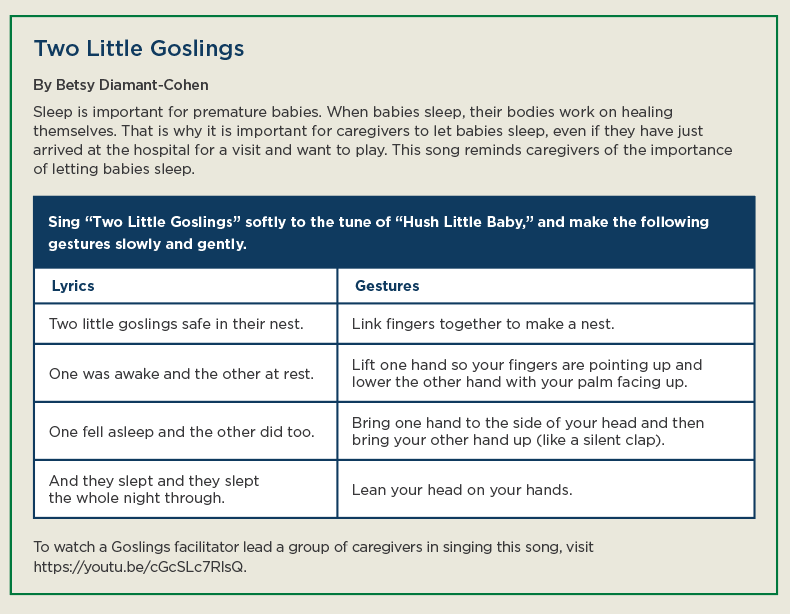
Watch Goslings facilitator lead a group of caregivers in singing the song in the chart above.
Although Goslings, to date, has only been offered in neonatal intensive care units (Shanty et al. 2019), the information presented in the program is appropriate for everyone caring for, bonding with, and educating infants. Here we provide several tips from Goslings that can be used by infant educators and shared with family members or other caregivers to help foster sensitive and responsive language and literacy interactions.
-
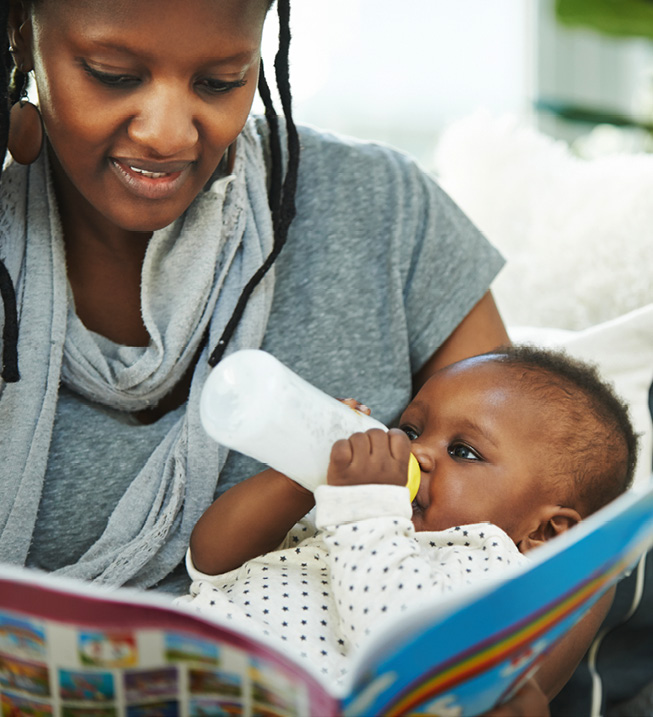 It’s never too early to start fostering language and literacy skills. Growing up in language- and print-rich environments has long-term positive benefits for children (Schmitt, Simpson, & Friend 2011). Make sure caregivers know that learning begins at birth.
-
Infants learn best through responsive, playful interactions in natural, everyday settings. Goslings recommends four types of language-rich activities caregivers can use with their infants: talking, reading, singing, and reciting nursery rhymes.
- Talking. Exposure to language in early childhood has been positively related to children’s later language and literacy abilities (Hart & Risley 1995; Hoff 2006). We recommend that caregivers first describe what is going on in the infant’s environment. For example, caregivers can describe what they are doing as they change an infant’s diaper. Describing shared interactions and pointing out and labeling objects in an infant’s environment is another great way to expose infants to language. Next, we recommend that caregivers respond to infant vocalizations. Infants make lots of sounds; caregivers can respond to these attempts to communicate by copying the sounds infants make and taking turns making different types of sounds (e.g., grunts, single-syllable sounds, raspberries). This game of “conversational” turn-taking is fun and sets a strong foundation for later language learning (Goldstein & Schwade 2008).
- Reading. Make sure that caregivers know the value of reading to infants. Research suggests that exposure to print-rich environments is important long before children can read (American Academy of Pediatrics 2014). Infants may not seem like they are paying attention, but they are listening and learning during these interactions. Caregivers can read as part of a bedtime routine. They can begin to develop routines from the day their infant is born. Storybooks can be used as a transition to bedtime. Caregivers can also get creative with books. They can read the words or describe the pictures to create a new story. Wordless picture books are great because the story is up to the teller each time.
- Singing. Singing is a great way to expose children to language, and studies have shown that singing is calming for both caregivers and infants (Loewy et al. 2013; Persico et al. 2017). Caregivers may be uncomfortable with the idea of singing, but remind them that infants don’t care about the quality of a singer’s voice; they like hearing the sound of their voice regardless of how good or bad a singer they may be. Songs can also be used to pass on traditions. Music and songs are important aspects of many cultures and religions. Caregivers can expose children to the songs they grew up singing with their families. Singing can serve the dual purpose of passing on traditions and fostering language development.
- Reciting nursery rhymes. Rhyming is an important skill because it exposes infants to language sounds and contributes to phonological awareness, which is critical in learning to read (Dunst, Meter, & Hamby 2011). Caregivers can turn to the classics and recite favorites from their childhood, or they can check out a book of rhymes from the library. Caregivers can also experiment by creating their own rhymes. To get started, try changing some words in a traditional nursery rhyme.
-
Consider incorporating toys into language-based interactions. Rattles, finger puppets, and other age-appropriate toys can be incorporated into daily language activities to promote sensory and language development. For example, while reciting nursery rhymes, caregivers can pretend that a finger puppet is talking. Remind caregivers that infants see best when items are held 8 to 10 inches from their eyes.
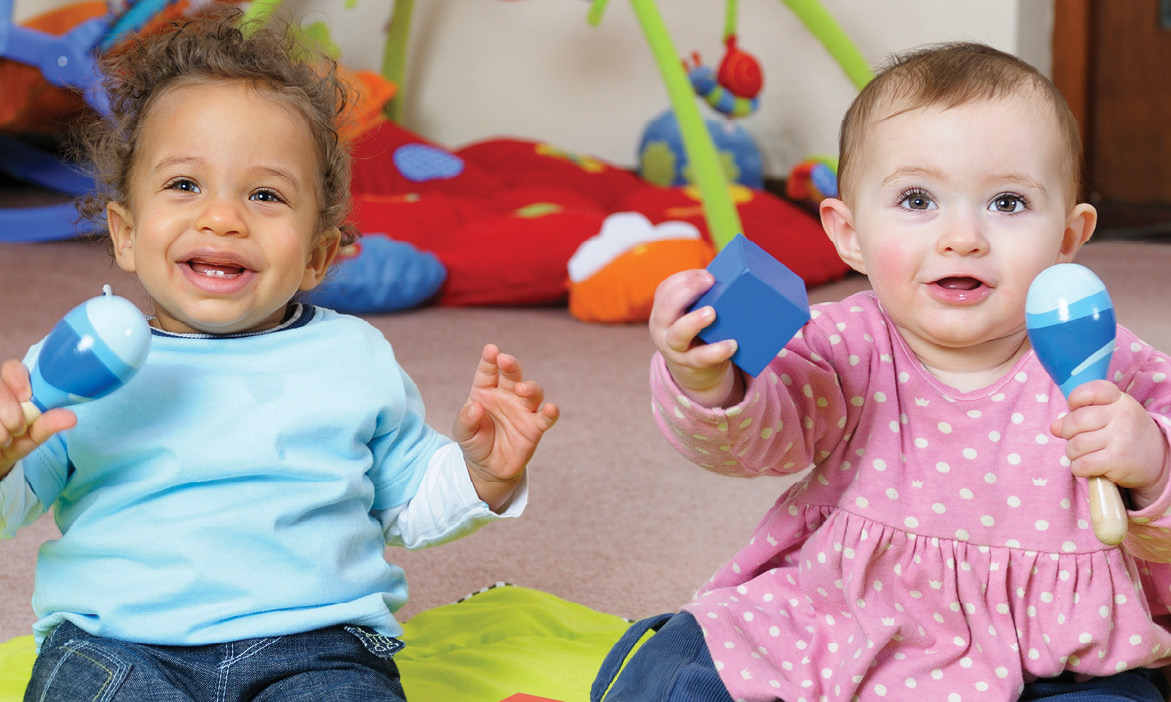
- Interactions should be pleasant for both caregiver and infant. Caregivers should approach interactions with infants with warmth and positivity by using a soft but enthusiastic voice and by being sensitive to the infant’s needs. Advise caregivers to be aware of the signs of overstimulation, such as fussiness, grimacing, and turning away. Caregivers should try to be responsive to these signals during interactions and change activities as appropriate. If an activity doesn’t work out, they can try again another time.
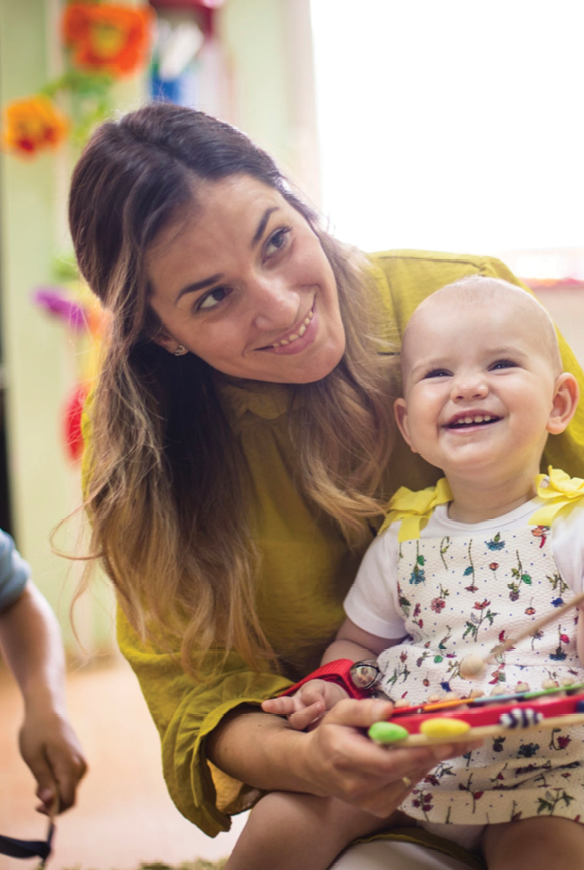 An intended outcome of Goslings is helping caregivers feel empowered and confident in their ability to be active participants in infants’ language and literacy development. We hope these tips can help caregivers feel ready to embark on a journey of lifelong language and literacy learning with their children.
References
American Academy of Pediatrics. 2014. “Literacy Promotion: An Essential Component of Primary Care Pediatric Practice.” Pediatrics 134 (2): 1–6.
Dunst, C.J., D. Meter, & D.W. Hamby. 2011. “Relationship Between Young Children’s Nursery Rhyme Experiences and Knowledge and Phonological and Print-Related Abilities.” Center for Early Literacy Learning 4 (1): 1–12. www.earlyliteracylearning.org/cellreviews/cellreviews_v4_n1.pdf.
Goldstein, M.H., & J.A. Schwade. 2008. “Social Feedback to Infants’ Babbling Facilitates Rapid Phonological Learning.” Psychological Science 19 (5): 515–23.
Hart, B., & T.R. Risley. 1995. Meaningful Differences in the Everyday Experience of Young American Children. Baltimore: Brookes.
Hoff, E. 2006. “How Social Contexts Support and Shape Language Development.” Developmental Review 26 (1): 55–88.
Loewy, J., K. Stewart, A. Dassler, A. Telsey, & P. Homel. 2013. “The Effects of Music Therapy on Vital Signs, Feeding, and Sleep in Premature Infants.” Pediatrics 131 (5): 902–18.
Persico, G., L. Antolini, P. Vergani, W. Costantini, M.T. Nardi, & L. Bellotti. 2017. “Maternal Singing of Lullabies During Pregnancy and After Birth: Effects on Mother-Infant Bonding and on Newborns’ Behaviour. Concurrent Cohort Study.” Women and Birth: Journal of The Australian College Of Midwives 30 (4): 214–20.
Schmitt, S.A., A.M. Simpson, & M. Friend. 2011. “A Longitudinal Assessment of the Home Literacy Environment and Early Language.” Infant & Child Development 20 (6): 409–31.
Shanty, L., R. Dowling, S. Sonnenschein, & B. Hussey-Gardner. 2019. “Evaluation of an Early Language and Literacy Program for Parents of Infants in the NICU.” Neonatal Network 33 (4): 206–16.
Photographs: © Getty Images