Educating Young Children in a Changing Climate: Impacts on Programs and Practices
You are here
It is through educators’ stories that I first realized what a changing climate means for early childhood education. I heard a center director describe how difficult the past few years have been because of increased flooding. Another administrator talked about grappling with whether to stay open on a day when the air was filled with smoke from wildfires. Still a third reflected on how to answer children’s questions about the “orange sky.”
Such stories highlight the operational and financial issues spurred by the climate as well as young children’s questions and concerns. These educators had not expected to deal with climate impacts in their daily work with children and families. But increasingly, they have had to reflect on how to respond with intention—and what supports they need to do so.
This issue of Young Children starts with an overview of climate impacts on programs and the policies needed as programs educate young children. The cluster then explores the issues raised by educators, administrators, and researchers and the solutions they are implementing. Grounded in the literature, authors describe how climate change affects educators, children, and programs in their local contexts; how educators integrate strategies, activities, and materials related to their surroundings in developmentally appropriate ways; and how policies and initiatives can support healthy environments for all. Woven throughout are reflections by practitioners, who share their stories of challenges, action, and hope.
The cluster begins with “Building Child Care Resiliency in the Face of a Changing Climate,” in which NAEYC and the Low-Income Investment Fund outline a multifaceted approach for policymakers and other stakeholders to ensure birth-to-5 programs can remain operational and safe for all educators and children.
As a former director, Lisa M. Beck reflects on one program’s journey toward environmentally sustainable choices and actions in “How One School Nurtures Environmental Stewardship.” She also shares program policy considerations that directors face as weather-related changes impact operations.
In “Connection, Curiosity, and Care: An E-STEM Approach to Climate Change Education in Early Childhood,” Victoria Carr, Julie Athman Ernst, and Sheila Williams Ridge present an approach to environment, science, technology, engineering, and mathematics that incorporates open-ended and intentional dialogue to respond to children’s observations about the reduced air quality and unseasonably warm weather they were experiencing firsthand.
Accompanying this is “Nature-Based Early Childhood Education: Examining Issues of Equity,” by Monica Wiedel-Lubinski. This is an excerpt from the book recently published by NAEYC, Nature-Based Early Childhood Education, in which the author discusses the challenges to equitable nature-based learning and ways of honoring children and families.
In “‘But What About the Butterflies?’ Empowering Children to Address Climate Change . . . One Caterpillar at a Time,” Rina Zampieron and Jennifer Feller reflect on their experiences integrating content and activities about black swallow-wort, a climate-induced invasive species in their area, into their curriculum.
Erin Hamel, Jingjing Xu, Liwei Zhao, Andree Champagne, Hong Tran, and Emily Adah Miller write about “Integrating Climate Change Conversations into Kindergarten and the Primary Grades.” Based on their study of project-based learning, they showcase how an elementary school educator developed integrated literacy, art, and science learning grounded in students’ experiences with flooding in their community.
Ben Mardell offers a final practitioner reflection in “What We Talk About Grows: The Critter Count,” sharing how children and adults started to attend to the animals in their city and how that attention—and the explorations and learning from it—grew over a year.
“Supports for Farm to Early Care and Education: Planting the Seed for Healthy Environments,” by Meagan K. Shedd and Cynthia Greene, describes how early learning programs connect to their local communities and sustainable practices through the food they provide. The authors also outline the policies and investments required to help achieve these and other farm to early care and education goals.
Educators are increasingly faced with curricular and operational challenges, such as extreme weather events, poor air quality, and flooding. Policies can be implemented to support programs, educators, and children in this evolving environment. As this issue shows, educators (and children) are showing resilience and hope. I hope both the policy and practical suggestions give you ideas and inspiration for your setting.
—Annie Moses
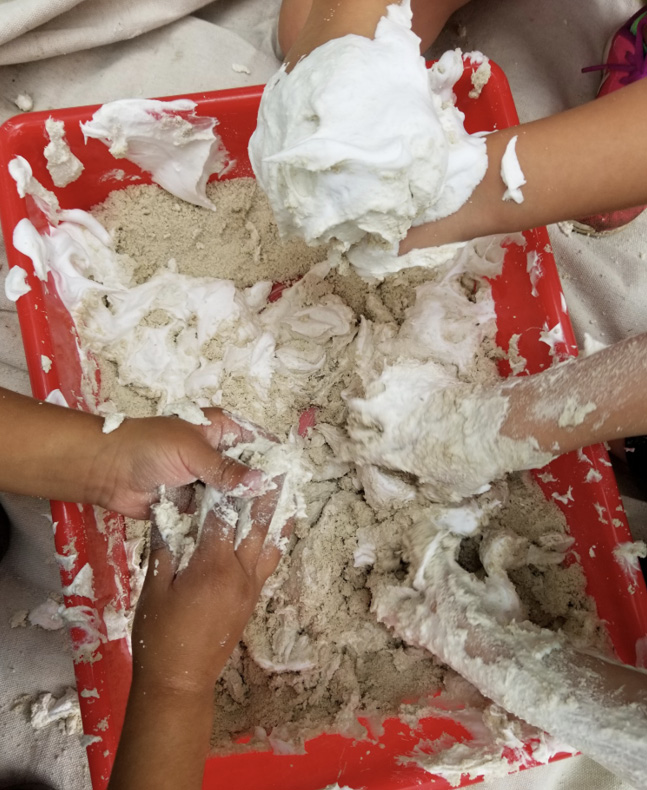
Children in Ms. Andrea’s 3-year-old class played with a mixture of sand and shaving cream as part of a sensory and art experience.
Is your classroom full of children’s artwork? To feature it in Young Children, see the link at the bottom of the page or email [email protected] for details.
We’d love to hear from you!
Send your thoughts on this issue, and on topics you’d like to read about in future issues of Young Children, to [email protected].
Would you like to see your children’s artwork featured in these pages? For guidance on submitting print-quality photos (as well as details on permissions and licensing), see NAEYC.org/resources/pubs/authors-photographers/photos.
Copyright © 2025 by the National Association for the Education of Young Children. See Permissions and Reprints online at NAEYC.org/resources/permissions.