NAEYC promotes high-quality early learning for all children, birth through age 8, by connecting practice, policy, and research. We advance a diverse early childhood profession and support all who care for, educate, and work on behalf of young children.
When children develop social and emotional skills, they experience positive effects in later life, including a general sense of wellness, increased quality of life, and self-empowerment.
Children start developing their self-image at a young age. As children grow, adults can help them form positive views or perceptions of themselves, including about their physical characteristics and behaviors.
NAEYC promotes high-quality early learning for all children, birth through age 8, by connecting practice, policy, and research. We advance a diverse early childhood profession and support all who care for, educate, and work on behalf of young children.
This article details a multifaceted, holistic approach for integrating social and emotional learning within the preschool day and offers ways that early childhood educators can adapt these practices to their own settings.
Authored by
Authored by:
Sara D. Hooks, Jennifer K. Pett, Janese Daniels, Nicole Vasanth
The Spring 2026 issue of Educating Young Children is focused entirely on the preschool-to-kindergarten transition and reading it this week hit me differently than it might have at any other time.
This year’s Voices of Practitioners compilation showcases five pedagogical narratives that each address how educators build empathy and belonging in classrooms, programs or schools, and communities.
NAEYC promotes high-quality early learning for all children, birth through age 8, by connecting practice, policy, and research. We advance a diverse early childhood profession and support all who care for, educate, and work on behalf of young children.
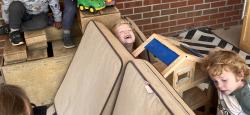
The story of Ben’s large-scale pretend play (physically, socially, and emotionally) and how our learning community engaged with it shows how we fostered a sense of belonging in our toddler classroom.
Sometimes our listening reinforces what we thought we knew—and sometimes it takes us in directions we didn’t anticipate, identifies consequences we didn’t envision, and helps us find solutions we hadn’t thought of.
In this issue of Young Children, authors present the meaning behind children’s behaviors and developmentally appropriate, equitable ways to respond to them.
As we reflect on what it means to transform our understanding of and approaches to children’s behaviors, let’s consider ways in which we are fostering an environment that supports young children’s social and emotional health and development.
In this issue of Young Children, authors present the meaning behind children’s behaviors and developmentally appropriate, equitable ways to respond to them.
NAEYC promotes high-quality early learning for all children, birth through age 8, by connecting practice, policy, and research. We advance a diverse early childhood profession and support all who care for, educate, and work on behalf of young children.