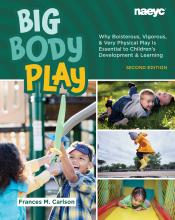
Big Body Play: Why Boisterous, Vigorous, and Very Physical Play Is Essential to Children's Development and Learning, Second Edition
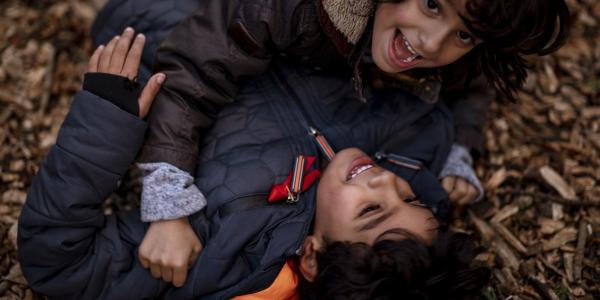
As children grow, the physical ways that they use their bodies naturally become rowdier, rougher, and riskier, especially in their play. But the climbing, leaping, running, and wrestling that many children love are often limited or shut down entirely by well-meaning adults. Author Frances Carlson—who coined the term big body play to describe the energetic, noisy kinds of play that children engage in—returns with this highly anticipated second edition to call attention to the pivotal role this play style has in children’s development and learning.
Drawing on evidence-based practice and the latest research, this updated and expanded resource
- Defines what big body play is and what it looks like for children from birth to age 8
- Delves into its benefits for children’s physical, social and emotional, cognitive, and language development and learning
- Breaks down myths, misperceptions, and biases surrounding this play style
- Provides strategies and ideas for how educators can create and maintain safe, supportive environments as well as adapt this play for all children
- And explores much more!
Discover why big body play belongs in your program—and how to safely support it for all children to enjoy!
Additional Book Information
Table of Contents
- About the Author
- About the Contributors
- Acknowledgments
- Introduction
- Chapter 1: What Is Big Body Play?
- Chapter 2: Play, Physical Activity, and Big Body Play in Particular
- Chapter 3: The Benefits
- Chapter 4: Debunking Myths and Misperceptions
- Chapter 5: Acknowledging and Breaking Down Biases
- Chapter 6: The Teacher’s Role
- Chapter 7: Adapting Big Body Play
- Chapter 8: Community Building with Educators and Families
- List of Online Appendices
- References
- Index
Online Appendices
To access the online appendices that complement content from the book, please complete this form. You'll be able to download these resources after you complete the form.
Book Details
Product Code: 1179
ISBN: 978-1-952331-46-6
Publish Date: 2026
Citation (in Chicago 18th ed. style): Carlson, F.M. 2026. Big Body Play: Why Boisterous, Vigorous, and Very Physical Play Is Essential to Children's Development and Learning. 2nd ed. NAEYC.

Reviews
Big Body Play is a powerful reminder that active, joyful, and physically engaging play is not optional in early childhood—it is essential to healthy development, learning, and well-being. This book is an invaluable resource for educators and caregivers alike.
—Stephanie Morris, Former CEO, SHAPE America (Society of Health and Physical Educators)
We say we want strong, smart, sociable children, yet we restrict the very play that builds those skills. Frances Carlson beautifully details why big body play matters and how early childhood educators can make it happen.
—Rae Pica, Early Childhood Education Consultant and Author, Rae Pica Keynotes and Consulting
Big Body Play reframes children’s rough-and-tumble movements—not as behavior to manage but as child-directed learning. This second edition shows how jumping, climbing, and physical risk taking develop confidence, social negotiation skills, and natural engagement with biomechanics and spatial reasoning.
—Anne Karabon, Wendell and Marlys Thompson Director, School of Education, Counseling, and Human Development, and Associate Professor, Early Childhood Education, South Dakota State University
This resource does a great job helping educators and families interpret and support physical play behaviors, an important developmental topic. Big Body Play will help bring about a contextual shift in children’s play.
—Garnett Booker, Kindergarten Teacher, Arlington Public Schools