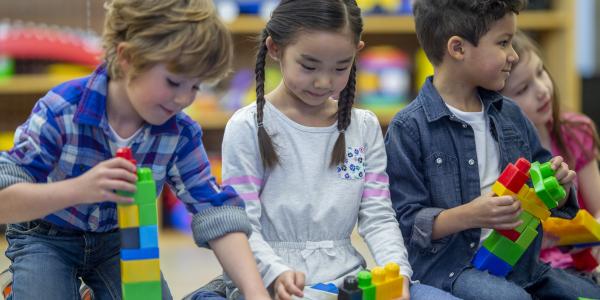
STEM learning does not begin with worksheets, formal lessons, or expensive technology. It begins with play; when children build, test ideas, move their bodies, explore materials, and make sense of the world through hands-on experiences. Powerful learning happens when teachers intentionally support children’s play.
Young children are natural engineers and problem solvers. As they plan, experiment, negotiate, and revise their ideas, they are building the foundational thinking that supports science, technology, engineering, and mathematics (STEM) throughout their lives.
Two recent NAEYC books, Computational Thinking for Preschoolers: Nurturing Creative Thinkers and Problem Solvers by Joohi Lee and Making and Tinkering with STEM: Solving Design Challenges with Young Children, Second Edition by Cate Heroman, offer powerful reminders that STEM learning is already happening in early childhood interactions. With intentional support from educators, playful moments become rich opportunities.
Below are two practical ways STEM starts with play, along with real-world examples from the books that you can implement today in your program or classroom.
1. Sequencing Movements and Solving Problems Through Outdoor Play (Computational Thinking)
Outdoor play naturally supports computational thinking. When children navigate their environment, moving through space, watching how objects behave, or following a series of steps, they are building skills such as sequencing, decomposition, prediction, and iteration – the core of computational thinking.
Try This: A Child-Created Obstacle Course
Invite children to design a simple obstacle course using materials already in your outdoor play area.
What children do:
- Arrange the course in a sequence
- Predict how they will move through it
- Adjust when something is difficult
- Try again and refine their plan
What they are learning:
These actions mirror the computational thinking process described by Lee, breaking a challenge into smaller steps, following and revising a sequence (algorithmic thinking), recognizing patterns, and persisting when something does not work the first time. That’s what computational thinking is. And you’re probably already doing it in your program.
How educators can extend it:
- Ask children to map out the course before trying it
- Encourage them to redesign a tricky part
- Invite children to explain how they solved the course
A simple physical activity becomes a meaningful CT experience when educators highlight children’s thinking and make space for them to plan, test, and revise.
2. Exploring Materials and Engineering Through Open-Ended Building (Making and Tinkering with STEM)
Tinkering experiences give children opportunities to test ideas, explore material properties, and create solutions. When children design structures, instruments, or moving objects, they practice key engineering habits such as observing, predicting, balancing, stabilizing, and improving.
Try This: Build a Fort
Provide clothespins, cardboard pieces, blankets, clips, and other materials readily available in your program, and invite children to design a fort together.
What children do:
- Negotiate roles and share materials
- Test different ways to stabilize walls
- Compare how fabrics drape or attach
- Strengthen weak spots when the structure shifts
What they are learning:
Heroman highlights how experiences like fort building help children explore stability, balance, spatial reasoning, and the properties of materials. They practice planning, trying, revising, and explaining their ideas, all essential engineering behaviors.
How educators can extend it:
- Ask open-ended questions such as “What could make this stronger?”
- Encourage children to sketch their ideas before building
- Introduce a new constraint such as “Build a fort big enough for three friends”
- Document the process through photos or children’s reflections
This kind of tinkering is powerful because it blends creativity, collaboration, and problem solving. Children learn not only what works, but why it works.
STEM Grows When Educators Name, Notice, and Nurture It
Across both books, is a shared message: STEM learning thrives when educators create environments where children feel safe to explore and confident trying new ideas.
You do not need specialized materials or scripted lessons to support STEM. You only need:
- Open-ended materials
- Time for children to test and revise ideas
- Thoughtful questions
- Opportunities for children to explain their thinking
From outdoor obstacle courses to cardboard forts, play is where STEM begins and where children discover they are capable problem solvers and creative thinkers.
References
Heroman, C. (2025). Making and Tinkering with STEM:, Solving Design Challenges with Young Children, Second Edition. NAEYC.
Lee, J. (2025). Computational Thinking for Preschoolers: Nurturing Creative Thinkers and Problem Solvers. NAEYC.
Nicole Santa is the Director of Marketing at NAEYC, with over 20 years of experience in the early childhood education field as an educator and program director, and over a decade in early childhood education marketing leadership.