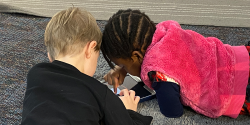
However, decades of research and professional practice point to the potential of technology and media, especially when the content is of high quality and created for educational purposes with young children.
Authored by
Authored by:
Rachel Konerman, Jennifer Horwitz, Sarah Clancy, Carmen Rietta
What Is Developmentally Appropriate Technology for Preschool?
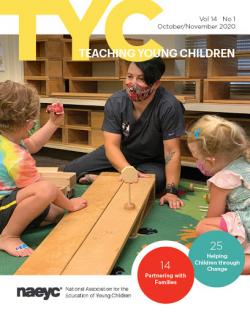
Teaching Young Children is NAEYC's magazine for anyone who works with preschoolers. Colorful, informative, and easy-to-read, TYC is packed full of teaching ideas, strategies, and tips.
The Costa Rica Ministry of Education has developed I Learn at Home, a learning initiative to facilitate the use of technological resources and distance instruction to support the educational process during this period of social distancing.
The Costa Rica Ministry of Education has developed I Learn at Home, a learning initiative to facilitate the use of technological resources and distance instruction to support the educational process during this period of social distancing.
Mathematics activities can contribute to later success in both math and reading, but activities focused on math and spatial learning can also be really fun and playful for young children—and for their teachers!
Authored by
Authored by:
Ashley Lewis Presser, Danae Kamdar, Ximena Dominguez
This article discusses why engineering is important in the early years, what are core elements of engineering, and how you can foster engineering in your setting.
Authored by
Authored by:
Katherine Laguzza, Katherine Katzer, Mary Eileen McDonnell, Christine Cunningham
Young children love to explore the world around them—and STEM activities are a great way to help them do it. With so many STEM ideas to choose from, how do you find what is best for your child?
Young children love to explore the world around them—and STEM activities are a great way to help them do it. With so many STEM ideas to choose from, how do you find what is best for your child?
When you go online to search for a science activity, how can you know which activities will really help children build knowledge about STEM (science, technology, engineering, and math) and support their scientific thinking?
In this article, we explore a project whose goal is to use home- and community-based knowledge and concepts with which children are already familiar to introduce new topics around science and engineering in preschool.
Authored by
Authored by:
Christine M. McWayne, Jayanthi Mistry, Sunah Hyun, Virginia Diez, Cynthia Parker, Betty Zan, Daryl Greenfield, Kimberly Brenneman
In this article, we explore a project whose goal is to use home- and community-based knowledge and concepts with which children are already familiar to introduce new topics around science and engineering in preschool.
Authored by
Authored by:
Christine M. McWayne, Jayanthi Mistry, Sunah Hyun, Virginia Diez, Cynthia Parker, Betty Zan, Daryl Greenfield, Kimberly Brenneman
If you join children during their play and ask open-ended, person-oriented and process-oriented questions, you can gain information about what each child understands and is coming to understand.
Fostering Content Knowledge: Meaningful Integration in the Primary Grades
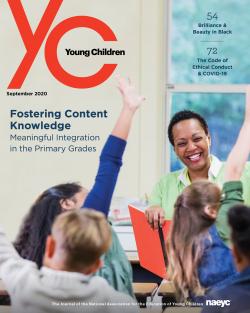
The September 2020 issue of Young Children includes a cluster of articles that showcase the power of integrating science, math, technology, literacy, and social studies to make learning meaningful and content-rich across the primary grades.
There are many different types of questions you can ask to encourage children to share their ideas and to guide them toward greater STEAM knowledge and inquiry skills.