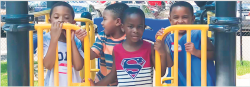
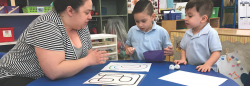
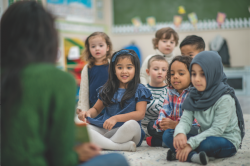
To be responsible, children must notice what needs to be done, think of useful options, and take pride in their contributions. Here’s how to encourage responsibility.
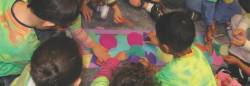
This article describes a program that combines exploratory art experiences with intentional teaching moments and offers suggestions for how teachers can organize their own programs.
Authored by
Authored by:
X. Christine Wang, Keely Benson, Corinne Eggleston, Bin Lin
A teacher conducted a pilot study to better understand how the children in her classroom were acquiring multiple languages and how to most effectively support them in the process.
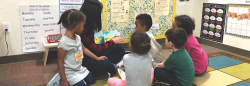
The SEEDS approach to repeated read alouds offers teachers a structured, emotionally supportive, and intentional way to increase children’s language and literacy development.
Speech-language pathologists can help teachers understand which communication behaviors are typical for a particular age range and which ones indicate a need for assessment and possibly an intervention.
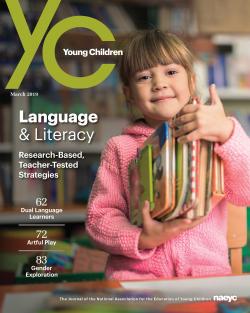
Early childhood teachers play a key role as children develop literacy. While this cluster does not cover the basics of reading instruction, it offers classroom-tested ways to make common practices like read alouds and discussions even more effective.
Ed Zigler was a man of passion, of dedication, of consummate intelligence, and of incredible street smarts. He was a man who knew what he wanted to get done, and he did it.
As children explore and observe nature, they become more aware of, and empathetic to, the plants and animals who share the natural world. Try these nature-based mindful activities indoors or outdoors with your tots!
For some young children, the transition from home to school is tough. Sometimes a little celebration of progress is just what children, and their teachers, need.
At NAEYC’s 2018 Annual Conference, a highlighted session by Sesame Workshop and the International Rescue Committee, shared the most recent and innovative early childhood education initiatives for young children affected by the Syrian refugee crisis.
Asking a child about his behavior can stop the behavior as it is happening and get him to think about it. The best questions are ones that require more than a yes-or-no answer. Here are some examples.
NAEYC members have recommended many children's books and resources to help children who experience the death of a loved one. If you ever need to support a child at such a time, we encourage you to refer to this list of resources.