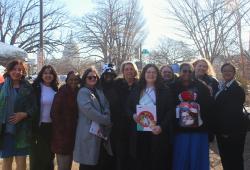
This Congress, NAEYC has endorsed bipartisan, legislation introduced in the House and the Senate to reauthorize the Child Care and Development Block Grant (CCDBG) – the Child Care Modernization Act.
Year of Reflections highlights the journeys, relationships, and lived experiences that shape early childhood education across generations and communities.
NAEYC promotes high-quality early learning for all children, birth through age 8, by connecting practice, policy, and research. We advance a diverse early childhood profession and support all who care for, educate, and work on behalf of young children.
NAEYC promotes high-quality early learning for all children, birth through age 8, by connecting practice, policy, and research. We advance a diverse early childhood profession and support all who care for, educate, and work on behalf of young children.
As part of NAEYC’s centennial, Year of Reflections highlights the journeys, relationships, and defining moments that shape careers in early childhood education.
NAEYC promotes high-quality early learning for all children, birth through age 8, by connecting practice, policy, and research. We advance a diverse early childhood profession and support all who care for, educate, and work on behalf of young children.
When children develop social and emotional skills, they experience positive effects in later life, including a general sense of wellness, increased quality of life, and self-empowerment.
Good nutrition is important for promoting healthy growth and development in young children, who are rapidly developing mentally and physically in the early years.
Children start developing their self-image at a young age. As children grow, adults can help them form positive views or perceptions of themselves, including about their physical characteristics and behaviors.
NAEYC promotes high-quality early learning for all children, birth through age 8, by connecting practice, policy, and research. We advance a diverse early childhood profession and support all who care for, educate, and work on behalf of young children.
NAEYC promotes high-quality early learning for all children, birth through age 8, by connecting practice, policy, and research. We advance a diverse early childhood profession and support all who care for, educate, and work on behalf of young children.
NAEYC promotes high-quality early learning for all children, birth through age 8, by connecting practice, policy, and research. We advance a diverse early childhood profession and support all who care for, educate, and work on behalf of young children.
NAEYC promotes high-quality early learning for all children, birth through age 8, by connecting practice, policy, and research. We advance a diverse early childhood profession and support all who care for, educate, and work on behalf of young children.
NAEYC promotes high-quality early learning for all children, birth through age 8, by connecting practice, policy, and research. We advance a diverse early childhood profession and support all who care for, educate, and work on behalf of young children.
NAEYC promotes high-quality early learning for all children, birth through age 8, by connecting practice, policy, and research. We advance a diverse early childhood profession and support all who care for, educate, and work on behalf of young children.
NAEYC promotes high-quality early learning for all children, birth through age 8, by connecting practice, policy, and research. We advance a diverse early childhood profession and support all who care for, educate, and work on behalf of young children.
Early childhood educators are responsible for ensuring children’s well-being. This includes teaching them about healthy habits, such as eating well and getting enough exercise.
Authored by
Authored by:
Sydney Yance, Chelsea Pansé-Barone, Julie C. Parker, Lori Elmore-Staton
Strong leadership is crucial in early childhood education settings. Many education leaders begin their careers as teachers. Carlyn Rahynes, founding principal of Learning Through Play Pre-K Center in the Bronx, New York, is no exception.
As we reach the midway point in NAEYC’s centennial year, we’re reflecting on where we’ve been as the membership organization for tens of thousands of early childhood education professionals.