Some of the Most Important Work in the Room Is Happening on the Floor

There is a moment every early childhood educator knows. A child is deep in play, completely absorbed, doing something that looks, to an untrained eye, like nothing in particular. And the educator sees it: the math, the language, the executive function, the neural architecture being built in real time.
The challenge has never been seeing it. The challenge has been making everyone else see it too.
That sits at the center of NAEYC’s work, and it is exactly what episode two of Small Talk: Big Ideas About Little Learners is built to address. When NAEYC CEO Michelle Kang sits down with Dr. Kathy Hirsh-Pasek, Professor of Psychology at Temple University, the conversation that unfolds is not just a compelling listen. It is the latest chapter in a body of work NAEYC has been assembling for decades.
The Research Has Always Said This
Kathy’s framing is deceptively simple: the characteristics that define how the human brain learns map directly onto the characteristics of play. Active. Engaging. Meaningful. Socially interactive. Iterative. Fun.
“How come so much of school is passive and distracting and sometimes not meaningful?” she asks. “We could change all that and it could be amazing to have joyful schools, joyful teaching, and deeper learning.”
This is not a new argument. It is a well-documented one that keeps having to be made. Kathy points to a 2025 study on world-class performers showing that children who meandered and explored widely outperformed those who specialized early. She also points to research on early literacy and math: block play builds the spatial language that predicts later math skills, storytelling predicts reading comprehension better than early phonics instruction, and number sense develops at the ice cream counter long before it develops on a worksheet.
“I assure you,” Kathy says, “they know about addition, subtraction, and mathematics when they go into that ice cream store.”
Where Developmentally Appropriate Practice Lives in This Conversation
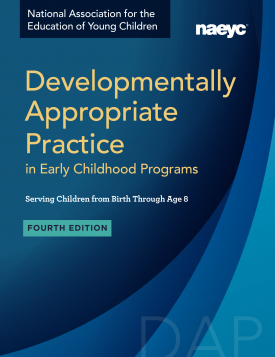
Kathy is not just a podcast guest. She is a contributing author to Developmentally Appropriate Practice in Early Childhood Programs Serving Children from Birth Through Age 8, Fourth Edition, NAEYC’s foundational text on how children learn and what high-quality early education actually looks like in practice.
Chapter 5, which Kathy co-authored, shows guided play in action across the full age span: first graders reporting on the weather through STEM-based exploration, toddlers discovering cause and effect through building and knocking over blocks, kindergarteners investigating animal habitats in dramatic play, preschoolers uncovering the properties of triangles through hands-on discovery.
These examples are not illustrations of enrichment. They are illustrations of curriculum implementation that consider how we teach, not just what we teach. The chapter makes the case that guided play, the intentional space between free exploration and direct instruction, is where skilled educators do their most powerful work. Teachers who know where the learning staircase leads, and who offer the next step at exactly the right moment without taking over, are practicing what the research supports.
The podcast brings that argument to life. Kathy describes a classroom visit in Colombia: a teacher with no paper, just a piece of chalk, drawing a number line in hardened mud. She steps back. Children jump on the line, compare distances, and fill the numbered boxes with rocks and leaves. They discover that four is greater than three entirely on their own. The teacher names what they found.
“The kids discovered it, explored it, and the teacher highlighted it,” Kathy says. “Amazingness.”
That is the DAP book, animated.
What the Position Statement Establishes
NAEYC’s position statement on Developmentally Appropriate Practice is explicit: play promotes joyful learning that builds self-regulation, language, cognition, and social competencies. It is essential for all children from birth through age 8. Not as a philosophy but as a principle.
That principle matters because play is under pressure. Highly scripted, test-focused curricula have displaced play-based learning in too many programs, particularly those serving children in under-resourced communities. The field needs a shared, research-grounded framework to push back. DAP is that framework.
The podcast is one way to make it accessible. When Kathy explains that games like Simon Says build executive function, that taking turns on the playground develops impulse control, that growing up bilingual builds cognitive flexibility, she is translating years of research into language that translates into language educators can use with parents, administrators, and policymakers who are still asking when the learning happens.
Building for This Moment
The DAP book grounds play in research and practice. The position statement outlines the research behind why it is so important for children's learning and development. The podcast makes it human and shareable. The resources below extend it into specific settings and age groups.
Together they form a complete case: from the science of how children learn, to the framework for how educators teach, to the public case for why it all deserves investment.
Kathy closes the conversation with a direct challenge to anyone who still isn’t sure: come into a high-quality early childhood program for two hours. Watch what educators do. Then try to argue it isn’t essential work.
NAEYC has been making that argument for 100 years. This is the latest version of it.
Listen to Episode 2 of Small Talk: Big Ideas About Little Learners
Go Deeper


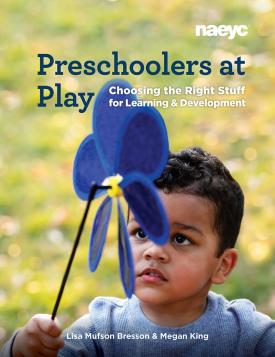
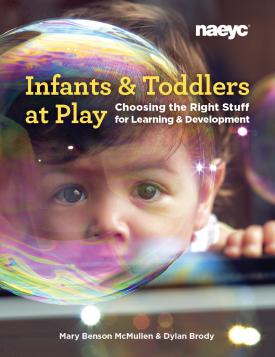
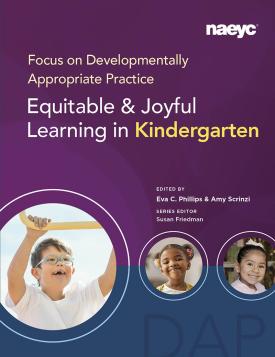
Coming in September: The fall issue of our member-exclusive academic journal, Young Children, will focus on integrating guided play and hands-on learning showing how educators use guided play to build on children’s interests, meet learning goals, and advance equity in a wide range of early childhood settings. Join now for access when it releases.