The specified file temporary://file6PgNih could not be copied, because the destination directory is not properly configured. This may be caused by a problem with file or directory permissions. More information is available in the system log.
The specified file temporary://filesAZ1Gl could not be copied, because the destination directory is not properly configured. This may be caused by a problem with file or directory permissions. More information is available in the system log.
The specified file temporary://file6A8aQ0 could not be copied, because the destination directory is not properly configured. This may be caused by a problem with file or directory permissions. More information is available in the system log.
The specified file temporary://file1e9xDu could not be copied, because the destination directory is not properly configured. This may be caused by a problem with file or directory permissions. More information is available in the system log.
The specified file temporary://filekfkmCO could not be copied, because the destination directory is not properly configured. This may be caused by a problem with file or directory permissions. More information is available in the system log.
The specified file temporary://filekbLw9o could not be copied, because the destination directory is not properly configured. This may be caused by a problem with file or directory permissions. More information is available in the system log.
The specified file temporary://file12mG9A could not be copied, because the destination directory is not properly configured. This may be caused by a problem with file or directory permissions. More information is available in the system log.
The specified file temporary://fileR3Vq9I could not be copied, because the destination directory is not properly configured. This may be caused by a problem with file or directory permissions. More information is available in the system log.
The specified file temporary://fileBuHBos could not be copied, because the destination directory is not properly configured. This may be caused by a problem with file or directory permissions. More information is available in the system log.
The specified file temporary://fileAFp3LC could not be copied, because the destination directory is not properly configured. This may be caused by a problem with file or directory permissions. More information is available in the system log.
The specified file temporary://fileYKwoL6 could not be copied, because the destination directory is not properly configured. This may be caused by a problem with file or directory permissions. More information is available in the system log.
The specified file temporary://fileU1OAB7 could not be copied, because the destination directory is not properly configured. This may be caused by a problem with file or directory permissions. More information is available in the system log.
The specified file temporary://filem6i8NR could not be copied, because the destination directory is not properly configured. This may be caused by a problem with file or directory permissions. More information is available in the system log.
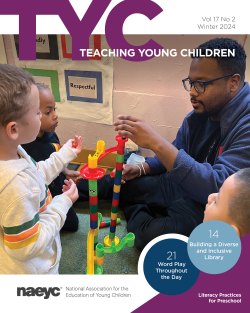
Teaching Young Children is NAEYC's magazine for anyone who works with preschoolers. Colorful, informative, and easy-to-read, TYC is packed full of teaching ideas, strategies, and tips.
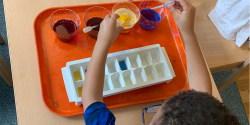
In this article, we describe how early childhood educators can purposefully plan for and scaffold vocabulary learning during open-ended art activities.
When reading together, families can support early language and comprehension skills by offering short sentence stems, or sentence starters, to help children share what they are thinking and learning.
In this article, we will explore what is known about using mentor texts in the early childhood classroom and provide suggestions for how to effectively choose and use them in kindergarten instruction.
By creating a classroom that stimulates wonder and encourages curiosity, teachers can tap into young children's interest in understanding their physical and social worlds.
Authored by
Authored by:
Kathryn Lake MacKay, Kim Collett Plank, Cindy Sanders, Cassy Lewis
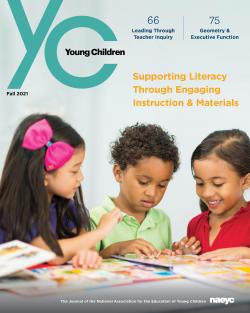
Supporting Literacy Through Engaging Instruction & Materials
The Fall 2021 issue of Young Children includes a cluster of articles offering a variety of practices and materials to help early childhood educators foster a love of literacy and support early reading, writing, listening, and speaking development.
In our ongoing work, we have identified four factors that influence the degree to which teachers are able to fuel science inquiry with multilingual learners while simultaneously promoting equitable and inclusive classroom science environments.
Authored by
Authored by:
Cindy Hoisington, Jessica Mercer Young, Jeff Winokur
Through the following examples, we aim to show how teachers can support young children’s growth in ways that are important to emergent writing development, with a focus on content knowledge, genre knowledge, and visual literacy.
Authored by
Authored by:
Carol A. Donovan, Diane C. Sekeres, Cailin Jane Kerch
In this article, the strategies we used for adapting our chosen curriculum to develop students’ critical thinking skills, language and literacy skills, and world knowledge.
Encouraging science through research-based teaching practices may be one way to increase teacher facilitation of early science education and promote language and literacy learning.
Authored by
Authored by:
Jill M. Pentimonti, Hope K. Gerde, Arianna E. Pikus
These kinds of conversations and interactions are laced with language-supporting activities, including activities that promote vocabulary and world knowledge accumulation.
Rich conversations help to build your child’s language and literacy development. Try the following activities the next time you are doing a load of laundry.
For young children, listening to, reading, writing, and illustrating informational texts is a great way to build knowledge and vocabulary in science, social studies, and the arts—and a great foundation for success in school and life.