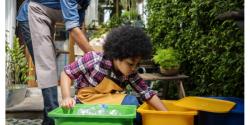
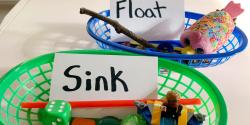
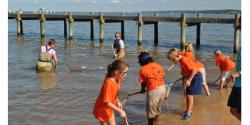
When you go online to search for a science activity, how can you know which activities will really help children build knowledge about STEM (science, technology, engineering, and math) and support their scientific thinking?
Through the following examples, we aim to show how teachers can support young children’s growth in ways that are important to emergent writing development, with a focus on content knowledge, genre knowledge, and visual literacy.
Authored by
Authored by:
Carol A. Donovan, Diane C. Sekeres, Cailin Jane Kerch
In this article, the strategies we used for adapting our chosen curriculum to develop students’ critical thinking skills, language and literacy skills, and world knowledge.
Promoting justice and knowledge in our youngest learners (and ourselves) could lead to lasting and deep community engagement, empowerment, and evolution.
Authored by
Authored by:
Veronica Benavides, Roxanne Ledda, Maimuna Mohammed
If you join children during their play and ask open-ended, person-oriented and process-oriented questions, you can gain information about what each child understands and is coming to understand.
Here are three strategies you (as the teacher) can use to help families turn picture books into tools to prompt rich conversations about expressing feelings, gaining self-esteem, showing perseverance, and many other important skills.
Our commitment to partnering with families has not changed. We are providing remote services that prioritize relationships and we are connecting with families using social media, sending weekly text messages to all, and reaching out to each family.
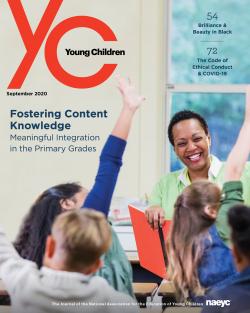
Fostering Content Knowledge: Meaningful Integration in the Primary Grades
The September 2020 issue of Young Children includes a cluster of articles that showcase the power of integrating science, math, technology, literacy, and social studies to make learning meaningful and content-rich across the primary grades.
The following article shares three principles for teachers of grades 1–3 who wish to attempt or refine an interdisciplinary approach uniting informational text instruction with social studies content.
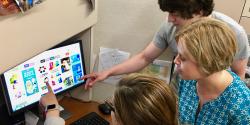
Our findings suggest that using screencasting apps can provide more equitable learning opportunities as teachers require all students to justify their mathematical ideas.
Encouraging science through research-based teaching practices may be one way to increase teacher facilitation of early science education and promote language and literacy learning.
Authored by
Authored by:
Jill M. Pentimonti, Hope K. Gerde, Arianna E. Pikus
Just as infants and toddlers need experience crawling or scooting to learn to walk and babbling and crying to learn to talk, they need to practice using their hands to control art supplies and practice using their minds to figure out how art supplies work