Social- emotional learning (SEL) is the foundation and heartbeat of the classroom. Students need to feel connected, safe, and secure, before we even begin to address academics. T
Our bi-weekly all staff virtual meetings included personal check-ins. During these moments of truth-telling and tears, teachers expressed loneliness and fears.
Our commitment to partnering with families has not changed. We are providing remote services that prioritize relationships and we are connecting with families using social media, sending weekly text messages to all, and reaching out to each family.
This module provides teachers with classroom examples and practical strategies to enhance their awareness of how cultural practices are deeply embedded in children and families behavior.
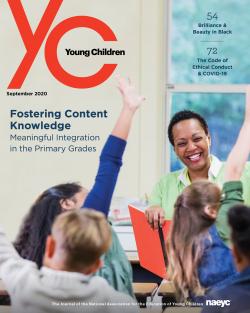
Fostering Content Knowledge: Meaningful Integration in the Primary Grades
The September 2020 issue of Young Children includes a cluster of articles that showcase the power of integrating science, math, technology, literacy, and social studies to make learning meaningful and content-rich across the primary grades.
Through inquiry, teachers and young children can create authentic, organic learning that informs their understanding of themselves, of others, and of the world they live in.
The following article shares three principles for teachers of grades 1–3 who wish to attempt or refine an interdisciplinary approach uniting informational text instruction with social studies content.
Our findings suggest that using screencasting apps can provide more equitable learning opportunities as teachers require all students to justify their mathematical ideas.
Encouraging science through research-based teaching practices may be one way to increase teacher facilitation of early science education and promote language and literacy learning.
Authored by
Authored by:
Jill M. Pentimonti, Hope K. Gerde, Arianna E. Pikus
Teachers can be the conduit to connect families with children who are experiencing some similar losses and routine challenges, and group support is valuable.
Teachers using an emergent inquiry curriculum are responsive to children, planning provocations around questions they have developed that challenge the children toward the edges of their own understandings.
NAEYC appreciates the work of the Developmentally Appropriate Practice/Diversity and Equity Workgroup and the Early Learning Systems Committee, who participated in the development of this statement. See a full list here.