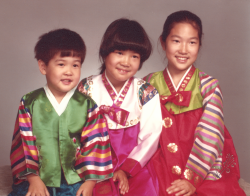
As Asian American Pacific Islander Month comes to a close, I’ve been reflecting on my own experience as the daughter of Korean immigrants. Asian American Pacific Islander is a broad term encompassing many cultures and stories.
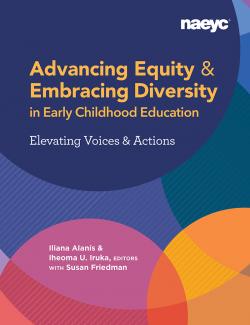
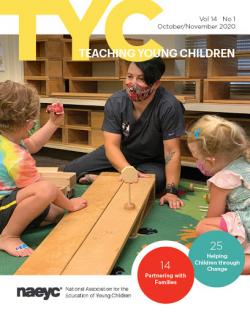
In our first digital-only issue, we have included chapters from the Advancing Equity book to showcase critical concepts, historical and current trends and obstacles, and recommendations for equitable practices.
En una época de rendiciones de cuentas, presiones y evaluaciones de alto nivel (¡incluso en algunas aulas de kindergarten!), muchos educadores de educación inicial se sienten presionados a enfocarse en el rigor académico.
Make your teaching more intentional and engaging with this collection of higher-order thinking modules that brings together three of NAEYC’s popular modules into one convenient package.
We stand with the Asian American Pacific Islander (AAPI) community and wrap our arms and our actions around our staff, members, families, children, and allies who see themselves and their families in these women.
Knowing that we all have implicit biases and, simultaneously, have the capacity to change our thinking and improve our practices, we’ve outlined four steps that early childhood educators can take to understand our own biases and to advance equity.
During the early childhood years, children start to develop their self-identity, a sense of who they are based on their roles and relationships in their family, early care settings or school and their community.
Durante los años de la primera infancia, los niños empiezan a desarrollar su identidad, una percepción de quiénes son según sus roles y relaciones dentro de la familia, el programa de cuidado infantil o la escuela y su comunidad.
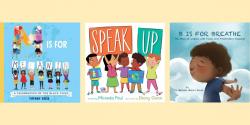
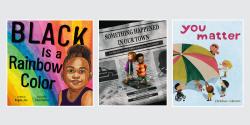
This is the first article in a two-part series that explores promoting children’s identity, agency, and voice regarding race through picture books. Included in this article are three exemplary books that early childhood educators can use to foster critica
Children need help making sense of what they are seeing and hearing. These conversations also offer us important teachable moments to engage young children in discussion about their identities, human diversity, fairness and unfairness, and the right of pe